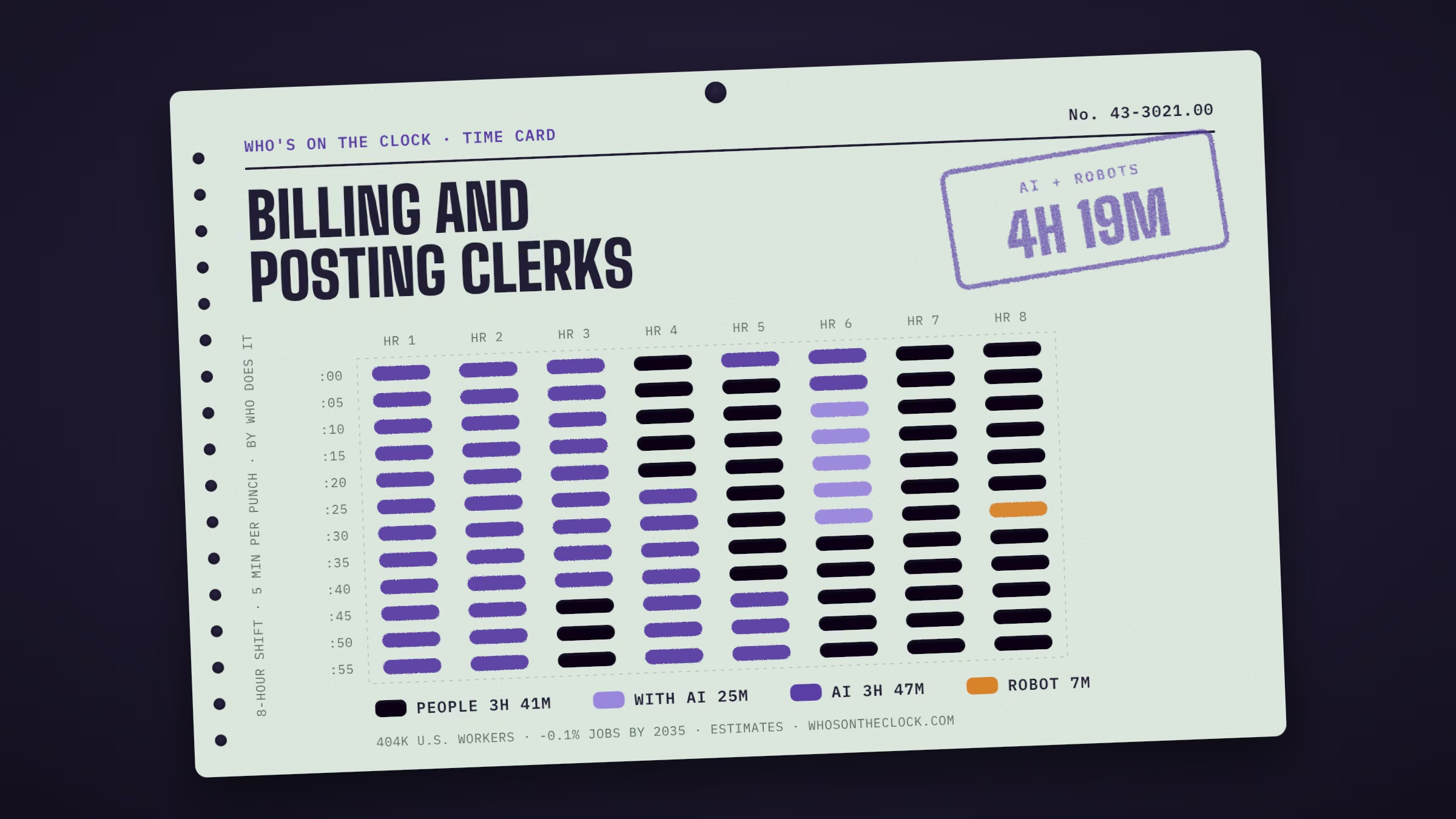
Compile, compute, and record billing, accounting, statistical, and other numerical data for billing purposes. Prepare billing invoices for services rendered or for delivery or shipment of goods.
Time card
Untick tasks you don't do, or set your own times.
| Mine | Task, by time spent | Human | With AI | AI | Robot |
|---|---|---|---|---|---|
Prepare itemized statements, bills, or invoices and record amounts due for items purchased or services rendered.1h 9m a shift · Observed in AI useTypical AI request: about 4h 19m alone, 27m with AIWhy this label?Marked AI because this task shows up regularly in real AI conversations (Anthropic Economic Index, 2025 usage), and in most of them AI does the task on its own rather than helping a person. Many workplaces may not use AI for it at all. How labels work | |||||
Verify accuracy of billing data and revise any errors.57m a shift · Observed in AI useTypical AI request: about 3h 50m alone, 27m with AIWhy this label?Marked AI because this task shows up regularly in real AI conversations (Anthropic Economic Index, 2025 usage), and in most of them AI does the task on its own rather than helping a person. Many workplaces may not use AI for it at all. How labels work | |||||
Resolve discrepancies in accounting records.38m a shift · Observed in AI useWhy this label?Marked AI because this task shows up regularly in real AI conversations (Anthropic Economic Index, 2025 usage), and in most of them AI does the task on its own rather than helping a person. Many workplaces may not use AI for it at all. How labels work | |||||
Perform bookkeeping work, including posting data or keeping other records concerning costs of goods or services or the shipment of goods.38m a shift · No AI or robot evidence foundWhy this label?No AI use or robot deployment showed up for this task in our data. That isn't proof it's safe; it may just be rare in the data. How labels work | |||||
Contact customers to obtain or relay account information.38m a shift · Observed in AI useWhy this label?Marked AI because this task shows up regularly in real AI conversations (Anthropic Economic Index, 2025 usage), and in most of them AI does the task on its own rather than helping a person. Many workplaces may not use AI for it at all. How labels work | |||||
Review documents, such as purchase orders, sales tickets, charge slips, or hospital records, to compute fees or charges due.38m a shift · No AI or robot evidence foundWhy this label?No AI use or robot deployment showed up for this task in our data. That isn't proof it's safe; it may just be rare in the data. How labels work | |||||
Keep records of invoices and support documents.25m a shift · Observed in AI useTypical AI request: about 3h 55m alone, 22m with AIWhy this label?Marked AI because this task shows up regularly in real AI conversations (Anthropic Economic Index, 2025 usage), and in most of them AI does the task on its own rather than helping a person. Many workplaces may not use AI for it at all. How labels work | |||||
Perform general administrative tasks, such as answering telephones, scheduling appointments, and ordering supplies or equipment.25m a shift · Observed in AI useWhy this label?Marked With AI because people regularly use AI to help with this task in real conversations (Anthropic Economic Index, 2025 usage), but AI doesn't usually finish it alone. How labels work | |||||
Create billing documents, shipping labels, credit memorandums, or credit forms.19m a shift · No AI or robot evidence foundWhy this label?No AI use or robot deployment showed up for this task in our data. That isn't proof it's safe; it may just be rare in the data. How labels work | |||||
Operate typing, adding, calculating, or billing machines.13m a shift · No AI or robot evidence foundWhy this label?No AI use or robot deployment showed up for this task in our data. That isn't proof it's safe; it may just be rare in the data. How labels work | |||||
Route statements for mailing or over-the-counter delivery to customers.13m a shift · Robots only in factory cellsWhy this label?Robots have done this only in factory setups built around the machine, so it stays Human for billing and posting clerks. How labels work | |||||
Track accumulated hours and dollar amounts charged to each client job to calculate client fees for professional services, such as legal or accounting services.13m a shift · No AI or robot evidence foundWhy this label?No AI use or robot deployment showed up for this task in our data. That isn't proof it's safe; it may just be rare in the data. How labels work | |||||
Load machines with statements, cancelled checks, or envelopes to prepare statements for distribution to customers or stuff envelopes by hand.13m a shift · Robots only in factory cellsWhy this label?Robots have done this only in factory setups built around the machine, so it stays Human for billing and posting clerks. How labels work | |||||
Compute credit terms, discounts, shipment charges, or rates for goods or services to complete billing documents.13m a shift · No AI or robot evidence foundWhy this label?No AI use or robot deployment showed up for this task in our data. That isn't proof it's safe; it may just be rare in the data. How labels work | |||||
Answer inquiries regarding rates, routing, or procedures.13m a shift · No AI or robot evidence foundWhy this label?No AI use or robot deployment showed up for this task in our data. That isn't proof it's safe; it may just be rare in the data. How labels work | |||||
Verify signatures and required information on checks.6m a shift · No AI or robot evidence foundWhy this label?No AI use or robot deployment showed up for this task in our data. That isn't proof it's safe; it may just be rare in the data. How labels work | |||||
Monitor equipment to ensure proper operation.6m a shift · Robots only in factory cellsWhy this label?Robots have done this only in factory setups built around the machine, so it stays Human for billing and posting clerks. How labels work | |||||
Fix minor problems, such as equipment jams, and notify repair personnel of major equipment problems.6m a shift · No AI or robot evidence foundWhy this label?This is physical work, and no robot has been shown doing it yet. How labels work | |||||
Weigh envelopes containing statements to determine correct postage and affix postage, using stamps or metering equipment.6m a shift · Robots deployed · e.g. Pitney Bowes SendPro P / Connect+ series with Weigh-On-The-Way (WOW)Why this label?Marked Robot because Pitney Bowes SendPro P / Connect+ series with Weigh-On-The-Way (WOW) (in real use) has done this task in a real workplace. It shows a robot can do it somewhere, not that most billing and posting clerks work alongside one. How labels work | |||||
Consult sources, such as rate books, manuals, or insurance company representatives, to determine specific charges or information such as rules, regulations, or government tax and tariff information.6m a shift · No AI or robot evidence foundWhy this label?No AI use or robot deployment showed up for this task in our data. That isn't proof it's safe; it may just be rare in the data. How labels work | |||||
Compare previously prepared bank statements with canceled checks and reconcile discrepancies.6m a shift · No AI or robot evidence foundWhy this label?No AI use or robot deployment showed up for this task in our data. That isn't proof it's safe; it may just be rare in the data. How labels work | |||||
Update manuals when rates, rules, or regulations are amended.6m a shift · No AI or robot evidence foundWhy this label?No AI use or robot deployment showed up for this task in our data. That isn't proof it's safe; it may just be rare in the data. How labels work | |||||
Compile reports of cost factors, such as labor, production, storage, and equipment.6m a shift · No AI or robot evidence foundWhy this label?No AI use or robot deployment showed up for this task in our data. That isn't proof it's safe; it may just be rare in the data. How labels work | |||||
Return checks to customers or retrieve checks returned to customers in error, adjusting accounts and answering inquiries about errors as necessary.6m a shift · No AI or robot evidence foundWhy this label?No AI use or robot deployment showed up for this task in our data. That isn't proof it's safe; it may just be rare in the data. How labels work | |||||
Post stop-payment notices to prevent payment of protested checks.time not estimated · No AI or robot evidence foundWhy this label?No AI use or robot deployment showed up for this task in our data. That isn't proof it's safe; it may just be rare in the data. How labels work | |||||
Take orders for imprinted checks.time not estimated · No AI or robot evidence foundWhy this label?No AI use or robot deployment showed up for this task in our data. That isn't proof it's safe; it may just be rare in the data. How labels work | |||||
Encode and cancel checks, using bank machines.time not estimated · Robots deployed · e.g. NCR SelfServ 34 ATM / iTRAN check processorWhy this label?Marked Robot because NCR SelfServ 34 ATM / iTRAN check processor (in real use) has done this task in a real workplace. It shows a robot can do it somewhere, not that most billing and posting clerks work alongside one. How labels work | |||||
Review compiled data on operating costs and revenues to set rates.time not estimated · No AI or robot evidence foundWhy this label?No AI use or robot deployment showed up for this task in our data. That isn't proof it's safe; it may just be rare in the data. How labels work |