Will AI replace clinical data managers?

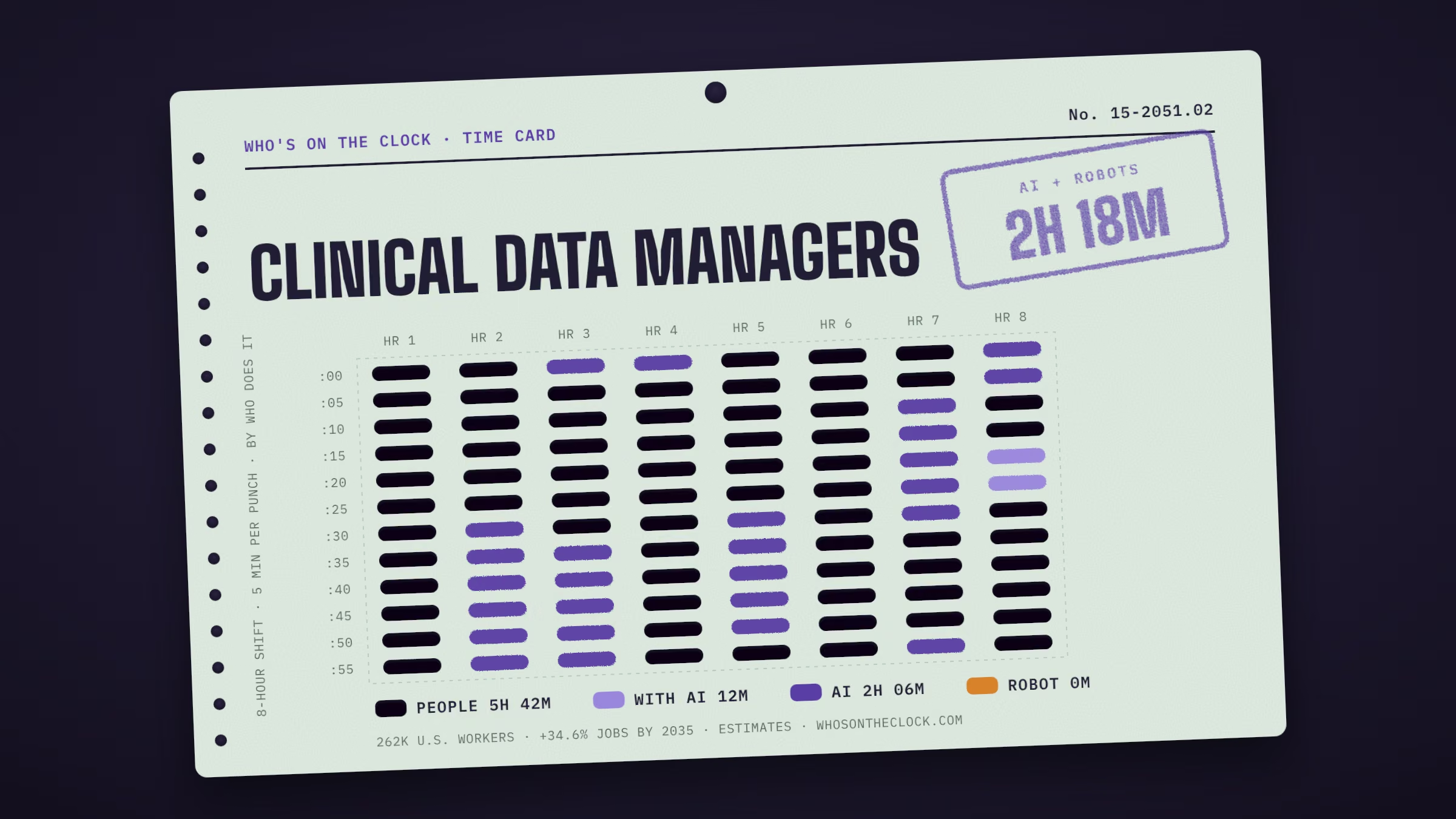
Parts of the job are being automated. About 2h 6m of an 8-hour shift goes to tasks that AI or robots already do largely on their own. The rest still needs a person. The breakdown: 12m done by people with AI help, 2h 6m that AI mostly does alone. The other 5h 42m (71%) stays with people. Separately, BLS expects about 34.6% more of these jobs by 2035 (all jobs: +3.5%).

Home / Computers & math / Clinical Data Managers

Time card for clinical data managers showing a typical 8-hour shift: 5h 42m done by people, 12m done by people with AI, 2h 6m by AI.
Each mark is 5 minutes of a typical shift for clinical data managers, colored by who does that task today. Estimates from O*NET tasks and Anthropic Economic Index data. How it's made

Apply knowledge of health care and database management to analyze clinical data, and to identify and report trends.

Time card

Untick tasks you don't do, or set your own times.
MineTask, by time spentHumanWith AIAIRobot
Design and validate clinical databases, including designing or testing logic checks.48m a shift · No AI or robot evidence found
Generate data queries, based on validation checks or errors and omissions identified during data entry, to resolve identified problems.42m a shift · No AI or robot evidence found
Process clinical data, including receipt, entry, verification, or filing of information.36m a shift · Observed in AI use
Develop project-specific data management plans that address areas such as coding, reporting, or transfer of data, database locks, and work flow processes.30m a shift · No AI or robot evidence found
Design forms for receiving, processing, or tracking data.30m a shift · Observed in AI use
Confer with end users to define or implement clinical system requirements such as data release formats, delivery schedules, and testing protocols.30m a shift · No AI or robot evidence found
Perform quality control audits to ensure accuracy, completeness, or proper usage of clinical systems and data.30m a shift · No AI or robot evidence found
Monitor work productivity or quality to ensure compliance with standard operating procedures.24m a shift · No AI or robot evidence found
Prepare data analysis listings and activity, performance, or progress reports.24m a shift · Observed in AI use
Analyze clinical data using appropriate statistical tools.24m a shift · No AI or robot evidence found
Develop technical specifications for data management programming and communicate needs to information technology staff.24m a shift · No AI or robot evidence found
Supervise the work of data management project staff.24m a shift · No AI or robot evidence found
Contribute to the compilation, organization, and production of protocols, clinical study reports, regulatory submissions, or other controlled documentation.24m a shift · Observed in AI use
Write work instruction manuals, data capture guidelines, or standard operating procedures.18m a shift · No AI or robot evidence found
Prepare appropriate formatting to data sets as requested.12m a shift · Observed in AI use
Evaluate processes and technologies, and suggest revisions to increase productivity and efficiency.12m a shift · No AI or robot evidence found
Read technical literature and participate in continuing education or professional associations to maintain awareness of current database technology and best practices.12m a shift · Observed in AI use
Train staff on technical procedures or software program usage.12m a shift · No AI or robot evidence found
Provide support and information to functional areas such as marketing, clinical monitoring, and medical affairs.12m a shift · No AI or robot evidence found
Track the flow of work forms, including in-house data flow or electronic forms transfer.6m a shift · No AI or robot evidence found
Develop or select specific software programs for various research scenarios.6m a shift · No AI or robot evidence found

On the floor

No company news tracked for this job yet. New stories are added as they happen.

Straight answers

Will AI replace clinical data managers?

Parts of the job are being automated. About 2h 6m of an 8-hour shift goes to tasks that AI or robots already do largely on their own. The rest still needs a person. The breakdown: 12m done by people with AI help, 2h 6m that AI mostly does alone. The other 5h 42m (71%) stays with people. Separately, BLS expects about 34.6% more of these jobs by 2035 (all jobs: +3.5%).

What parts of the job can AI already do?

AI shows up regularly in 6 of 21 tasks, about 2h 18m of a typical shift. The biggest ones:

  • Process clinical data, including receipt, entry, verification, or filing of information. (36m a shift, AI mostly does it alone)
  • Design forms for receiving, processing, or tracking data. (30m a shift, AI mostly does it alone)
  • Prepare data analysis listings and activity, performance, or progress reports. (24m a shift, AI mostly does it alone)
  • Contribute to the compilation, organization, and production of protocols, clinical study reports, regulatory submissions, or other controlled documentation. (24m a shift, AI mostly does it alone)
  • Prepare appropriate formatting to data sets as requested. (12m a shift, AI mostly does it alone)
What parts of the job are still done by people?

5h 42m of a typical shift, or 71%, goes to tasks with no AI or robot evidence yet. The biggest:

  • Design and validate clinical databases, including designing or testing logic checks. (48m a shift)
  • Generate data queries, based on validation checks or errors and omissions identified during data entry, to resolve identified problems. (42m a shift)
  • Develop project-specific data management plans that address areas such as coding, reporting, or transfer of data, database locks, and work flow processes. (30m a shift)
  • Confer with end users to define or implement clinical system requirements such as data release formats, delivery schedules, and testing protocols. (30m a shift)
  • Perform quality control audits to ensure accuracy, completeness, or proper usage of clinical systems and data. (30m a shift)
How much do clinical data managers make?

The median pay is about $120,230 a year ($57.80 an hour), 136% above the median for all U.S. jobs ($50,980). Source: BLS, May 2025.

Is this job growing or shrinking?

BLS projects growth of 34.6% from 2025 to 2035, compared with 3.5% growth for all jobs. That's about 371,000 jobs in 2035. It expects about 25,000 openings a year, mostly from people retiring or changing careers. These projections don't single out AI as a cause.

How many people do this job?

About 262,000 people in the U.S., roughly 0.17% of all workers (BLS, May 2025).

What do you need to become one?

Bachelor's degree. O*NET rates this job at level 4 of 5 for preparation.

What should I learn to stay ahead?

Based on official skill ratings and the tasks that stay with people:

  • Skills that matter more here than in most jobs: Programming, Mathematics, Critical Thinking, Systems Analysis
  • Get strong at the parts of the job that stay with people (listed above), which take 5h 42m of a typical shift
  • Tools employers list: Structured query language SQL, SAS, Microsoft Visio, Microsoft PowerPoint, Microsoft Office software
  • Learn to use AI well on the tasks where it already shows up in this job (listed above)
What similar jobs could I move into?

These use similar skills:

  • Statisticians (2h 34m touched, $106k median pay)
  • Software Quality Assurance Analysts and Testers (3h 26m touched, $104k median pay)
  • Health Informatics Specialists (1h 37m touched, $106k median pay)
  • Social Science Research Assistants (3h 57m touched, $62k median pay)
  • Bioinformatics Technicians (3h 38m touched, $81k median pay)
How solid are these numbers?

Each task carries its own evidence label. For this job: 6 observed in real AI use, 15 with no AI or robot evidence found. The minutes per task are estimates, not measured hours, and "no evidence" doesn't prove a task is safe.

Tools in demand

  • Structured query language SQL
  • SAS
  • Microsoft Visio
  • Microsoft PowerPoint
  • Microsoft Office software
  • Microsoft Excel
  • Epic Systems
  • C#

Also called

Application Coordinator, Clinical Applications Director, Clinical Biostatistics Director, Clinical Data Abstractor, Clinical Data Analyst, Clinical Data Coordinator, Clinical Data Management Director (CDM Director), Clinical Data Management Manager (CDM Manager), Clinical Data Manager, Clinical Informatics Manager, Clinical Statistics Manager, Clinical Trials Data Coordinator, Data Coordinator, Data Deliverables Manager