Will AI replace respiratory therapists?

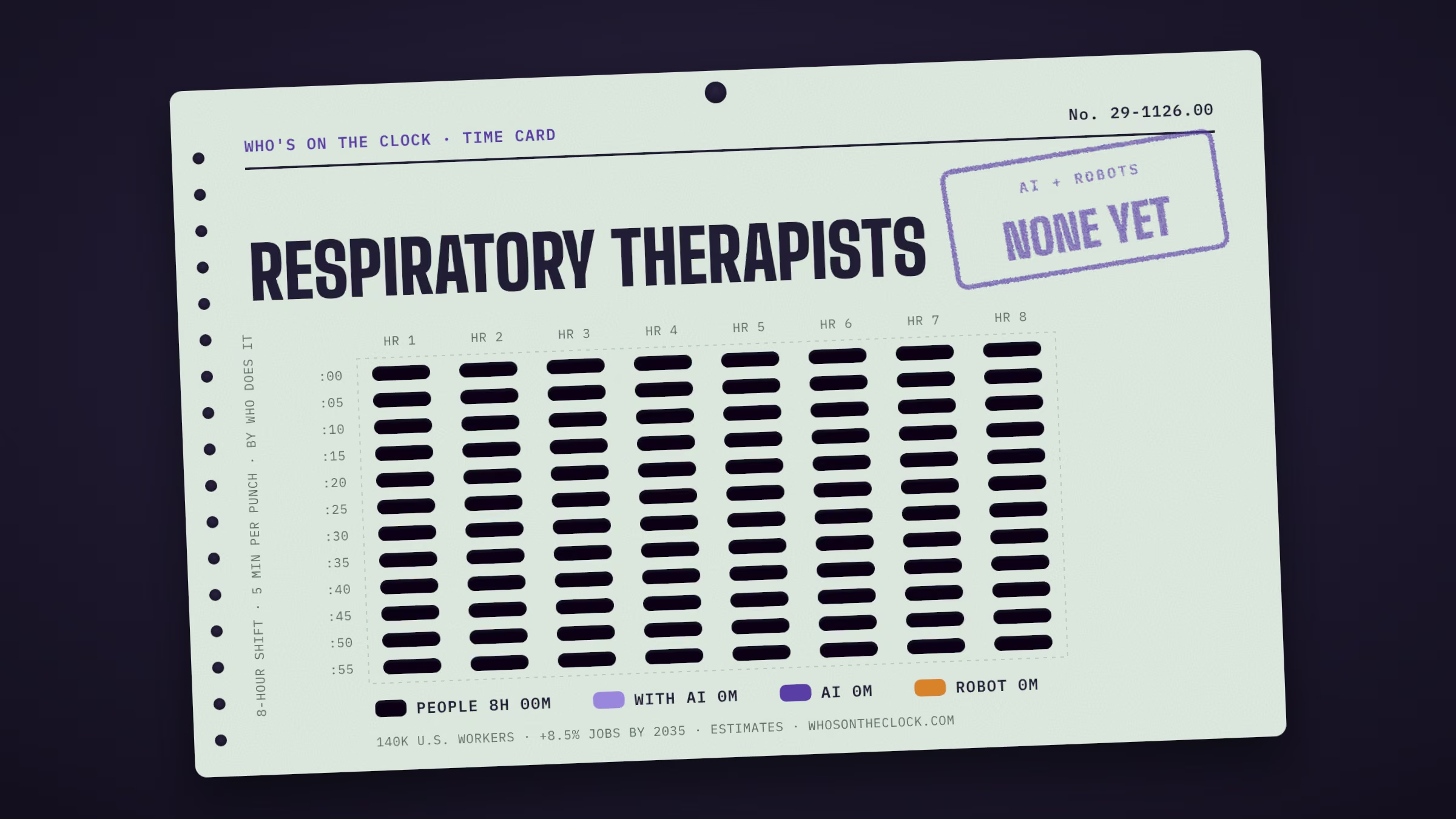
Not on current evidence. Less than 30 minutes of a typical shift goes to tasks that AI or robots are doing today. The other 8h (100%) stays with people. Separately, BLS expects about 8.5% more of these jobs by 2035 (all jobs: +3.5%).

Time card for respiratory therapists showing a typical 8-hour shift: 8h done by people.
Each mark is 5 minutes of a typical shift for respiratory therapists, colored by who does that task today. Estimates from O*NET tasks and Anthropic Economic Index data. How it's made

Home / Healthcare practitioners / Respiratory Therapists

Assess, treat, and care for patients with breathing disorders. Assume primary responsibility for all respiratory care modalities, including the supervision of respiratory therapy technicians. Initiate and conduct therapeutic procedures; maintain patient records; and select, assemble, check, and operate equipment.

Time card

Untick tasks you don't do, or set your own times.
MineTask, by time spentHumanWith AIAIRobot
Set up and operate devices, such as mechanical ventilators, therapeutic gas administration apparatus, environmental control systems, or aerosol generators, following specified parameters of treatment.1h 24m a shift · No AI or robot evidence found
Monitor patient's physiological responses to therapy, such as vital signs, arterial blood gases, or blood chemistry changes, and consult with physician if adverse reactions occur.58m a shift · No AI or robot evidence found
Maintain charts that contain patients' pertinent identification and therapy information.52m a shift · No AI or robot evidence found
Read prescription, measure arterial blood gases, and review patient information to assess patient condition.39m a shift · No AI or robot evidence found
Inspect, clean, test, and maintain respiratory therapy equipment to ensure equipment is functioning safely and efficiently, ordering repairs when necessary.32m a shift · Robots only in factory cells
Work as part of a team of physicians, nurses, or other healthcare professionals to manage patient care by assisting with medical procedures or related duties.26m a shift · No AI or robot evidence found
Provide emergency care, such as artificial respiration, external cardiac massage, or assistance with cardiopulmonary resuscitation.19m a shift · No AI or robot evidence found
Explain treatment procedures to patients to gain cooperation and allay fears.19m a shift · No AI or robot evidence found
Determine requirements for treatment, such as type, method and duration of therapy, precautions to be taken, or medication and dosages, compatible with physicians' orders.19m a shift · No AI or robot evidence found
Educate patients and their families about their conditions and teach appropriate disease management techniques, such as breathing exercises or the use of medications or respiratory equipment.19m a shift · No AI or robot evidence found
Perform bronchopulmonary drainage and assist or instruct patients in performance of breathing exercises.19m a shift · Robots only in factory cells
Enforce safety rules and ensure careful adherence to physicians' orders.13m a shift · No AI or robot evidence found
Conduct tests, such as electrocardiograms (EKGs), stress testing, or lung capacity tests, to evaluate patients' cardiopulmonary functions.13m a shift · No AI or robot evidence found
Perform pulmonary function and adjust equipment to obtain optimum results in therapy.13m a shift · No AI or robot evidence found
Relay blood analysis results to a physician.6m a shift · No AI or robot evidence found
Make emergency visits to resolve equipment problems.6m a shift · No AI or robot evidence found
Demonstrate respiratory care procedures to trainees or other healthcare personnel.6m a shift · No AI or robot evidence found
Use a variety of testing techniques to assist doctors in cardiac or pulmonary research or to diagnose disorders.6m a shift · No AI or robot evidence found
Transport patients to the hospital or within the hospital.6m a shift · No AI or robot evidence found
Teach, train, supervise, or use the assistance of students, respiratory therapy technicians, or assistants.6m a shift · No AI or robot evidence found
Perform endotracheal intubation to maintain open airways for patients who are unable to breathe on their own.6m a shift · No AI or robot evidence found
Monitor cardiac patients, using electrocardiography devices, such as a holter monitor.6m a shift · No AI or robot evidence found

On the floor

No company news tracked for this job yet. New stories are added as they happen.

Ask the clock

Will AI replace respiratory therapists?

Not on current evidence. Less than 30 minutes of a typical shift goes to tasks that AI or robots are doing today. The other 8h (100%) stays with people. Separately, BLS expects about 8.5% more of these jobs by 2035 (all jobs: +3.5%).

What can AI already do for respiratory therapists?

None of this job's tasks show regular AI use yet. That can mean the work is hands-on or in person, or simply that it rarely comes up in AI usage data.

Where do robots fit in?

Not in workplaces like this one, based on a 2026 review of robot deployments. 2 more tasks have only been done in factory setups built around the machine, so they stay with people here. For 13 physical tasks, no robot has shown it can do the work yet.

What still needs a person?

8h of a typical shift, or 100%, goes to tasks with no AI or robot evidence yet. No AI usage or robot deployment has shown up for these so far. The biggest:

  • Set up and operate devices, such as mechanical ventilators, therapeutic gas administration apparatus, environmental control systems, or aerosol generators, following specified parameters of treatment. (1h 24m a shift)
  • Monitor patient's physiological responses to therapy, such as vital signs, arterial blood gases, or blood chemistry changes, and consult with physician if adverse reactions occur. (58m a shift)
  • Maintain charts that contain patients' pertinent identification and therapy information. (52m a shift)
  • Read prescription, measure arterial blood gases, and review patient information to assess patient condition. (39m a shift)
  • Inspect, clean, test, and maintain respiratory therapy equipment to ensure equipment is functioning safely and efficiently, ordering repairs when necessary. (32m a shift)
Why is that work hard to automate?

Much of it comes down to where and how the work happens. In-person, hands-on and high-stakes work is where AI and robots have made the least headway so far. In the official O*NET survey of people in this job:

  • 98% work at arm's length or closer to other people
  • 92% are exposed to disease or infection every day
  • 86% say a mistake would be very or extremely serious
Are employers still hiring respiratory therapists?

On Indeed, job postings in the Therapy sector are at 188% of their February 2020 level (all U.S. postings: 104%), up 3.2% from a year earlier, as of Oct 9, 2026. BLS separately expects about 8,600 openings a year in this job through 2035. Across all U.S. postings, 7.3% now mention AI skills. Sector postings cover more than this one job and move for many reasons besides AI.

How much do respiratory therapists make?

The median pay is about $82,280 a year ($39.56 an hour), 61% above the median for all U.S. jobs ($50,980). Most people in this job earn between $63,660 and $118,050 a year; that range covers the middle 80%. Pay figures are from BLS, May 2025, and vary a lot by state and employer. Pick a state to compare:

Is this job growing or shrinking?

BLS projects growth of 8.5% from 2025 to 2035, compared with 3.5% growth for all jobs. That's about 154,000 jobs in 2035. It expects about 8,600 openings a year, mostly from people retiring or changing careers. These projections don't single out AI as a cause.

How many respiratory therapists are there in the U.S.?

About 140,000 people in the U.S., roughly 0.09% of all workers (BLS, May 2025). That makes it the 227th largest of the 796 jobs on this site. BLS expects about 154,000 in 2035.

What training do respiratory therapists need?

The most common requirement is an associate's degree: about 83% of people in the job said so in the official O*NET survey. O*NET rates the job at level 3 of 5 for preparation, which usually means: vocational school or associate's degree. Requirements vary by state and employer, especially for licensed work.

What should I learn to stay ahead of AI?

These come from the job's official skill ratings and from the tasks that AI and robots touch least today. Building them keeps you strong in the parts of the work that still need a person:

  • Skills that matter more here than in most jobs: Monitoring, Service Orientation, Science, Social Perceptiveness
  • Get strong at the parts of the job that stay with people (listed above), which take 8h of a typical shift
  • Tools employers list: eClinicalWorks EHR software, MEDITECH software, Microsoft Excel, Microsoft Office software, Microsoft Outlook
What new tasks are respiratory therapists taking on?

Yes. Occupational experts recently added these to the official task list, a sign of how the work itself is shifting. New tasks aren't rated for AI or robots yet:

  • Attend high-risk and caesarian section infant deliveries to provide neonatal respiratory care as needed.
What other jobs could respiratory therapists move into?

These use similar skills. Matches come from 109 official ratings of skills, knowledge and work activities, and each needs the same or less preparation unless the official list relates the jobs directly:

  • Critical Care Nurses (46m touched, $98k median pay)
  • Radiation Therapists (1h 31m touched, $105k median pay)
  • Diagnostic Medical Sonographers (0m touched, $97k median pay)
  • Cardiovascular Technologists and Technicians (57m touched, $74k median pay)
  • Acute Care Nurses (12m touched, $98k median pay)
How solid are these numbers?

Each task carries its own evidence label. For this job: 22 with no AI or robot evidence found. The minutes per task are estimates, not measured hours, and "no evidence" doesn't prove a task is safe.

Tools in demand

  • eClinicalWorks EHR software
  • MEDITECH software
  • Microsoft Excel
  • Microsoft Office software
  • Microsoft Outlook
  • Microsoft PowerPoint
  • Microsoft Word

Also called

Cardiopulmonary Rehabilitation Respiratory Therapist, Certified Respiratory Therapist (CRT), Hospital Respiratory Therapist, Inhalation Therapist, NICU Respiratory Therapist (Neonatal Intensive Care Unit Respiratory Therapist), Oxygen Therapist, Registered Respiratory Therapist (RRT), Respiratory Care Practitioner (RCP), Respiratory Therapist (RT), Staff Respiratory Therapist, Staff Therapist, Travel Registered Respiratory Therapist (Travel RRT), Travel Respiratory Therapist