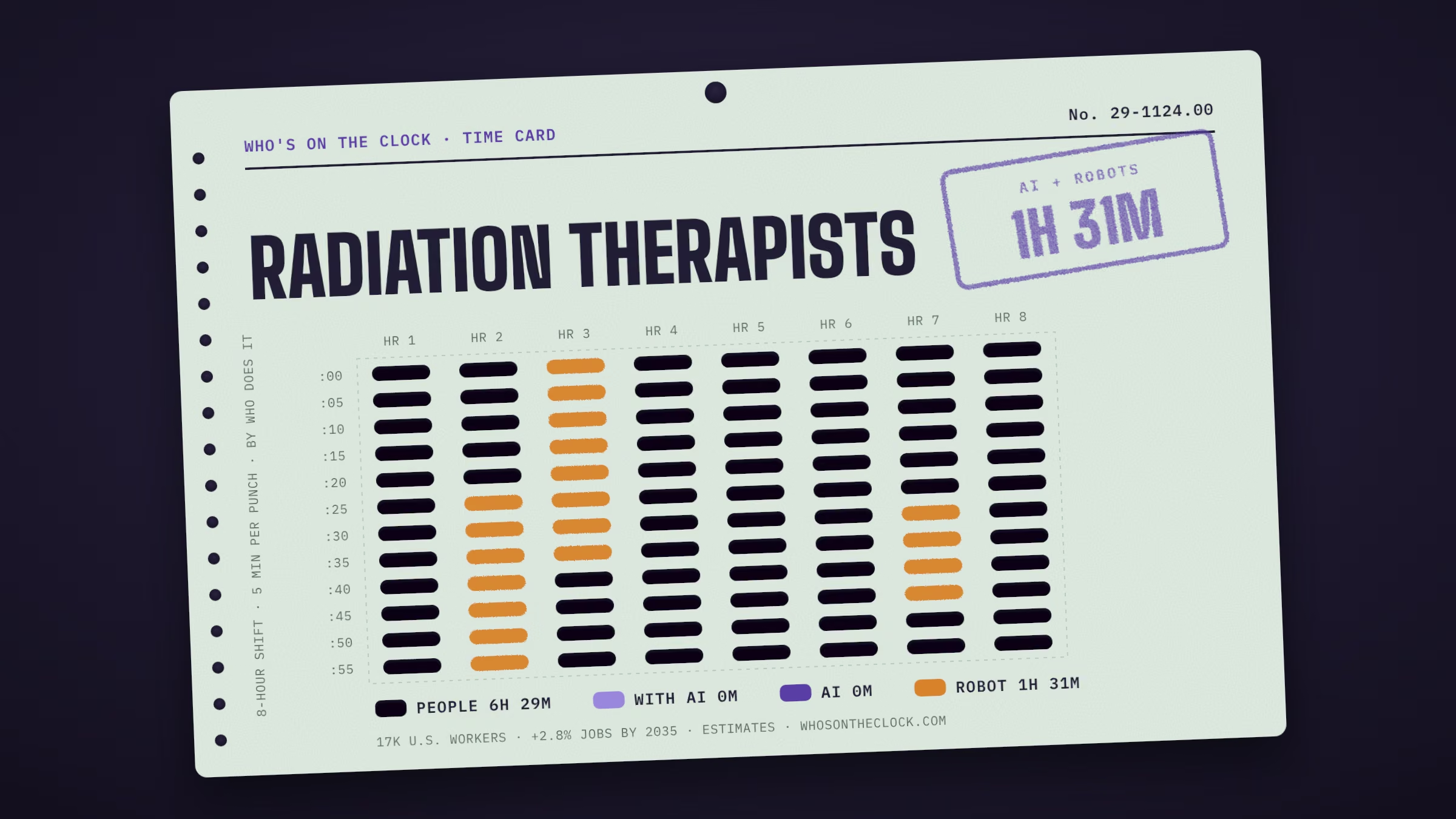
Provide radiation therapy to patients as prescribed by a radiation oncologist according to established practices and standards. Duties may include reviewing prescription and diagnosis; acting as liaison with physician and supportive care personnel; preparing equipment, such as immobilization, treatment, and protection devices; and maintaining records, reports, and files. May assist in dosimetry procedures and tumor localization.
Time card
Untick tasks you don't do, or set your own times.
| Mine | Task, by time spent | Human | With AI | AI | Robot |
|---|---|---|---|---|---|
Position patients for treatment with accuracy, according to prescription.1h 25m a shift · Robots only in factory cellsWhy this label?Robots have done this only in factory setups built around the machine, so it stays Human for radiation therapists. How labels work | |||||
Administer prescribed doses of radiation to specific body parts, using radiation therapy equipment according to established practices and standards.1h 13m a shift · Robots deployed · e.g. CyberKnife image-guided robotic radiosurgeryWhy this label?Marked Robot because CyberKnife image-guided robotic radiosurgery (in real use) has done this task in a real workplace. It shows a robot can do it somewhere, not that most radiation therapists work alongside one. How labels work | |||||
Enter data into computer and set controls to operate or adjust equipment or regulate dosage.36m a shift · No AI or robot evidence foundWhy this label?No AI use or robot deployment showed up for this task in our data. That isn't proof it's safe; it may just be rare in the data. How labels work | |||||
Review prescription, diagnosis, patient chart, and identification.30m a shift · No AI or robot evidence foundWhy this label?No AI use or robot deployment showed up for this task in our data. That isn't proof it's safe; it may just be rare in the data. How labels work | |||||
Maintain records, reports, or files as required, including such information as radiation dosages, equipment settings, or patients' reactions.30m a shift · No AI or robot evidence foundWhy this label?No AI use or robot deployment showed up for this task in our data. That isn't proof it's safe; it may just be rare in the data. How labels work | |||||
Check radiation therapy equipment to ensure proper operation.24m a shift · Robots only in factory cellsWhy this label?Robots have done this only in factory setups built around the machine, so it stays Human for radiation therapists. How labels work | |||||
Observe and reassure patients during treatment and report unusual reactions to physician or turn equipment off if unexpected adverse reactions occur.24m a shift · No AI or robot evidence foundWhy this label?No AI use or robot deployment showed up for this task in our data. That isn't proof it's safe; it may just be rare in the data. How labels work | |||||
Educate, prepare, and reassure patients and their families by answering questions, providing physical assistance, and reinforcing physicians' advice regarding treatment reactions or post-treatment care.24m a shift · No AI or robot evidence foundWhy this label?This is physical work, and no robot has been shown doing it yet. How labels work | |||||
Conduct most treatment sessions independently, in accordance with the long-term treatment plan and under the general direction of the patient's physician.18m a shift · Robots only in factory cellsWhy this label?Robots have done this only in factory setups built around the machine, so it stays Human for radiation therapists. How labels work | |||||
Check for side effects, such as skin irritation, nausea, or hair loss to assess patients' reaction to treatment.18m a shift · No AI or robot evidence foundWhy this label?No AI use or robot deployment showed up for this task in our data. That isn't proof it's safe; it may just be rare in the data. How labels work | |||||
Prepare or construct equipment, such as immobilization, treatment, or protection devices.18m a shift · No AI or robot evidence foundWhy this label?This is physical work, and no robot has been shown doing it yet. How labels work | |||||
Photograph treated area of patient and process film.18m a shift · Robots deployed · e.g. CyberKnife (Accuray)Why this label?Marked Robot because CyberKnife (Accuray) (in real use) has done this task in a real workplace. It shows a robot can do it somewhere, not that most radiation therapists work alongside one. How labels work | |||||
Follow principles of radiation protection for patient, self, and others.12m a shift · No AI or robot evidence foundWhy this label?This is physical work, and no robot has been shown doing it yet. How labels work | |||||
Help physicians, radiation oncologists, or clinical physicists to prepare physical or technical aspects of radiation treatment plans, using information about patient condition and anatomy.12m a shift · No AI or robot evidence foundWhy this label?This is physical work, and no robot has been shown doing it yet. How labels work | |||||
Act as liaison with physicist and supportive care personnel.12m a shift · No AI or robot evidence foundWhy this label?No AI use or robot deployment showed up for this task in our data. That isn't proof it's safe; it may just be rare in the data. How labels work | |||||
Schedule patients for treatment times.12m a shift · No AI or robot evidence foundWhy this label?No AI use or robot deployment showed up for this task in our data. That isn't proof it's safe; it may just be rare in the data. How labels work | |||||
Provide assistance to other healthcare personnel during dosimetry procedures and tumor localization.12m a shift · No AI or robot evidence foundWhy this label?This is physical work, and no robot has been shown doing it yet. How labels work | |||||
Calculate actual treatment dosages delivered during each session.6m a shift · No AI or robot evidence foundWhy this label?No AI use or robot deployment showed up for this task in our data. That isn't proof it's safe; it may just be rare in the data. How labels work | |||||
Train or supervise student or subordinate radiotherapy technologists.6m a shift · No AI or robot evidence foundWhy this label?No AI use or robot deployment showed up for this task in our data. That isn't proof it's safe; it may just be rare in the data. How labels work | |||||
Implement appropriate follow-up care plans.6m a shift · No AI or robot evidence foundWhy this label?No AI use or robot deployment showed up for this task in our data. That isn't proof it's safe; it may just be rare in the data. How labels work | |||||
Store, sterilize, or prepare the special applicators containing the radioactive substance implanted by the physician.time not estimated · Robots only in factory cellsWhy this label?Robots have done this only in factory setups built around the machine, so it stays Human for radiation therapists. How labels work | |||||
Assist in the preparation of sealed radioactive materials, such as cobalt, radium, cesium, or isotopes, for use in radiation treatments.time not estimated · Robots only in factory cellsWhy this label?Robots have done this only in factory setups built around the machine, so it stays Human for radiation therapists. How labels work |