Will AI replace disc jockeys?

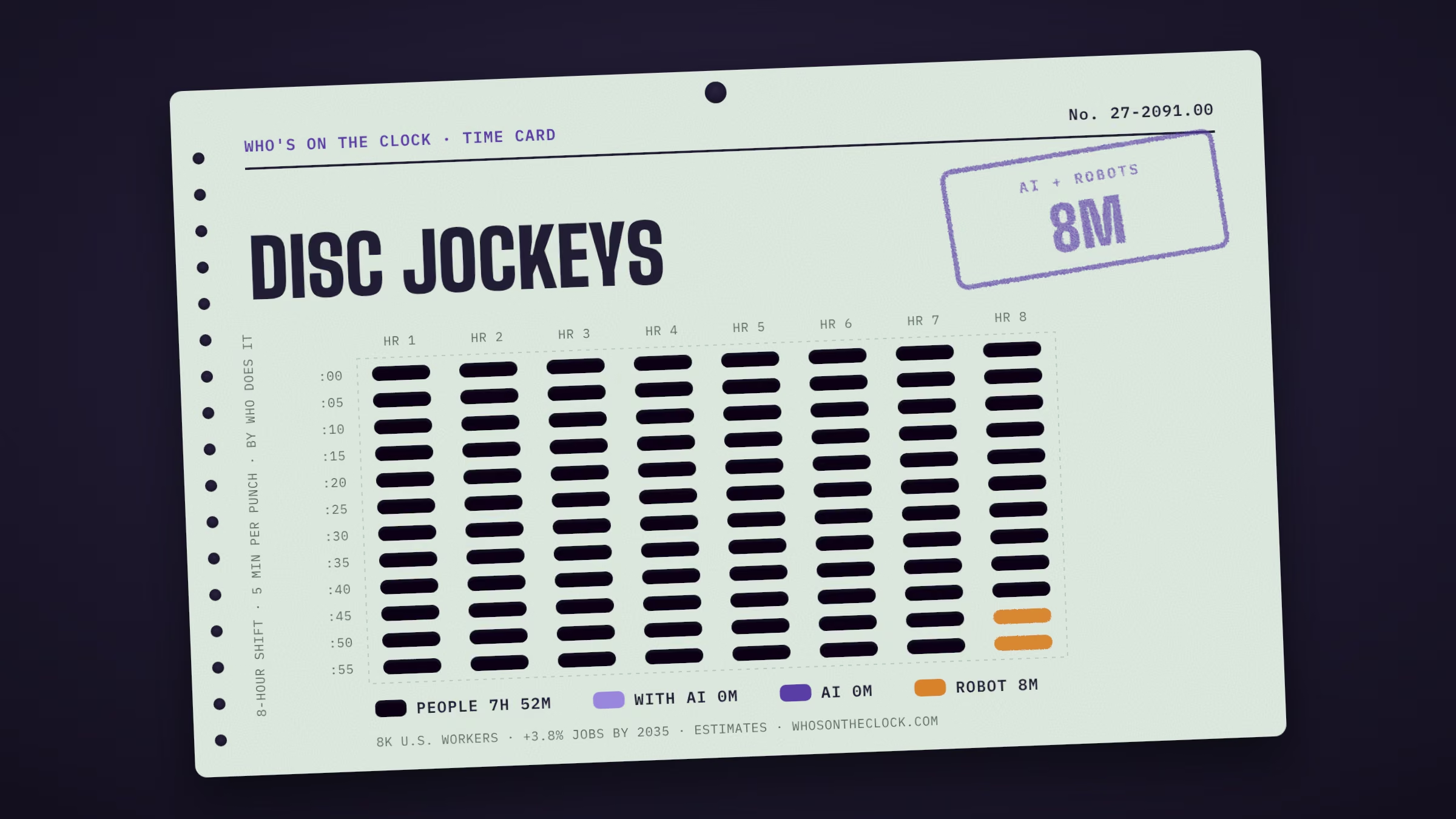
Not on current evidence. Less than 30 minutes of a typical shift goes to tasks that AI or robots are doing today. The other 7h 52m (98%) stays with people. Separately, BLS expects about 3.8% more of these jobs by 2035 (all jobs: +3.5%).

Time card for disc jockeys showing a typical 8-hour shift: 7h 52m done by people, 8m by robots.
Each mark is 5 minutes of a typical shift for disc jockeys, colored by who does that task today. Estimates from O*NET tasks and Anthropic Economic Index data. How it's made

Home / Arts, media & sports / Disc Jockeys

Play prerecorded music for live audiences at venues or events such as clubs, parties, or wedding receptions. May use techniques such as mixing, cutting, or sampling to manipulate recordings. May also perform as emcee (master of ceremonies).

Time card

Untick tasks you don't do, or set your own times.
MineTask, by time spentHumanWith AIAIRobot
Assemble audio and video equipment.56m a shift · Robots only in factory cells
Communicate with clients or venue owners to determine event information, such as music preferences, scheduling, and anticipated attendance.48m a shift · No AI or robot evidence found
Select and play music incorporating crowd preferences and mood.48m a shift · No AI or robot evidence found
Create tailored playlists by aligning music with event functions.40m a shift · No AI or robot evidence found
Mix, cut, or sample recorded music using DJ controllers, CDJs, or DJ mixers.40m a shift · No AI or robot evidence found
Operate disc jockey controller and other equipment, such as microphones.40m a shift · No AI or robot evidence found
Advertise services using media such as internet advertising and brochures.32m a shift · No AI or robot evidence found
Listen to music before playing at events to ensure recordings are appropriate and meet quality standards.24m a shift · No AI or robot evidence found
Maintain up-to-date knowledge of music releases and trends.24m a shift · No AI or robot evidence found
Organize music libraries or playlists.24m a shift · No AI or robot evidence found
Accept music requests from event guests.16m a shift · No AI or robot evidence found
Adhere to schedules to keep events running on time.16m a shift · No AI or robot evidence found
Conduct sound checks to ensure equipment is working and appropriate for the venue.16m a shift · Robots only in factory cells
Encourage guests to dance using group dances, competitions, or other party games.16m a shift · No AI or robot evidence found
Collect payments from customers.8m a shift · No AI or robot evidence found
Create itemized invoices to record amounts due for services rendered.8m a shift · No AI or robot evidence found
Develop written contracts for bookings.8m a shift · No AI or robot evidence found
Lead party games, such as dance-offs or prize giveaways.8m a shift · No AI or robot evidence found
Operate visual effects equipment, such as lights, fog machines, or lasers.8m a shift · Robots deployed · e.g. Denon DJ PRIME 4 with SoundSwitch (StagelinQ)

On the floor

No company news tracked for this job yet. New stories are added as they happen.

Ask the clock

Will AI replace disc jockeys?

Not on current evidence. Less than 30 minutes of a typical shift goes to tasks that AI or robots are doing today. The other 7h 52m (98%) stays with people. Separately, BLS expects about 3.8% more of these jobs by 2035 (all jobs: +3.5%).

What can AI already do for disc jockeys?

None of this job's tasks show regular AI use yet. That can mean the work is hands-on or in person, or simply that it rarely comes up in AI usage data.

Where do robots fit in?

For some tasks, yes. Robots have done 1 of this job's tasks in workplaces like this one, about 8m of a typical shift. 2 more tasks have only been done in factory setups built around the machine, so they stay with people here.

  • Operate visual effects equipment, such as lights, fog machines, or lasers. (8m a shift; e.g. Denon DJ PRIME 4 with SoundSwitch (StagelinQ), in use)
What still needs a person?

7h 52m of a typical shift, or 98%, goes to tasks with no AI or robot evidence yet. No AI usage or robot deployment has shown up for these so far. The biggest:

  • Assemble audio and video equipment. (56m a shift)
  • Communicate with clients or venue owners to determine event information, such as music preferences, scheduling, and anticipated attendance. (48m a shift)
  • Select and play music incorporating crowd preferences and mood. (48m a shift)
  • Create tailored playlists by aligning music with event functions. (40m a shift)
  • Mix, cut, or sample recorded music using DJ controllers, CDJs, or DJ mixers. (40m a shift)
Are employers still hiring disc jockeys?

On Indeed, job postings in the Arts & Entertainment sector are at 87% of their February 2020 level (all U.S. postings: 104%), up 12.4% from a year earlier, as of Oct 9, 2026. BLS separately expects about 1,700 openings a year in this job through 2035. Across all U.S. postings, 7.3% now mention AI skills. Sector postings cover more than this one job and move for many reasons besides AI.

How much do disc jockeys make?

The median pay is about $44,949 a year ($21.61 an hour), 12% below the median for all U.S. jobs ($50,980). Pay figures are from BLS, May 2025, and vary a lot by state and employer.

Is this job growing or shrinking?

BLS projects growth of 3.8% from 2025 to 2035, compared with 3.5% growth for all jobs. That's about 18,000 jobs in 2035. It expects about 1,700 openings a year, mostly from people retiring or changing careers. These projections don't single out AI as a cause.

How many disc jockeys are there in the U.S.?

About 7,920 people in the U.S., roughly 0.01% of all workers (BLS, May 2025). That makes it the 695th largest of the 796 jobs on this site. BLS expects about 18,000 in 2035.

What training do disc jockeys need?

O*NET rates the job at level 2 of 5 for preparation, which usually means: high school diploma, some training. Requirements vary by state and employer, especially for licensed work.

What should I learn to stay ahead of AI?

These come from the job's official skill ratings and from the tasks that AI and robots touch least today. Building them keeps you strong in the parts of the work that still need a person:

  • Get strong at the parts of the job that stay with people (listed above), which take 7h 52m of a typical shift
  • Tools employers list: Microsoft Office software, Microsoft Excel, Microsoft Word
What other jobs could disc jockeys move into?

These use similar skills. Matches come from 109 official ratings of skills, knowledge and work activities, and each needs the same or less preparation unless the official list relates the jobs directly:

  • Broadcast Announcers and Radio Disc Jockeys (26m touched, $47k median pay)
  • Sound Engineering Technicians (0m touched, $73k median pay)
  • Music Directors and Composers (26m touched, $74k median pay)
  • Agents and Business Managers of Artists, Performers, and Athletes (1h 53m touched, $83k median pay)
  • Audio and Video Technicians (6m touched, $58k median pay)
How solid are these numbers?

Each task carries its own evidence label. For this job: 1 with robots in real deployments, 18 with no AI or robot evidence found. The minutes per task are estimates, not measured hours, and "no evidence" doesn't prove a task is safe.

Tools in demand

  • Microsoft Office software
  • Microsoft Excel
  • Microsoft Word

Also called

Announcer, Club Disc Jockey (Club DJ), DJ (Disk Jockey), DJ Assistant (Disc Jockey Assistant), Deejay (DJ), Disc Jockey (DJ), Emcee, Entertainer, Event Disc Jockey (Event DJ), Event Entertainer, Event Host, Event Master of Ceremonies (Event MC), Host DJ (Host Disc Jockey), Karaoke Host