Will AI replace dispatchers?

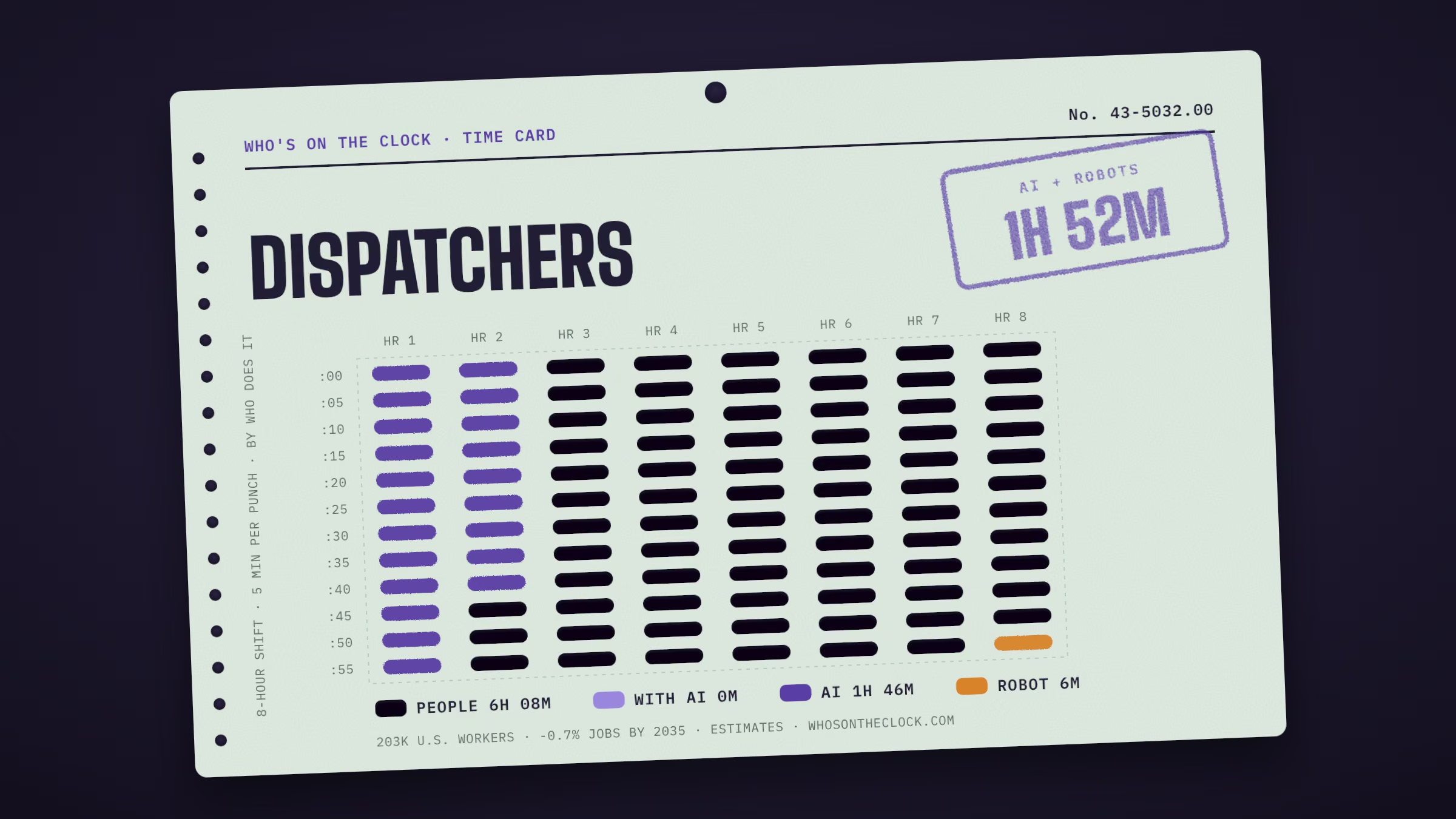
AI already handles some of this work on its own in real use, for tasks like “Schedule or dispatch workers, work crews, equipment”. That's 1h 46m of a typical shift; 6h 8m still has no AI or robot evidence. BLS expects about 0.7% fewer of these jobs by 2035.

Time card for dispatchers showing a typical 8-hour shift: 6h 8m done by people, 1h 46m by AI, 6m by robots.
Each mark is 5 minutes of a typical shift for dispatchers, colored by who does that task today. Estimates from O*NET tasks and Anthropic Economic Index data. How it's made

Home / Office & admin / Dispatchers

Schedule and dispatch workers, work crews, equipment, or service vehicles for conveyance of materials, freight, or passengers, or for normal installation, service, or emergency repairs rendered outside the place of business. Duties may include using radio, telephone, or computer to transmit assignments and compiling statistics and reports on work progress.

Time card

Untick tasks you don't do, or set your own times.
MineTask, by time spentHumanWith AIAIRobot
Schedule or dispatch workers, work crews, equipment, or service vehicles to appropriate locations, according to customer requests, specifications, or needs, using radios or telephones.1h 46m a shift · Observed in AI use
Why this label?Marked AI because this task shows up regularly in real AI conversations (Anthropic Economic Index, 2025 usage), and in most of them AI does the task on its own rather than helping a person. Many workplaces may not use AI for it at all. How labels work
Relay work orders, messages, or information to or from work crews, supervisors, or field inspectors, using telephones or two-way radios.1h 2m a shift · No AI or robot evidence found
Why this label?No AI use or robot deployment showed up for this task in our data. That isn't proof it's safe; it may just be rare in the data. How labels work
Confer with customers or supervising personnel to address questions, problems, or requests for service or equipment.56m a shift · No AI or robot evidence found
Why this label?No AI use or robot deployment showed up for this task in our data. That isn't proof it's safe; it may just be rare in the data. How labels work
Record and maintain files or records of customer requests, work or services performed, charges, expenses, inventory, or other dispatch information.56m a shift · No AI or robot evidence found
Why this label?No AI use or robot deployment showed up for this task in our data. That isn't proof it's safe; it may just be rare in the data. How labels work
Monitor personnel or equipment locations and utilization to coordinate service and schedules.50m a shift · No AI or robot evidence found
Why this label?No AI use or robot deployment showed up for this task in our data. That isn't proof it's safe; it may just be rare in the data. How labels work
Prepare daily work and run schedules.44m a shift · No AI or robot evidence found
Why this label?No AI use or robot deployment showed up for this task in our data. That isn't proof it's safe; it may just be rare in the data. How labels work
Receive or prepare work orders.44m a shift · No AI or robot evidence found
Why this label?No AI use or robot deployment showed up for this task in our data. That isn't proof it's safe; it may just be rare in the data. How labels work
Arrange for necessary repairs to restore service and schedules.19m a shift · No AI or robot evidence found
Why this label?No AI use or robot deployment showed up for this task in our data. That isn't proof it's safe; it may just be rare in the data. How labels work
Determine types or amounts of equipment, vehicles, materials, or personnel required, according to work orders or specifications.19m a shift · No AI or robot evidence found
Why this label?No AI use or robot deployment showed up for this task in our data. That isn't proof it's safe; it may just be rare in the data. How labels work
Advise personnel about traffic problems, such as construction areas, accidents, congestion, weather conditions, or other hazards.12m a shift · No AI or robot evidence found
Why this label?No AI use or robot deployment showed up for this task in our data. That isn't proof it's safe; it may just be rare in the data. How labels work
Oversee all communications within specifically assigned territories.6m a shift · No AI or robot evidence found
Why this label?No AI use or robot deployment showed up for this task in our data. That isn't proof it's safe; it may just be rare in the data. How labels work
Order supplies or equipment and issue them to personnel.6m a shift · Robots deployed · e.g. AutoCrib industrial vending systems
Why this label?Marked Robot because AutoCrib industrial vending systems (in real use) has done this task in a real workplace. It shows a robot can do it somewhere, not that most dispatchers work alongside one. How labels work

Clock history

  1. 1h 52m touchedFirst published: O*NET 30.1, Anthropic Economic Index (2025 usage and September 2026 robot study), BLS May 2025

When new data changes this clock, the date, the new numbers and the reason are logged here. Company news alone never moves the clock.

On the floor

  1. Rolling outPenske
    Penske Logistics rolls out AI to track 600,000 loads and contact carriers

    After a six-month pilot, Penske Logistics is rolling out an AI system from Augment that checks shipment status and contacts carrier dispatchers by call, email or text, for about 600,000 loads at first. Penske expects 30 to 40 percent productivity gains.

    MyChesCo

  2. Rolling outFleetWorks
    FleetWorks raises $17 million for an always-on AI truck dispatcher

    FleetWorks raised $17 million led by First Round Capital for its AI dispatcher. Less than six months after launch it had onboarded over 10,000 carriers and partnered with more than 15 of the top 100 U.S. freight brokers.

    Pulse 2.0

Ask the clock

Will AI replace dispatchers?

Unlikely, though parts of the work are changing. About 1h 52m of an 8-hour shift goes to tasks touched by AI working on its own. The breakdown: 1h 46m that AI mostly does alone, 6m that robots have done in real workplaces. The other 6h 8m (77%) stays with people. Separately, BLS expects about 0.7% fewer of these jobs by 2035 (all jobs: +3.5%).

What can AI already do for dispatchers?

AI shows up regularly in 1 of 12 tasks, about 1h 46m of a typical shift. The biggest ones:

  • Schedule or dispatch workers, work crews, equipment, or service vehicles to appropriate locations, according to customer requests, specifications, or needs, using radios or telephones. (1h 46m a shift, AI mostly does it alone)
Where do robots fit in?

For some tasks, yes. Robots have done 1 of this job's tasks in workplaces like this one, about 6m of a typical shift.

  • Order supplies or equipment and issue them to personnel. (6m a shift; e.g. AutoCrib industrial vending systems, in use)
What still needs a person?

6h 8m of a typical shift, or 77%, goes to tasks with no AI or robot evidence yet. No AI usage or robot deployment has shown up for these so far. The biggest:

  • Relay work orders, messages, or information to or from work crews, supervisors, or field inspectors, using telephones or two-way radios. (1h 2m a shift)
  • Confer with customers or supervising personnel to address questions, problems, or requests for service or equipment. (56m a shift)
  • Record and maintain files or records of customer requests, work or services performed, charges, expenses, inventory, or other dispatch information. (56m a shift)
  • Monitor personnel or equipment locations and utilization to coordinate service and schedules. (50m a shift)
  • Prepare daily work and run schedules. (44m a shift)
Why is that work hard to automate?

Much of it comes down to where and how the work happens. In-person, hands-on and high-stakes work is where AI and robots have made the least headway so far. In the official O*NET survey of people in this job:

  • 98% talk face to face with others every day
  • 92% are in constant contact with other people
  • 79% carry high or very high responsibility for other workers' safety
What are companies actually doing?

We track 2 sourced company moves that affect this job. Most recent:

  • Jan 25, 2026: Penske Logistics rolls out AI to track 600,000 loads and contact carriers (Rolling out)
  • Oct 18, 2025: FleetWorks raises $17 million for an always-on AI truck dispatcher (Rolling out)
Are employers still hiring dispatchers?

On Indeed, job postings in the Logistic Support sector are at 119% of their February 2020 level (all U.S. postings: 104%), up 5.1% from a year earlier, as of Oct 9, 2026. BLS separately expects about 16,000 openings a year in this job through 2035. Across all U.S. postings, 7.3% now mention AI skills. Sector postings cover more than this one job and move for many reasons besides AI.

How much do dispatchers make?

The median pay is about $50,340 a year ($24.20 an hour), 1% below the median for all U.S. jobs ($50,980). Most people in this job earn between $36,030 and $78,140 a year; that range covers the middle 80%. Pay figures are from BLS, May 2025, and vary a lot by state and employer. Pick a state to compare:

Is this job growing or shrinking?

BLS projects a decline of 0.7% from 2025 to 2035, compared with 3.5% growth for all jobs. That's about 202,000 jobs in 2035. Even so, it expects about 16,000 openings a year, mostly from people retiring or changing careers. These projections don't single out AI as a cause.

How many dispatchers are there in the U.S.?

About 203,000 people in the U.S., roughly 0.13% of all workers (BLS, May 2025). That makes it the 170th largest of the 796 jobs on this site. BLS expects about 202,000 in 2035.

What training do dispatchers need?

The most common requirement is a high school diploma: about 47% of people in the job said so in the official O*NET survey. O*NET rates the job at level 2 of 5 for preparation, which usually means: high school diploma, some training. Requirements vary by state and employer, especially for licensed work.

What should I learn to stay ahead of AI?

These come from the job's official skill ratings and from the tasks that AI and robots touch least today. Building them keeps you strong in the parts of the work that still need a person:

  • Skills that matter more here than in most jobs: Time Management, Coordination, Monitoring, Speaking
  • Get strong at the parts of the job that stay with people (listed above), which take 6h 8m of a typical shift
  • Tools employers list: Microsoft Word, Microsoft Outlook, Microsoft Office software, Microsoft Excel, Kronos Workforce Timekeeper
  • Learn to use AI well on the tasks where it already shows up in this job (listed above)
What other jobs could dispatchers move into?

These use similar skills. Matches come from 109 official ratings of skills, knowledge and work activities, and each needs the same or less preparation unless the official list relates the jobs directly:

  • First-Line Supervisors of Passenger Attendants (29m touched, $63k median pay)
  • First-Line Supervisors of Material-Moving Machine and Vehicle Operators (48m touched, $63k median pay)
  • Public Safety Telecommunicators (22m touched, $53k median pay)
  • Railroad Conductors and Yardmasters (34m touched, $78k median pay)
  • Production, Planning, and Expediting Clerks (44m touched, $60k median pay)
How solid are these numbers?

Each task carries its own evidence label. For this job: 1 observed in real AI use, 1 with robots in real deployments, 10 with no AI or robot evidence found. The minutes per task are estimates, not measured hours, and "no evidence" doesn't prove a task is safe.

Tools in demand

  • Kronos Workforce Timekeeper
  • Microsoft Access

Plus everyday office tools: Microsoft Word, Microsoft Outlook, Microsoft Office software, Microsoft Excel, Microsoft PowerPoint, Microsoft Windows.

Also called

Aircraft Dispatcher, Airplane Dispatch Clerk, Auto Service Dispatcher (Automotive Service Dispatcher), Automobile Rental Dispatcher, Bus Dispatcher, Bus Starter, Bus and Trolley Dispatcher, Cab Starter, Cab Station Attendant, Car Dispatcher, Car Distributor, Car Starter, Car Supplier, Car Tracer