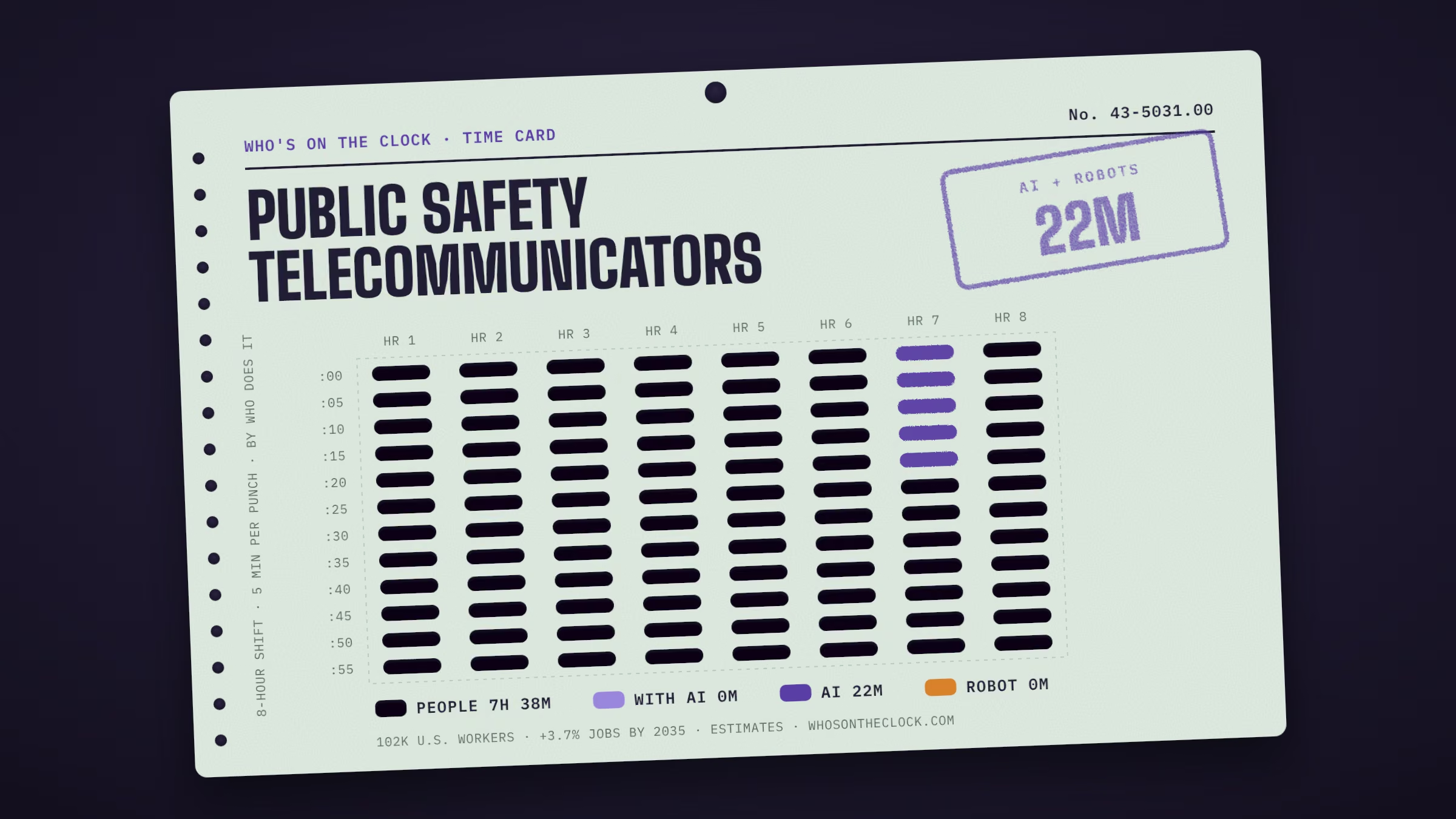
Operate telephone, radio, or other communication systems to receive and communicate requests for emergency assistance at 9-1-1 public safety answering points and emergency operations centers. Take information from the public and other sources regarding crimes, threats, disturbances, acts of terrorism, fires, medical emergencies, and other public safety matters. May coordinate and provide information to law enforcement and emergency response personnel. May access sensitive databases and other information sources as needed. May provide additional instructions to callers based on knowledge of and certification in law enforcement, fire, or emergency medical procedures.
Time card
Untick tasks you don't do, or set your own times.
| Mine | Task, by time spent | Human | With AI | AI | Robot |
|---|---|---|---|---|---|
Question callers to determine their locations and the nature of their problems to determine type of response needed.1h 16m a shift · No AI or robot evidence foundWhy this label?No AI use or robot deployment showed up for this task in our data. That isn't proof it's safe; it may just be rare in the data. How labels work | |||||
Determine response requirements and relative priorities of situations, and dispatch units in accordance with established procedures.1h 16m a shift · No AI or robot evidence foundWhy this label?No AI use or robot deployment showed up for this task in our data. That isn't proof it's safe; it may just be rare in the data. How labels work | |||||
Receive incoming telephone or alarm system calls regarding emergency and non-emergency police and fire service, emergency ambulance service, information, and after-hours calls for departments within a city.55m a shift · No AI or robot evidence foundWhy this label?No AI use or robot deployment showed up for this task in our data. That isn't proof it's safe; it may just be rare in the data. How labels work | |||||
Record details of calls, dispatches, and messages.44m a shift · No AI or robot evidence foundWhy this label?No AI use or robot deployment showed up for this task in our data. That isn't proof it's safe; it may just be rare in the data. How labels work | |||||
Relay information and messages to and from emergency sites, to law enforcement agencies, and to all other individuals or groups requiring notification.38m a shift · No AI or robot evidence foundWhy this label?No AI use or robot deployment showed up for this task in our data. That isn't proof it's safe; it may just be rare in the data. How labels work | |||||
Monitor various radio frequencies, such as those used by public works departments, school security, and civil defense, to stay apprised of developing situations.38m a shift · No AI or robot evidence foundWhy this label?No AI use or robot deployment showed up for this task in our data. That isn't proof it's safe; it may just be rare in the data. How labels work | |||||
Enter, update, and retrieve information from teletype networks and computerized data systems regarding such things as wanted persons, stolen property, vehicle registration, and stolen vehicles.27m a shift · No AI or robot evidence foundWhy this label?No AI use or robot deployment showed up for this task in our data. That isn't proof it's safe; it may just be rare in the data. How labels work | |||||
Read and effectively interpret small-scale maps and information from a computer screen to determine locations and provide directions.22m a shift · Observed in AI useWhy this label?Marked AI because this task shows up regularly in real AI conversations (Anthropic Economic Index, 2025 usage), and in most of them AI does the task on its own rather than helping a person. Many workplaces may not use AI for it at all. How labels work | |||||
Scan status charts and computer screens, and contact emergency response field units to determine emergency units available for dispatch.22m a shift · No AI or robot evidence foundWhy this label?No AI use or robot deployment showed up for this task in our data. That isn't proof it's safe; it may just be rare in the data. How labels work | |||||
Answer routine inquiries, and refer calls not requiring dispatches to appropriate departments and agencies.22m a shift · No AI or robot evidence foundWhy this label?No AI use or robot deployment showed up for this task in our data. That isn't proof it's safe; it may just be rare in the data. How labels work | |||||
Provide emergency medical instructions to callers.16m a shift · No AI or robot evidence foundWhy this label?No AI use or robot deployment showed up for this task in our data. That isn't proof it's safe; it may just be rare in the data. How labels work | |||||
Learn material and pass required tests for certification.16m a shift · No AI or robot evidence foundWhy this label?No AI use or robot deployment showed up for this task in our data. That isn't proof it's safe; it may just be rare in the data. How labels work | |||||
Maintain access to, and security of, highly sensitive materials.5m a shift · No AI or robot evidence foundWhy this label?No AI use or robot deployment showed up for this task in our data. That isn't proof it's safe; it may just be rare in the data. How labels work | |||||
Observe alarm registers and scan maps to determine whether a specific emergency is in the dispatch service area.5m a shift · No AI or robot evidence foundWhy this label?No AI use or robot deployment showed up for this task in our data. That isn't proof it's safe; it may just be rare in the data. How labels work | |||||
Maintain files of information relating to emergency calls, such as personnel rosters and emergency call-out and pager files.5m a shift · No AI or robot evidence foundWhy this label?No AI use or robot deployment showed up for this task in our data. That isn't proof it's safe; it may just be rare in the data. How labels work | |||||
Test and adjust communication and alarm systems, and report malfunctions to maintenance units.5m a shift · No AI or robot evidence foundWhy this label?No AI use or robot deployment showed up for this task in our data. That isn't proof it's safe; it may just be rare in the data. How labels work | |||||
Monitor alarm systems to detect emergencies, such as fires and illegal entry into establishments.5m a shift · No AI or robot evidence foundWhy this label?No AI use or robot deployment showed up for this task in our data. That isn't proof it's safe; it may just be rare in the data. How labels work | |||||
Operate and maintain mobile dispatch vehicles and equipment.time not estimated · No AI or robot evidence foundWhy this label?This is physical work, and no robot has been shown doing it yet. How labels work |