Will AI replace dredge operators?
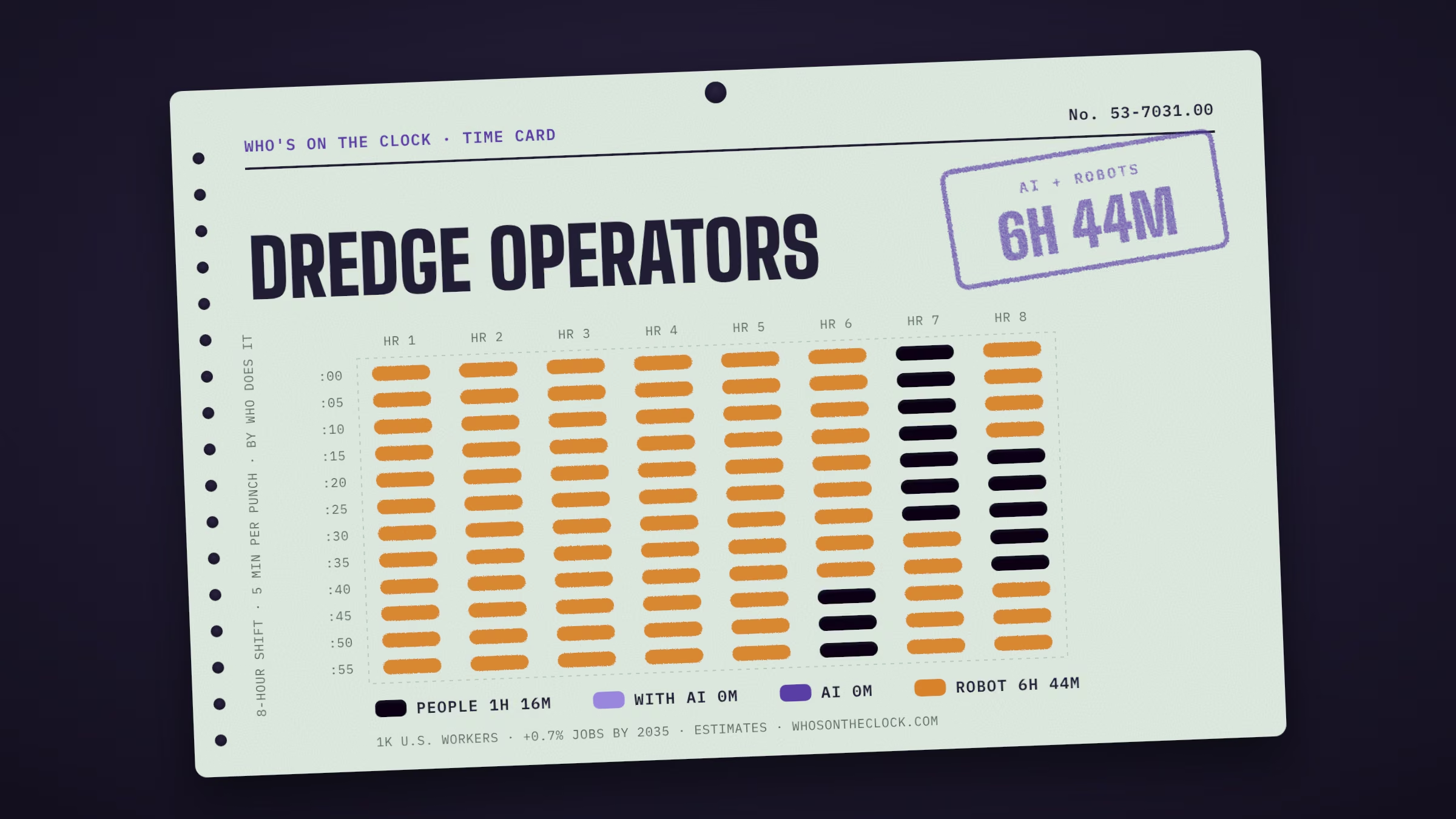
Parts of the job are being automated. About 6h 44m of an 8-hour shift goes to tasks that AI or robots already do largely on their own. The rest still needs a person. The other 1h 16m (16%) stays with people. Separately, BLS expects about 0.7% more of these jobs by 2035 (all jobs: +3.5%).
What parts of the job can AI already do?
None of this job's tasks show regular AI use yet. That can mean the work is hands-on or in person, or simply that it rarely comes up in AI usage data.
Can a robot do this job?
For some tasks, yes. Robots have done 4 of this job's tasks in workplaces like this one, about 6h 44m of a typical shift. For 1 physical task, no robot has shown it can do the work yet.
- Move levers to position dredges for excavation, to engage hydraulic pumps, to raise and lower suction booms, and to control rotation of cutterheads. (4h 40m a shift; e.g. Automatic monitoring and control system for cutter suction dredgers, in use)
- Start power winches that draw in or let out cables to change positions of dredges, or pull in and let out cables manually. (1h 5m a shift; e.g. Kruse Integration PLC dredge automation (Auto Swing Speed / Auto Swing Tension Control), in use)
- Lower anchor poles to verify depths of excavations, using winches, or scan depth gauges to determine depths of excavations. (43m a shift; e.g. Kruse Integration dredge automation on the Phoenix Pinelands cutter suction dredge, in use)
- Start and stop engines to operate equipment. (16m a shift; e.g. Kongsberg K-Chief Power Management System (PMS), in use)
What parts of the job are still done by people?
1h 16m of a typical shift, or 16%, goes to tasks with no AI or robot evidence yet. The biggest:
- Direct or assist workers placing shore anchors and cables, laying additional pipes from dredges to shore, and pumping water from pontoons. (49m a shift)
- Pump water to clear machinery pipelines. (27m a shift)
How much do dredge operators make?
The median pay is about $49,640 a year ($23.86 an hour), 3% below the median for all U.S. jobs ($50,980). Source: BLS, May 2025.
Is this job growing or shrinking?
BLS projects growth of 0.7% from 2025 to 2035, compared with 3.5% growth for all jobs. That's about 1,300 jobs in 2035. It expects about 100 openings a year, mostly from people retiring or changing careers. These projections don't single out AI as a cause.
How many people do this job?
About 1,040 people in the U.S., roughly 0.00% of all workers (BLS, May 2025).
What do you need to become one?
High school diploma, some training. O*NET rates this job at level 2 of 5 for preparation.
What should I learn to stay ahead?
Based on official skill ratings and the tasks that stay with people:
- Skills that matter more here than in most jobs: Operation and Control, Operations Monitoring, Coordination, Judgment and Decision Making
- Get strong at the parts of the job that stay with people (listed above), which take 1h 16m of a typical shift
Are there new tasks in this job?
Yes. Occupational experts recently added these to the official task list:
- Perform maintenance on dredge equipment, such as changing engine oil.
What similar jobs could I move into?
These use similar skills, with less of a typical shift touched by AI or robots:
- Loading and Moving Machine Operators, Underground Mining (2h 16m touched, $75k median pay)
- Refuse and Recyclable Material Collectors (5h 14m touched, $50k median pay)
- Continuous Mining Machine Operators (1h 44m touched, $62k median pay)
- Machine Feeders and Offbearers (3h 26m touched, $41k median pay)
- Transportation Vehicle, Equipment and Systems Inspectors (0m touched, $92k median pay)
How solid are these numbers?
Each task carries its own evidence label. For this job: 4 with robots in real deployments, 2 with no AI or robot evidence found. The minutes per task are estimates, not measured hours, and "no evidence" doesn't prove a task is safe.