Will AI replace electrical engineers?

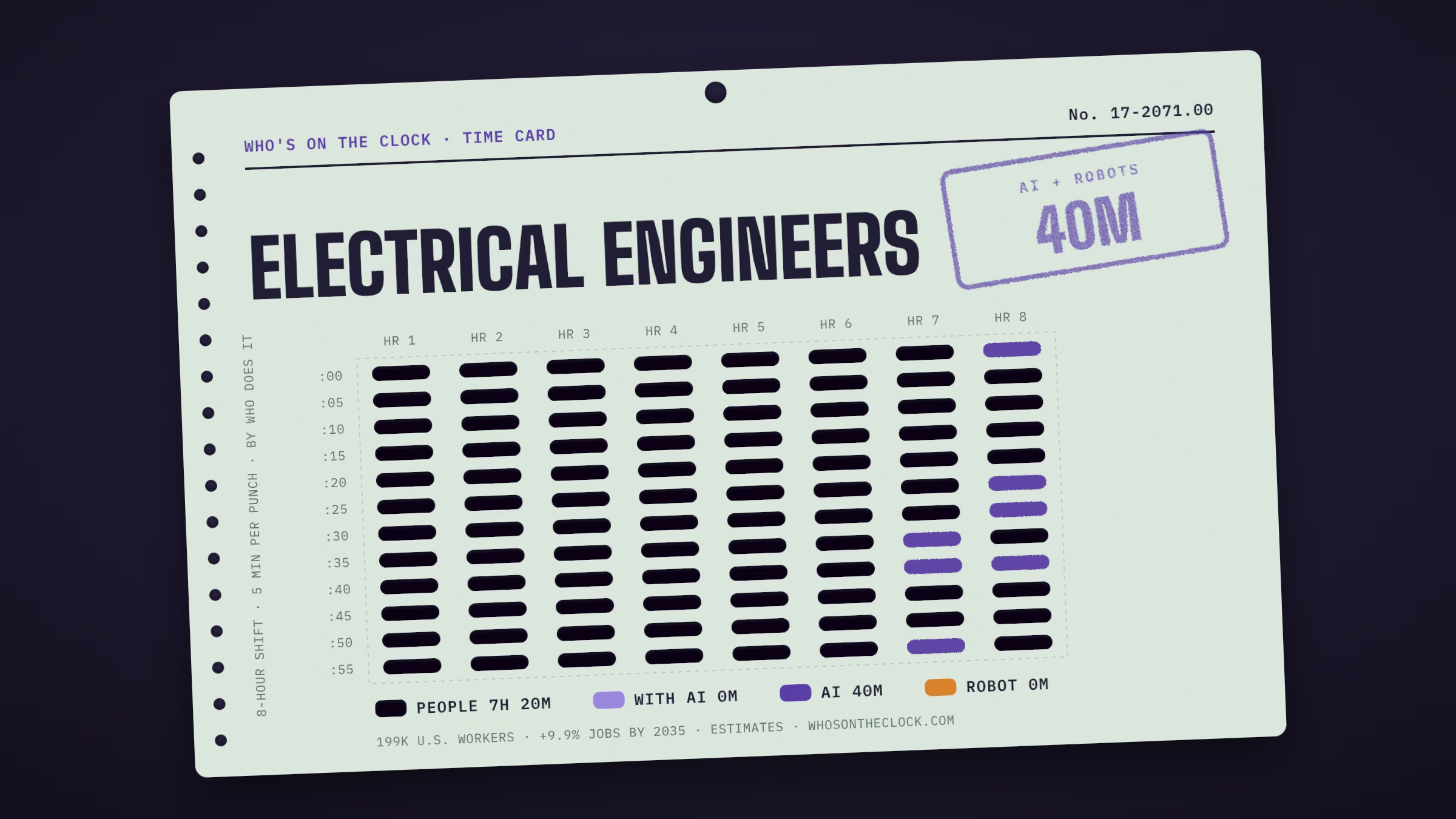
Not replace, but it is changing the job. About 40m of an 8-hour shift goes to tasks touched by AI working on its own. The other 7h 20m (92%) stays with people. Separately, BLS expects about 9.9% more of these jobs by 2035 (all jobs: +3.5%).

Time card for electrical engineers showing a typical 8-hour shift: 7h 20m done by people, 40m by AI.
Each mark is 5 minutes of a typical shift for electrical engineers, colored by who does that task today. Estimates from O*NET tasks and Anthropic Economic Index data. How it's made

Home / Engineering & architecture / Electrical Engineers

Research, design, develop, test, or supervise the manufacturing and installation of electrical equipment, components, or systems for commercial, industrial, military, or scientific use.

Time card

Untick tasks you don't do, or set your own times.
MineTask, by time spentHumanWith AIAIRobot
Design, implement, maintain, or improve electrical instruments, equipment, facilities, components, products, or systems for commercial, industrial, or domestic purposes.1h 20m a shift · No AI or robot evidence found
Confer with engineers, customers, or others to discuss existing or potential engineering projects or products.51m a shift · No AI or robot evidence found
Operate computer-assisted engineering or design software or equipment to perform engineering tasks.46m a shift · No AI or robot evidence found
Oversee project production efforts to assure projects are completed on time and within budget.34m a shift · No AI or robot evidence found
Direct or coordinate manufacturing, construction, installation, maintenance, support, documentation, or testing activities to ensure compliance with specifications, codes, or customer requirements.29m a shift · No AI or robot evidence found
Perform detailed calculations to compute and establish manufacturing, construction, or installation standards or specifications.29m a shift · No AI or robot evidence found
Prepare technical drawings, specifications of electrical systems, or topographical maps to ensure that installation and operations conform to standards and customer requirements.29m a shift · No AI or robot evidence found
Compile data and write reports regarding existing or potential electrical engineering studies or projects.29m a shift · No AI or robot evidence found
Supervise or train project team members, as necessary.23m a shift · No AI or robot evidence found
Inspect completed installations and observe operations to ensure conformance to design and equipment specifications and compliance with operational, safety, or environmental standards.17m a shift · No AI or robot evidence found
Develop software to control electrical systems.17m a shift · No AI or robot evidence found
Investigate customer or public complaints to determine the nature and extent of problems.11m a shift · Observed in AI useTypical AI request: about 1h 29m alone, 23m with AI
Prepare specifications for purchases of materials or equipment.11m a shift · No AI or robot evidence found
Estimate labor, material, or construction costs for budget preparation purposes.11m a shift · Observed in AI use
Plan or implement research methodology or procedures to apply principles of electrical theory to engineering projects.11m a shift · No AI or robot evidence found
Assist in developing capital project programs for new equipment or major repairs.11m a shift · No AI or robot evidence found
Conduct field surveys or study maps, graphs, diagrams, or other data to identify and correct power system problems.11m a shift · Observed in AI use
Investigate or test vendors' or competitors' products.6m a shift · No AI or robot evidence found
Collect data relating to commercial or residential development, population, or power system interconnection to determine operating efficiency of electrical systems.6m a shift · Observed in AI use
Develop systems that produce electricity with renewable energy sources, such as wind, solar, or biofuels.6m a shift · No AI or robot evidence found
Integrate electrical systems with renewable energy systems to improve overall efficiency.6m a shift · No AI or robot evidence found
Design electrical systems or components that minimize electric energy requirements, such as lighting systems designed to account for natural lighting.6m a shift · No AI or robot evidence found

On the floor

  1. Rolling outCadence
    Cadence launches AI agent for chip design and verification

    Cadence launched the ChipStack AI Super Agent, which automates front-end chip design and verification work. Tenstorrent reported up to 4X reduced verification time, and Nvidia and Qualcomm are evaluating or deploying it.

    AIwire

  2. AnnouncedAECOM
    AECOM buys AI engineering startup Consigli

    AECOM acquired Norwegian startup Consigli, which brands itself as "The Autonomous Engineer" and claims engineering time reductions of up to 90%. The reported price was 4 billion NOK, about $390 million.

    AEC Magazine

Ask the clock

Will AI replace electrical engineers?

Not replace, but it is changing the job. About 40m of an 8-hour shift goes to tasks touched by AI working on its own. The other 7h 20m (92%) stays with people. Separately, BLS expects about 9.9% more of these jobs by 2035 (all jobs: +3.5%).

What parts of the job can AI already do?

AI shows up regularly in 4 of 22 tasks, about 40m of a typical shift. The biggest ones:

  • Investigate customer or public complaints to determine the nature and extent of problems. (11m a shift, AI mostly does it alone)
  • Estimate labor, material, or construction costs for budget preparation purposes. (11m a shift, AI mostly does it alone)
  • Conduct field surveys or study maps, graphs, diagrams, or other data to identify and correct power system problems. (11m a shift, AI mostly does it alone)
  • Collect data relating to commercial or residential development, population, or power system interconnection to determine operating efficiency of electrical systems. (6m a shift, AI mostly does it alone)
Can a robot do this job?

Not in workplaces like this one, based on a 2026 review of robot deployments. For 1 physical task, no robot has shown it can do the work yet.

What parts of the job are still done by people?

7h 20m of a typical shift, or 92%, goes to tasks with no AI or robot evidence yet. No AI usage or robot deployment has shown up for these so far. The biggest:

  • Design, implement, maintain, or improve electrical instruments, equipment, facilities, components, products, or systems for commercial, industrial, or domestic purposes. (1h 20m a shift)
  • Confer with engineers, customers, or others to discuss existing or potential engineering projects or products. (51m a shift)
  • Operate computer-assisted engineering or design software or equipment to perform engineering tasks. (46m a shift)
  • Oversee project production efforts to assure projects are completed on time and within budget. (34m a shift)
  • Direct or coordinate manufacturing, construction, installation, maintenance, support, documentation, or testing activities to ensure compliance with specifications, codes, or customer requirements. (29m a shift)
What are companies actually doing?

We track 2 sourced company moves that affect this job. Most recent:

  • Feb 10, 2026: Cadence launches AI agent for chip design and verification (Rolling out)
  • Nov 25, 2025: AECOM buys AI engineering startup Consigli (Announced)
How much time does AI save on this job's tasks?

For the 1 task in this job where AI shows up and timing data exists, a typical request takes about 1h 29m for a person alone and about 23m with AI. These are Claude's own estimates from real conversations in April and May 2026 (Anthropic Economic Index). They describe single requests, not whole workdays, and time saved on a task doesn't mean jobs are cut. The biggest gaps:

  • Investigate customer or public complaints to determine the nature and extent of problems (about 1h 29m alone, 23m with AI)
Are employers still hiring for this job?

On Indeed, job postings in the Electrical Engineering sector are at 153% of their February 2020 level (all U.S. postings: 104%), up 32.4% from a year earlier, as of Oct 9, 2026. BLS separately expects about 11,000 openings a year in this job through 2035. Across all U.S. postings, 7.3% now mention AI skills. Sector postings cover more than this one job and move for many reasons besides AI.

How much do electrical engineers make?

The median pay is about $120,630 a year ($58.00 an hour), 137% above the median for all U.S. jobs ($50,980). Most people in this job earn between $76,550 and $184,300 a year; that range covers the middle 80%. Pay figures are from BLS, May 2025, and vary a lot by state and employer.

Is this job growing or shrinking?

BLS projects growth of 9.9% from 2025 to 2035, compared with 3.5% growth for all jobs. That's about 220,000 jobs in 2035. It expects about 11,000 openings a year, mostly from people retiring or changing careers. These projections don't single out AI as a cause.

How many people do this job?

About 199,000 people in the U.S., roughly 0.13% of all workers (BLS, May 2025). That makes it the 172nd largest of the 796 jobs on this site. BLS expects about 220,000 in 2035.

What do you need to become one?

The most common requirement is a bachelor's degree: about 82% of people in the job said so in the official O*NET survey. O*NET rates the job at level 4 of 5 for preparation, which usually means: bachelor's degree. Requirements vary by state and employer, especially for licensed work.

What should I learn to stay ahead?

These come from the job's official skill ratings and from the tasks that AI and robots touch least today. Building them keeps you strong in the parts of the work that still need a person:

  • Skills that matter more here than in most jobs: Operations Analysis, Writing, Active Learning, Mathematics
  • Get strong at the parts of the job that stay with people (listed above), which take 7h 20m of a typical shift
  • Tools employers list: The MathWorks MATLAB, Python, Microsoft PowerPoint, Microsoft Office software, Microsoft Excel
  • Learn to use AI well on the tasks where it already shows up in this job (listed above)
What similar jobs could I move into?

These use similar skills, with less of a typical shift touched by AI or robots. Matches come from 109 official ratings of skills, knowledge and work activities, and each needs the same or less preparation unless the official list relates the jobs directly:

  • Solar Energy Systems Engineers (0m touched, $123k median pay)
  • Fire-Prevention and Protection Engineers (0m touched, $115k median pay)
  • Nuclear Engineers (0m touched, $134k median pay)
  • Materials Engineers (0m touched, $113k median pay)
How solid are these numbers?

Each task carries its own evidence label. For this job: 4 observed in real AI use, 18 with no AI or robot evidence found. The minutes per task are estimates, not measured hours, and "no evidence" doesn't prove a task is safe.

Tools in demand

  • The MathWorks MATLAB
  • Python
  • Microsoft PowerPoint
  • Microsoft Office software
  • Microsoft Excel
  • C++
  • C
  • Autodesk Revit

Also called

Automation Engineer, Cable Engineer, Circuits Engineer, Controls Engineer, Design Engineer, Distribution Engineer, Distribution Field Engineer, District Plant Engineer, Division Engineer, Division Plant Engineer, Electrical Controls Engineer, Electrical Design Engineer, Electrical Designer, Electrical Engineer