Will AI replace materials engineers?

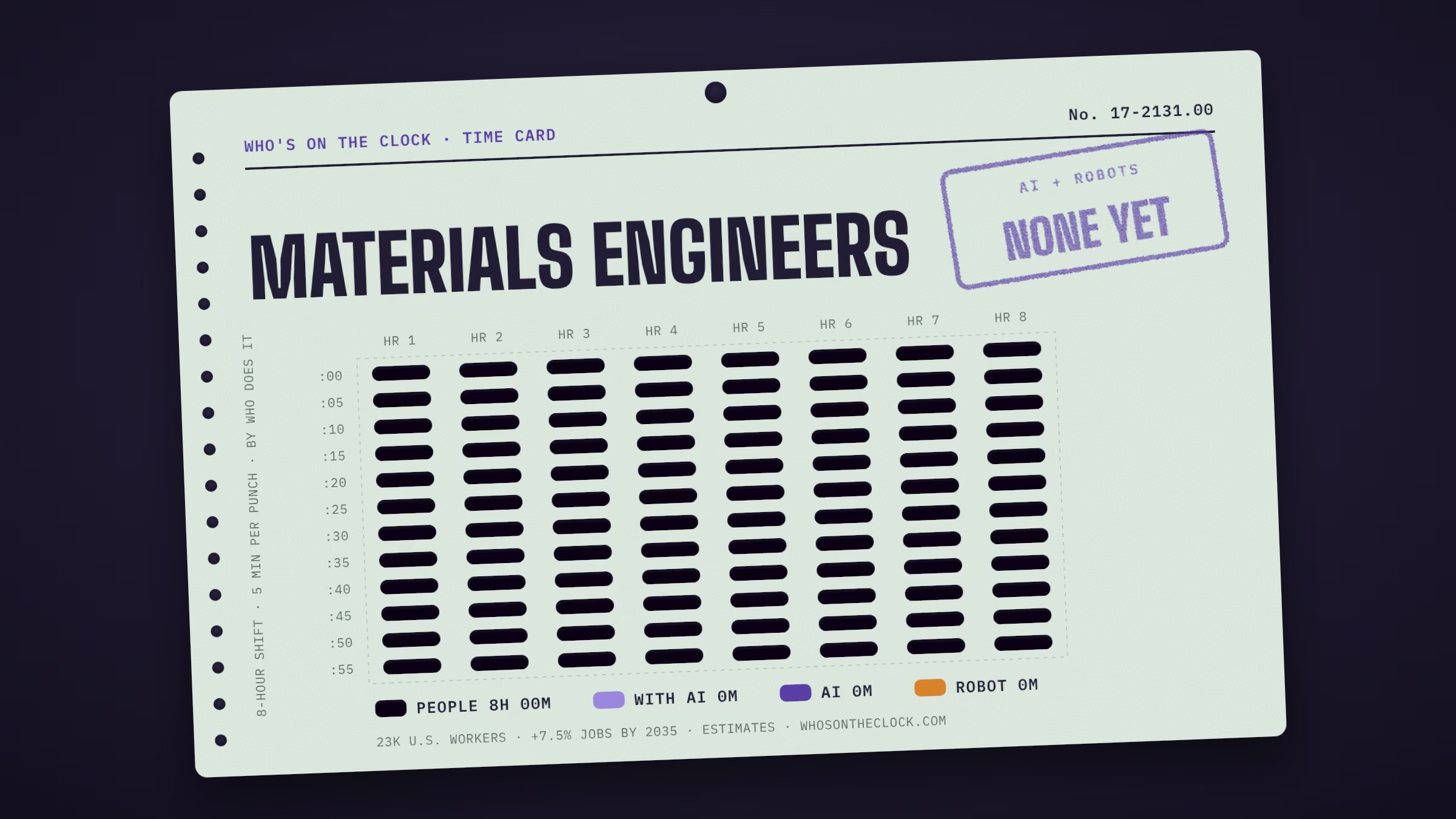
Not on current evidence. Less than 30 minutes of a typical shift goes to tasks that AI or robots are doing today. The other 8h (100%) stays with people. Separately, BLS expects about 7.5% more of these jobs by 2035 (all jobs: +3.5%).

Time card for materials engineers showing a typical 8-hour shift: 8h done by people.
Each mark is 5 minutes of a typical shift for materials engineers, colored by who does that task today. Estimates from O*NET tasks and Anthropic Economic Index data. How it's made

Home / Engineering & architecture / Materials Engineers

Evaluate materials and develop machinery and processes to manufacture materials for use in products that must meet specialized design and performance specifications. Develop new uses for known materials. Includes those engineers working with composite materials or specializing in one type of material, such as graphite, metal and metal alloys, ceramics and glass, plastics and polymers, and naturally occurring materials. Includes metallurgists and metallurgical engineers, ceramic engineers, and welding engineers.

Time card

Untick tasks you don't do, or set your own times.
MineTask, by time spentHumanWith AIAIRobot
Analyze product failure data and laboratory test results to determine causes of problems and develop solutions.53m a shift · No AI or robot evidence found
Design and direct the testing or control of processing procedures.47m a shift · No AI or robot evidence found
Conduct or supervise tests on raw materials or finished products to ensure their quality.41m a shift · No AI or robot evidence found
Perform managerial functions, such as preparing proposals and budgets, analyzing labor costs, and writing reports.36m a shift · No AI or robot evidence found
Evaluate technical specifications and economic factors relating to process or product design objectives.30m a shift · No AI or robot evidence found
Review new product plans, and make recommendations for material selection, based on design objectives such as strength, weight, heat resistance, electrical conductivity, and cost.30m a shift · No AI or robot evidence found
Supervise the work of technologists, technicians, and other engineers and scientists.30m a shift · No AI or robot evidence found
Plan and implement laboratory operations to develop material and fabrication procedures that meet cost, product specification, and performance standards.30m a shift · No AI or robot evidence found
Plan and evaluate new projects, consulting with other engineers and corporate executives, as necessary.30m a shift · No AI or robot evidence found
Determine appropriate methods for fabricating and joining materials.24m a shift · No AI or robot evidence found
Guide technical staff in developing materials for specific uses in projected products or devices.24m a shift · No AI or robot evidence found
Monitor material performance, and evaluate its deterioration.18m a shift · No AI or robot evidence found
Supervise production and testing processes in industrial settings, such as metal refining facilities, smelting or foundry operations, or nonmetallic materials production operations.18m a shift · No AI or robot evidence found
Solve problems in a number of engineering fields, such as mechanical, chemical, electrical, civil, nuclear, and aerospace.18m a shift · No AI or robot evidence found
Replicate the characteristics of materials and their components, using computers.18m a shift · No AI or robot evidence found
Modify properties of metal alloys, using thermal and mechanical treatments.12m a shift · No AI or robot evidence found
Conduct training sessions on new material products, applications, or manufacturing methods for customers and their employees.6m a shift · No AI or robot evidence found
Present technical information at conferences.6m a shift · No AI or robot evidence found
Design processing plants and equipment.6m a shift · No AI or robot evidence found
Write for technical magazines, journals, and trade association publications.6m a shift · No AI or robot evidence found
Teach in colleges and universities.time not estimated · No AI or robot evidence found

On the floor

No company news tracked for this job yet. New stories are added as they happen.

Ask the clock

Will AI replace materials engineers?

Not on current evidence. Less than 30 minutes of a typical shift goes to tasks that AI or robots are doing today. The other 8h (100%) stays with people. Separately, BLS expects about 7.5% more of these jobs by 2035 (all jobs: +3.5%).

What parts of the job can AI already do?

None of this job's tasks show regular AI use yet. That can mean the work is hands-on or in person, or simply that it rarely comes up in AI usage data.

What parts of the job are still done by people?

8h of a typical shift, or 100%, goes to tasks with no AI or robot evidence yet. No AI usage or robot deployment has shown up for these so far. The biggest:

  • Analyze product failure data and laboratory test results to determine causes of problems and develop solutions. (53m a shift)
  • Design and direct the testing or control of processing procedures. (47m a shift)
  • Conduct or supervise tests on raw materials or finished products to ensure their quality. (41m a shift)
  • Perform managerial functions, such as preparing proposals and budgets, analyzing labor costs, and writing reports. (36m a shift)
  • Evaluate technical specifications and economic factors relating to process or product design objectives. (30m a shift)
Are employers still hiring for this job?

On Indeed, job postings in the Mechanical Engineering sector are at 168% of their February 2020 level (all U.S. postings: 104%), up 43.4% from a year earlier, as of Oct 9, 2026. BLS separately expects about 1,300 openings a year in this job through 2035. Across all U.S. postings, 7.3% now mention AI skills. Sector postings cover more than this one job and move for many reasons besides AI.

How much do materials engineers make?

The median pay is about $112,860 a year ($54.26 an hour), 121% above the median for all U.S. jobs ($50,980). Most people in this job earn between $72,300 and $175,720 a year; that range covers the middle 80%. Pay figures are from BLS, May 2025, and vary a lot by state and employer.

Is this job growing or shrinking?

BLS projects growth of 7.5% from 2025 to 2035, compared with 3.5% growth for all jobs. That's about 26,000 jobs in 2035. It expects about 1,300 openings a year, mostly from people retiring or changing careers. These projections don't single out AI as a cause.

How many people do this job?

About 23,000 people in the U.S., roughly 0.01% of all workers (BLS, May 2025). That makes it the 521st largest of the 796 jobs on this site. BLS expects about 26,000 in 2035.

What do you need to become one?

The most common requirement is a bachelor's degree: about 48% of people in the job said so in the official O*NET survey. O*NET rates the job at level 4 of 5 for preparation, which usually means: bachelor's degree. Requirements vary by state and employer, especially for licensed work.

What should I learn to stay ahead?

These come from the job's official skill ratings and from the tasks that AI and robots touch least today. Building them keeps you strong in the parts of the work that still need a person:

  • Skills that matter more here than in most jobs: Science, Mathematics, Operations Analysis, Complex Problem Solving
  • Get strong at the parts of the job that stay with people (listed above), which take 8h of a typical shift
  • Tools employers list: Microsoft PowerPoint, Microsoft Office software, Microsoft Excel, Autodesk AutoCAD, C++
What similar jobs could I move into?

These use similar skills. Matches come from 109 official ratings of skills, knowledge and work activities, and each needs the same or less preparation unless the official list relates the jobs directly:

  • Nanosystems Engineers (2h 16m touched, $123k median pay)
  • Materials Scientists (1h 34m touched, $118k median pay)
  • Fuel Cell Engineers (0m touched, $104k median pay)
  • Chemical Engineers (0m touched, $125k median pay)
  • Nuclear Engineers (0m touched, $134k median pay)
How solid are these numbers?

Each task carries its own evidence label. For this job: 21 with no AI or robot evidence found. The minutes per task are estimates, not measured hours, and "no evidence" doesn't prove a task is safe.

Tools in demand

  • Microsoft PowerPoint
  • Microsoft Office software
  • Microsoft Excel
  • Autodesk AutoCAD
  • C++
  • Dassault Systemes SolidWorks
  • Microsoft Access
  • Microsoft Outlook

Also called

Automotive Sheet Metal Engineer, Ceramic Design Engineer, Ceramic Engineer, Ceramic Research Engineer, Ceramics Test Engineer, Corrosion Engineer, Design Engineer, Engineer, Extractive Metallurgist, Extrusion Engineer, Failure Analysis Engineer, Forensic Materials Engineer, Foundry Metallurgist, Foundry Process Engineer