Will AI replace financial quantitative analysts?

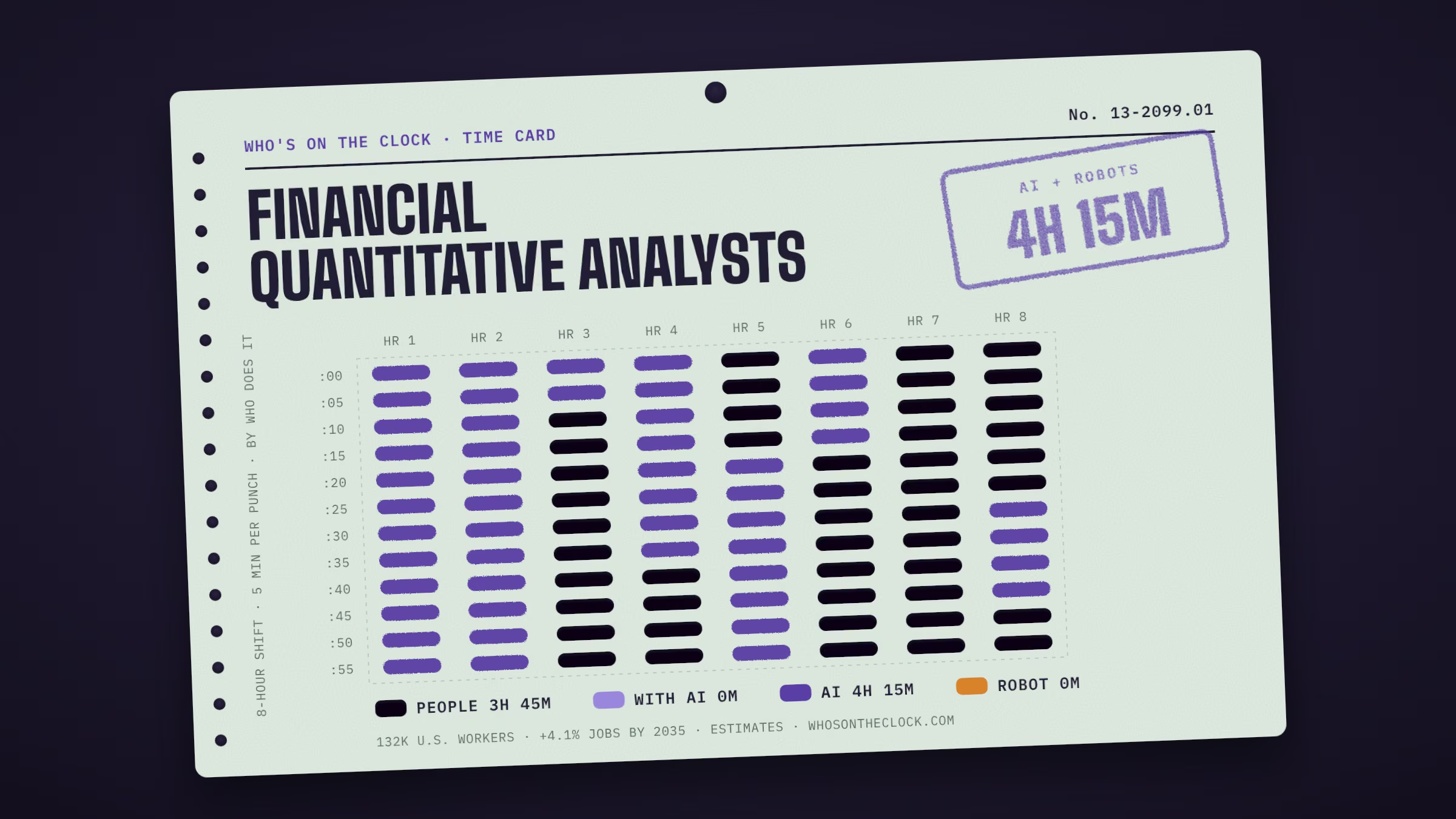
Some tasks are already handled by AI or machines; the rest still needs a person. About 4h 14m of an 8-hour shift goes to tasks that AI or robots largely take over. The other 3h 45m (47%) stays with people. Separately, BLS expects about 4.1% more of these jobs by 2035 (all jobs: +3.5%).

Time card for financial quantitative analysts showing a typical 8-hour shift: 3h 45m done by people, 4h 14m by AI.
Each mark is 5 minutes of a typical shift for financial quantitative analysts, colored by who does that task today. Estimates from O*NET tasks and Anthropic Economic Index data. How it's made

Home / Business & finance / Financial Quantitative Analysts

Develop quantitative techniques to inform securities investing, equities investing, pricing, or valuation of financial instruments. Develop mathematical or statistical models for risk management, asset optimization, pricing, or relative value analysis.

Time card

Untick tasks you don't do, or set your own times.
MineTask, by time spentHumanWith AIAIRobot
Apply mathematical or statistical techniques to address practical issues in finance, such as derivative valuation, securities trading, risk management, or financial market regulation.1h 18m a shift · Observed in AI useTypical AI request: about 3h 47m alone, 23m with AI
Research or develop analytical tools to address issues such as portfolio construction or optimization, performance measurement, attribution, profit and loss measurement, or pricing models.59m a shift · Observed in AI use
Develop core analytical capabilities or model libraries, using advanced statistical, quantitative, or econometric techniques.49m a shift · No AI or robot evidence found
Interpret results of financial analysis procedures.39m a shift · Observed in AI useTypical AI request: about 10h 47m alone, 1h 2m with AI
Maintain or modify all financial analytic models in use.39m a shift · No AI or robot evidence found
Produce written summary reports of financial research results.29m a shift · Observed in AI useTypical AI request: about 12h 1m alone, 54m with AI
Provide application or analytical support to researchers or traders on issues such as valuations or data.29m a shift · Observed in AI useTypical AI request: about 5h 19m alone, 1h 2m with AI
Define or recommend model specifications or data collection methods.24m a shift · No AI or robot evidence found
Devise or apply independent models or tools to help verify results of analytical systems.20m a shift · No AI or robot evidence found
Collaborate in the development or testing of new analytical software to ensure compliance with user requirements, specifications, or scope.20m a shift · No AI or robot evidence found
Confer with other financial engineers or analysts on trading strategies, market dynamics, or trading system performance to inform development of quantitative techniques.20m a shift · No AI or robot evidence found
Consult traders or other financial industry personnel to determine the need for new or improved analytical applications.15m a shift · No AI or robot evidence found
Research new financial products or analytics to determine their usefulness.15m a shift · No AI or robot evidence found
Collaborate with product development teams to research, model, validate, or implement quantitative structured solutions for new or expanded markets.15m a shift · No AI or robot evidence found
Identify, track, or maintain metrics for trading system operations.10m a shift · Observed in AI use
Prepare requirements documentation for use by software developers.10m a shift · Observed in AI useTypical AI request: about 13h 32m alone, 1h 11m with AI
Develop methods of assessing or measuring corporate performance in terms of environmental, social, and governance (ESG) issues.5m a shift · No AI or robot evidence found
Assess the potential impact of climate change on business financial issues, such as damage repairs, insurance costs, or potential disruptions of daily activities.5m a shift · No AI or robot evidence found
Develop solutions to help clients hedge carbon exposure or risk.time not estimated · No AI or robot evidence found
Develop tools to assess green technologies or green financial products, such as green hedge funds or social responsibility investment funds.time not estimated · No AI or robot evidence found
Analyze pricing or risks of carbon trading products.time not estimated · No AI or robot evidence found

On the floor

No company news tracked for this job yet. New stories are added as they happen.

Ask the clock

Will AI replace financial quantitative analysts?

Some tasks are already handled by AI or machines; the rest still needs a person. About 4h 14m of an 8-hour shift goes to tasks that AI or robots largely take over. The other 3h 45m (47%) stays with people. Separately, BLS expects about 4.1% more of these jobs by 2035 (all jobs: +3.5%).

What can AI already do for financial quantitative analysts?

AI shows up regularly in 7 of 21 tasks, about 4h 14m of a typical shift. The biggest ones:

  • Apply mathematical or statistical techniques to address practical issues in finance, such as derivative valuation, securities trading, risk management, or financial market regulation. (1h 18m a shift, AI mostly does it alone)
  • Research or develop analytical tools to address issues such as portfolio construction or optimization, performance measurement, attribution, profit and loss measurement, or pricing models. (59m a shift, AI mostly does it alone)
  • Interpret results of financial analysis procedures. (39m a shift, AI mostly does it alone)
  • Produce written summary reports of financial research results. (29m a shift, AI mostly does it alone)
  • Provide application or analytical support to researchers or traders on issues such as valuations or data. (29m a shift, AI mostly does it alone)
What still needs a person?

3h 45m of a typical shift, or 47%, goes to tasks with no AI or robot evidence yet. No AI usage or robot deployment has shown up for these so far. The biggest:

  • Develop core analytical capabilities or model libraries, using advanced statistical, quantitative, or econometric techniques. (49m a shift)
  • Maintain or modify all financial analytic models in use. (39m a shift)
  • Define or recommend model specifications or data collection methods. (24m a shift)
  • Devise or apply independent models or tools to help verify results of analytical systems. (20m a shift)
  • Collaborate in the development or testing of new analytical software to ensure compliance with user requirements, specifications, or scope. (20m a shift)
Why is that work hard to automate?

Much of it comes down to where and how the work happens. In-person, hands-on and high-stakes work is where AI and robots have made the least headway so far. In the official O*NET survey of people in this job:

  • 53% say a mistake would be very or extremely serious
How much time does AI save on these tasks?

For the 5 tasks in this job where AI shows up and timing data exists, a typical request takes about 10h 47m for a person alone and about 1h 2m with AI. These are Claude's own estimates from real conversations in April and May 2026 (Anthropic Economic Index). They describe single requests, not whole workdays, and time saved on a task doesn't mean jobs are cut. The biggest gaps:

  • Prepare requirements documentation for use by software developers (about 13h 32m alone, 1h 11m with AI)
  • Produce written summary reports of financial research results (about 12h 1m alone, 54m with AI)
  • Interpret results of financial analysis procedures (about 10h 47m alone, 1h 2m with AI)
Are employers still hiring financial quantitative analysts?

On Indeed, job postings in the Banking & Finance sector are at 106% of their February 2020 level (all U.S. postings: 104%), up 10.8% from a year earlier, as of Oct 9, 2026. BLS separately expects about 9,400 openings a year in this job through 2035. Across all U.S. postings, 7.3% now mention AI skills. Sector postings cover more than this one job and move for many reasons besides AI.

How much do financial quantitative analysts make?

The median pay is about $81,100 a year ($38.99 an hour), 59% above the median for all U.S. jobs ($50,980). Most people in this job earn between $48,460 and $151,490 a year; that range covers the middle 80%. Pay figures are from BLS, May 2025, and vary a lot by state and employer. Pick a state to compare:

Is this job growing or shrinking?

BLS projects growth of 4.1% from 2025 to 2035, compared with 3.5% growth for all jobs. That's about 143,000 jobs in 2035. It expects about 9,400 openings a year, mostly from people retiring or changing careers. These projections don't single out AI as a cause.

How many financial quantitative analysts are there in the U.S.?

About 132,000 people in the U.S., roughly 0.08% of all workers (BLS, May 2025). That makes it the 236th largest of the 796 jobs on this site. BLS expects about 143,000 in 2035.

What training do financial quantitative analysts need?

The most common requirement is a master's degree: about 60% of people in the job said so in the official O*NET survey. O*NET rates the job at level 5 of 5 for preparation, which usually means: graduate degree. Requirements vary by state and employer, especially for licensed work.

What should I learn to stay ahead of AI?

These come from the job's official skill ratings and from the tasks that AI and robots touch least today. Building them keeps you strong in the parts of the work that still need a person:

  • Skills that matter more here than in most jobs: Mathematics, Complex Problem Solving, Critical Thinking, Active Learning
  • Get strong at the parts of the job that stay with people (listed above), which take 3h 45m of a typical shift
  • Tools employers list: The MathWorks MATLAB, Tableau, Structured query language SQL, SAS, R
  • Learn to use AI well on the tasks where it already shows up in this job (listed above)
What other jobs could financial quantitative analysts move into?

These use similar skills, with less of a typical shift touched by AI or robots. Matches come from 109 official ratings of skills, knowledge and work activities, and each needs the same or less preparation unless the official list relates the jobs directly:

  • Actuaries (41m touched, $130k median pay)
  • Statisticians (2h 34m touched, $106k median pay)
  • Operations Research Analysts (3h 13m touched, $89k median pay)
How solid are these numbers?

Each task carries its own evidence label. For this job: 7 observed in real AI use, 14 with no AI or robot evidence found. The minutes per task are estimates, not measured hours, and "no evidence" doesn't prove a task is safe.

Tools in demand

  • The MathWorks MATLAB
  • Tableau
  • Structured query language SQL
  • SAS
  • R
  • Python
  • Microsoft Visual Basic for Applications VBA
  • Microsoft PowerPoint

Also called

Data Analyst, Equity Analyst, Equity Structurer, Finance Analyst, Financial Analyst, Financial Engineer, Financial Quantitative Analyst, Investment Portfolio Control Consultant, Investment Strategist, Model Risk Manager, Model Validation Analyst, Portfolio Manager, Predictive Modeler, Private Equity Analyst