Will AI replace healthcare social workers?

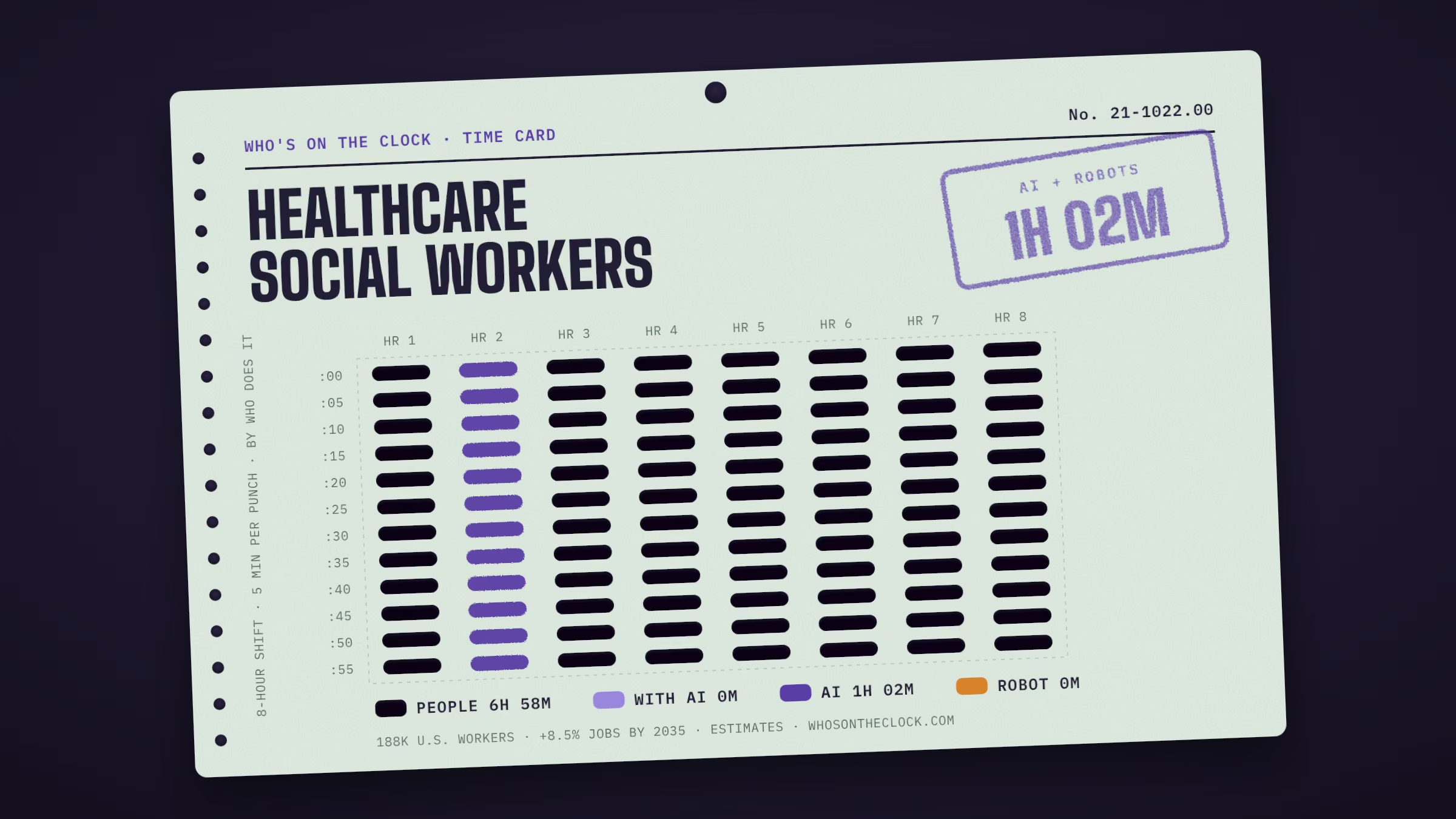
Not replace, but it is changing the job. About 1h 2m of an 8-hour shift goes to tasks touched by AI working on its own. The other 6h 58m (87%) stays with people. Separately, BLS expects about 8.5% more of these jobs by 2035 (all jobs: +3.5%).

Time card for healthcare social workers showing a typical 8-hour shift: 6h 58m done by people, 1h 2m by AI.
Each mark is 5 minutes of a typical shift for healthcare social workers, colored by who does that task today. Estimates from O*NET tasks and Anthropic Economic Index data. How it's made

Home / Social services / Healthcare Social Workers

Provide individuals, families, and groups with the psychosocial support needed to cope with chronic, acute, or terminal illnesses. Services include advising family caregivers. Provide patients with information and counseling, and make referrals for other services. May also provide case and care management or interventions designed to promote health, prevent disease, and address barriers to access to healthcare.

Time card

Untick tasks you don't do, or set your own times.
MineTask, by time spentHumanWith AIAIRobot
Collaborate with other professionals to evaluate patients' medical or physical condition and to assess client needs.1h 2m a shift · No AI or robot evidence found
Monitor, evaluate, and record client progress according to measurable goals described in treatment and care plan.1h 2m a shift · Observed in AI useTypical AI request: about 5h 28m alone, 1h 48m with AI
Refer patient, client, or family to community resources to assist in recovery from mental or physical illness and to provide access to services such as financial assistance, legal aid, housing, job placement or education.55m a shift · No AI or robot evidence found
Utilize consultation data and social work experience to plan and coordinate client or patient care and rehabilitation, following through to ensure service efficacy.49m a shift · No AI or robot evidence found
Counsel clients and patients in individual and group sessions to help them overcome dependencies, recover from illness, and adjust to life.43m a shift · No AI or robot evidence found
Plan discharge from care facility to home or other care facility.43m a shift · No AI or robot evidence found
Identify environmental impediments to client or patient progress through interviews and review of patient records.37m a shift · No AI or robot evidence found
Advocate for clients or patients to resolve crises.31m a shift · No AI or robot evidence found
Educate clients about end-of-life symptoms and options to assist them in making informed decisions.18m a shift · No AI or robot evidence found
Organize support groups or counsel family members to assist them in understanding, dealing with, and supporting the client or patient.18m a shift · No AI or robot evidence found
Modify treatment plans to comply with changes in clients' status.18m a shift · No AI or robot evidence found
Supervise and direct other workers providing services to clients or patients.12m a shift · No AI or robot evidence found
Oversee Medicaid- and Medicare-related paperwork and recordkeeping in hospitals.12m a shift · No AI or robot evidence found
Plan and conduct programs to combat social problems, prevent substance abuse, or improve community health and counseling services.6m a shift · No AI or robot evidence found
Develop or advise on social policy and assist in community development.6m a shift · No AI or robot evidence found
Investigate child abuse or neglect cases and take authorized protective action when necessary.6m a shift · No AI or robot evidence found
Conduct social research to advance knowledge in the social work field.time not estimated · No AI or robot evidence found

On the floor

  1. Rolling outSt Helens Borough Council
    St Helens rolls out Magic Notes AI to 450 frontline staff

    St Helens Borough Council rolled out Beam's Magic Notes AI tool to 450 frontline staff, including social workers. In a pilot with 17 practitioners, users saved about 3.7 hours per week and submitted reports 71% faster.

    St Helens Borough Council

Ask the clock

Will AI replace healthcare social workers?

Not replace, but it is changing the job. About 1h 2m of an 8-hour shift goes to tasks touched by AI working on its own. The other 6h 58m (87%) stays with people. Separately, BLS expects about 8.5% more of these jobs by 2035 (all jobs: +3.5%).

What parts of the job can AI already do?

AI shows up regularly in 1 of 17 tasks, about 1h 2m of a typical shift. The biggest ones:

  • Monitor, evaluate, and record client progress according to measurable goals described in treatment and care plan. (1h 2m a shift, AI mostly does it alone)
What parts of the job are still done by people?

6h 58m of a typical shift, or 87%, goes to tasks with no AI or robot evidence yet. No AI usage or robot deployment has shown up for these so far. The biggest:

  • Collaborate with other professionals to evaluate patients' medical or physical condition and to assess client needs. (1h 2m a shift)
  • Refer patient, client, or family to community resources to assist in recovery from mental or physical illness and to provide access to services such as financial assistance, legal aid, housing, job placement or education. (55m a shift)
  • Utilize consultation data and social work experience to plan and coordinate client or patient care and rehabilitation, following through to ensure service efficacy. (49m a shift)
  • Counsel clients and patients in individual and group sessions to help them overcome dependencies, recover from illness, and adjust to life. (43m a shift)
  • Plan discharge from care facility to home or other care facility. (43m a shift)
Why does a person still do this work?

Part of the answer is the setting, not just the tasks. Work that is in person, hands on or high stakes is where AI and robots have made the least headway so far. In the official O*NET survey of people in this job:

  • 96% talk face to face with others every day
  • 78% handle conflict at least once a week
  • 73% work at arm's length or closer to other people
What are companies actually doing?

We track 1 sourced company move that affects this job. Most recent:

  • Nov 26, 2025: St Helens rolls out Magic Notes AI to 450 frontline staff (Rolling out)
How much time does AI save on this job's tasks?

For the 1 task in this job where AI shows up and timing data exists, a typical request takes about 5h 28m for a person alone and about 1h 48m with AI. These are Claude's own estimates from real conversations in April and May 2026 (Anthropic Economic Index). They describe single requests, not whole workdays, and time saved on a task doesn't mean jobs are cut. The biggest gaps:

  • Monitor, evaluate, and record client progress according to measurable goals described in treatment and care plan (about 5h 28m alone, 1h 48m with AI)
Are employers still hiring for this job?

On Indeed, job postings in the Community & Social Service sector are at 105% of their February 2020 level (all U.S. postings: 104%), down 6.2% from a year earlier, as of Oct 9, 2026. BLS separately expects about 17,000 openings a year in this job through 2035. Across all U.S. postings, 7.3% now mention AI skills. Sector postings cover more than this one job and move for many reasons besides AI.

How much do healthcare social workers make?

The median pay is about $67,880 a year ($32.63 an hour), 33% above the median for all U.S. jobs ($50,980). Most people in this job earn between $46,220 and $100,360 a year; that range covers the middle 80%. Pay figures are from BLS, May 2025, and vary a lot by state and employer. Pick a state to compare:

Is this job growing or shrinking?

BLS projects growth of 8.5% from 2025 to 2035, compared with 3.5% growth for all jobs. That's about 211,000 jobs in 2035. It expects about 17,000 openings a year, mostly from people retiring or changing careers. These projections don't single out AI as a cause.

How many people do this job?

About 188,000 people in the U.S., roughly 0.12% of all workers (BLS, May 2025). That makes it the 178th largest of the 796 jobs on this site. BLS expects about 211,000 in 2035.

What do you need to become one?

The most common requirement is a master's degree: about 70% of people in the job said so in the official O*NET survey. O*NET rates the job at level 5 of 5 for preparation, which usually means: graduate degree. Requirements vary by state and employer, especially for licensed work.

What should I learn to stay ahead?

These come from the job's official skill ratings and from the tasks that AI and robots touch least today. Building them keeps you strong in the parts of the work that still need a person:

  • Skills that matter more here than in most jobs: Social Perceptiveness, Coordination, Service Orientation, Complex Problem Solving
  • Get strong at the parts of the job that stay with people (listed above), which take 6h 58m of a typical shift
  • Tools employers list: Zoom, Microsoft Teams, MEDITECH software, Microsoft Excel, Microsoft Office software
  • Learn to use AI well on the tasks where it already shows up in this job (listed above)
Are there new tasks in this job?

Yes. Occupational experts recently added these to the official task list, a sign of how the work itself is shifting. New tasks aren't rated for AI or robots yet:

  • Conduct psychological assessment of clients.
What similar jobs could I move into?

These use similar skills, with less of a typical shift touched by AI or robots. Matches come from 109 official ratings of skills, knowledge and work activities, and each needs the same or less preparation unless the official list relates the jobs directly:

  • Marriage and Family Therapists (0m touched, $67k median pay)
  • Mental Health Counselors (19m touched, $60k median pay)
  • Social and Human Service Assistants (0m touched, $46k median pay)
  • Child, Family, and School Social Workers (0m touched, $60k median pay)
  • Rehabilitation Counselors (0m touched, $47k median pay)
How solid are these numbers?

Each task carries its own evidence label. For this job: 1 observed in real AI use, 16 with no AI or robot evidence found. The minutes per task are estimates, not measured hours, and "no evidence" doesn't prove a task is safe.

Tools in demand

  • Zoom
  • Microsoft Teams
  • MEDITECH software
  • Microsoft Excel
  • Microsoft Office software
  • Microsoft PowerPoint
  • Microsoft Word

Also called

AIDS Social Worker, Bereavement Counselor, Case Manager, Case Worker, Caseworker, Certified Health Care Social Worker, Certified Social Worker in Health Care (C-SWHC), Client Advocate, Clinical Social Worker, Disability Advocate, Disability Coordinator, Disability Specialist, Discharge Planner, Elder Counselor