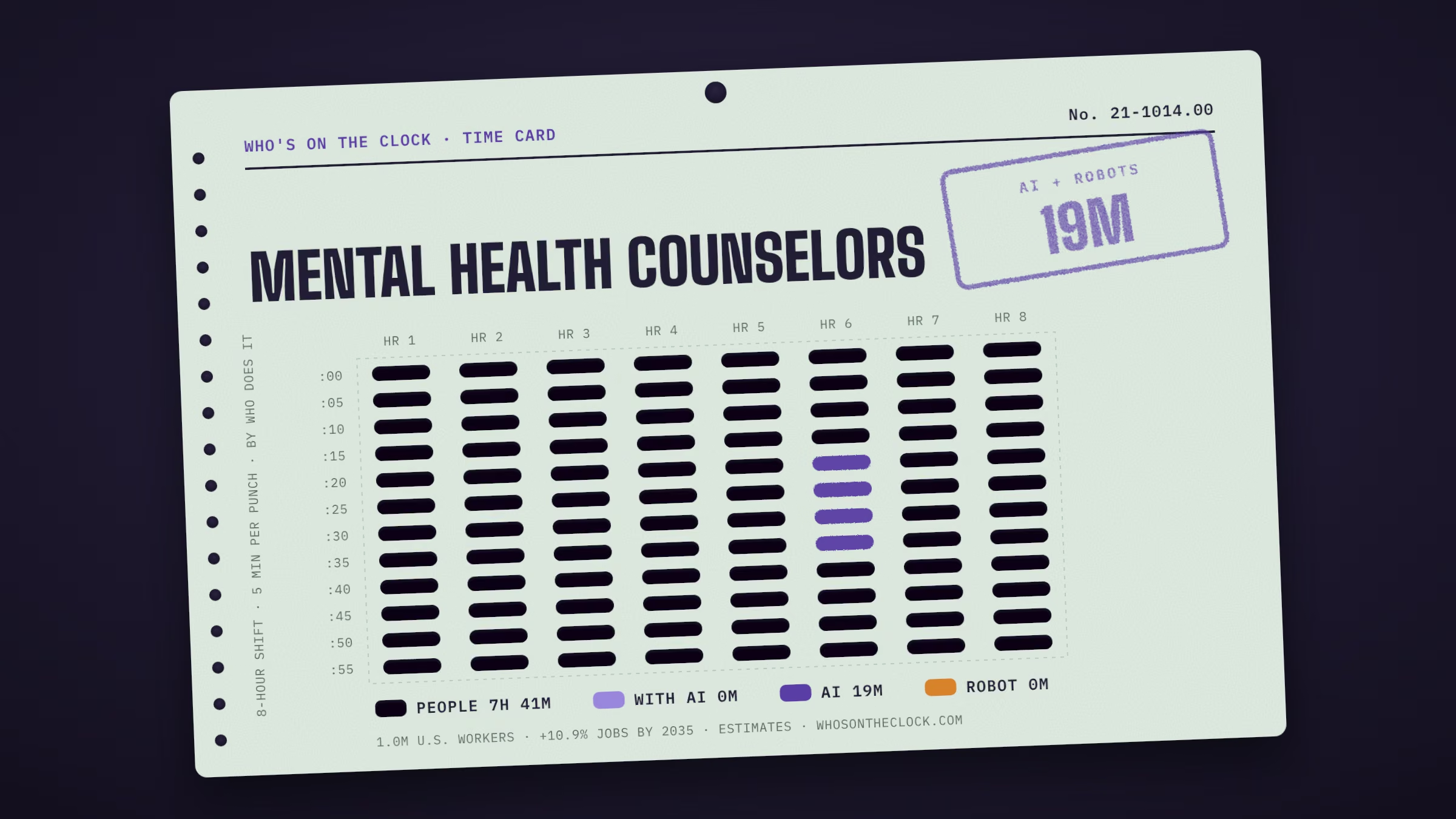
Counsel and advise individuals and groups to promote optimum mental and emotional health, with an emphasis on prevention. May help individuals deal with a broad range of mental health issues, such as those associated with addictions and substance abuse; family, parenting, and marital problems; stress management; self-esteem; or aging.
Time card
Untick tasks you don't do, or set your own times.
| Mine | Task, by time spent | Human | With AI | AI | Robot |
|---|---|---|---|---|---|
| Counsel clients or patients, individually or in group sessions, to assist in overcoming dependencies, adjusting to life, or making changes.1h 38m a shift · No AI or robot evidence found | |||||
| Encourage clients to express their feelings and discuss what is happening in their lives, helping them to develop insight into themselves or their relationships.1h 2m a shift · No AI or robot evidence found | |||||
| Guide clients in the development of skills or strategies for dealing with their problems.1h 2m a shift · No AI or robot evidence found | |||||
| Fill out and maintain client-related paperwork, including federal- and state-mandated forms, client diagnostic records, and progress notes.37m a shift · No AI or robot evidence found | |||||
| Prepare and maintain all required treatment records and reports.37m a shift · No AI or robot evidence found | |||||
| Develop and implement treatment plans based on clinical experience and knowledge.18m a shift · No AI or robot evidence found | |||||
| Collect information about clients through interviews, observation, or tests.18m a shift · Observed in AI useTypical AI request: about 2h 52m alone, 35m with AI | |||||
| Collaborate with mental health professionals and other staff members to perform clinical assessments or develop treatment plans.18m a shift · No AI or robot evidence found | |||||
| Assess patients for risk of suicide attempts.12m a shift · No AI or robot evidence found | |||||
| Evaluate clients' physical or mental condition, based on review of client information.12m a shift · No AI or robot evidence found | |||||
| Counsel family members to assist them in understanding, dealing with, or supporting clients or patients.12m a shift · No AI or robot evidence found | |||||
| Maintain confidentiality of records relating to clients' treatment.6m a shift · No AI or robot evidence found | |||||
| Perform crisis interventions to help ensure the safety of the patients and others.6m a shift · No AI or robot evidence found | |||||
| Perform crisis interventions with clients.6m a shift · No AI or robot evidence found | |||||
| Modify treatment activities or approaches as needed to comply with changes in clients' status.6m a shift · No AI or robot evidence found | |||||
| Evaluate the effectiveness of counseling programs on clients' progress in resolving identified problems and moving towards defined objectives.6m a shift · No AI or robot evidence found | |||||
| Supervise other counselors, social service staff, assistants, or graduate students.6m a shift · No AI or robot evidence found | |||||
| Discuss with individual patients their plans for life after leaving therapy.6m a shift · No AI or robot evidence found | |||||
| Refer patients, clients, or family members to community resources or to specialists as necessary.6m a shift · No AI or robot evidence found | |||||
| Act as client advocates to coordinate required services or to resolve emergency problems in crisis situations.6m a shift · No AI or robot evidence found | |||||
| Learn about new developments in counseling by reading professional literature, attending courses and seminars, or establishing and maintaining contact with other social service agencies.6m a shift · No AI or robot evidence found | |||||
| Plan, organize, or lead structured programs of counseling, work, study, recreation, or social activities for clients.6m a shift · No AI or robot evidence found | |||||
| Monitor clients' use of medications.6m a shift · No AI or robot evidence found | |||||
| Plan or conduct programs to prevent substance abuse or improve community health or counseling services.6m a shift · No AI or robot evidence found | |||||
| Meet with families, probation officers, police, or other interested parties to exchange necessary information during the treatment process.6m a shift · No AI or robot evidence found | |||||
| Coordinate or direct employee workshops, courses, or training about mental health issues.6m a shift · No AI or robot evidence found | |||||
| Gather information about community mental health needs or resources that could be used in conjunction with therapy.time not estimated · No AI or robot evidence found |