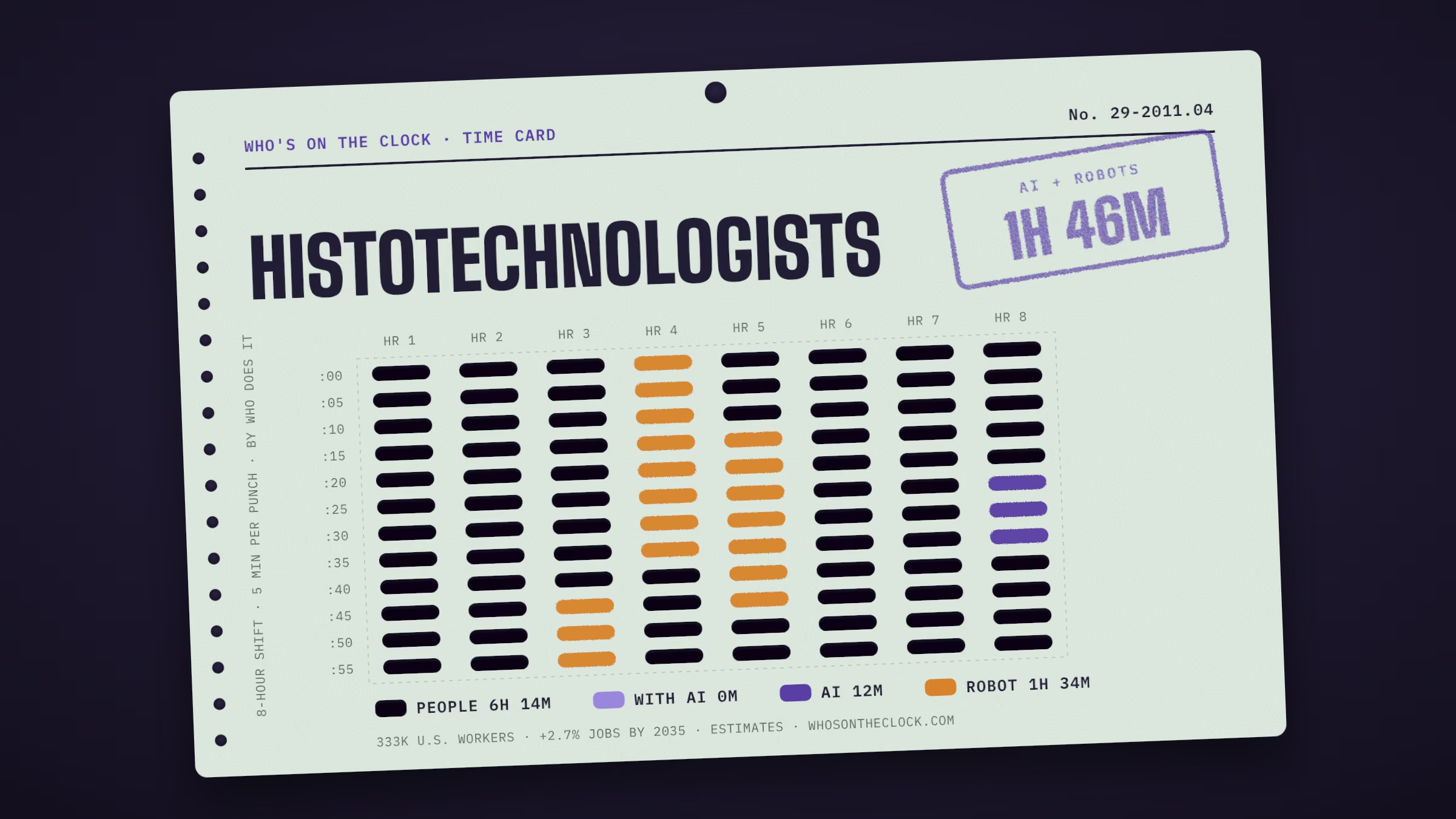
Unlikely, though parts of the work are changing. About 1h 46m of an 8-hour shift goes to tasks touched by robots. The breakdown: 13m that AI mostly does alone, 1h 34m that robots have done in real workplaces. The other 6h 14m (78%) stays with people. Separately, BLS expects about 2.7% more of these jobs by 2035 (all jobs: +3.5%).
⤢ Full sizeEach mark is 5 minutes of a typical shift for histotechnologists, colored by who does that task today. Estimates from O*NET tasks and Anthropic Economic Index data. How it's made
Apply knowledge of health and disease causes to evaluate new laboratory techniques and procedures to examine tissue samples. Process and prepare histological slides from tissue sections for microscopic examination and diagnosis by pathologists. May solve technical or instrument problems or assist with research studies.
Time card
Untick tasks you don't do, or set your own times.
Mine
Task, by time spent
Human
With AI
AI
Robot
Cut sections of body tissues for microscopic examination, using microtomes.1h 34m a shift · Robots only in factory cells
Stain tissue specimens with dyes or other chemicals to make cell details visible under microscopes.1h 9m a shift · Robots only in factory cells
Compile materials for distribution to pathologists, such as surgical working drafts, requisitions, and slides.37m a shift · Robots only in factory cells
Examine slides under microscopes to ensure tissue preparation meets laboratory requirements.37m a shift · Robots deployed · e.g. AIRAQc (with clinical WSI scanners)
Operate computerized laboratory equipment to dehydrate, decalcify, or microincinerate tissue samples.31m a shift · Robots only in factory cells
Perform procedures associated with histochemistry to prepare specimens for immunofluorescence or microscopy.31m a shift · Robots only in factory cells
Prepare substances, such as reagents and dilution, and stains for histological specimens according to protocols.25m a shift · Robots only in factory cells
Compile and maintain records of preventive maintenance and instrument performance checks according to schedule and regulations.19m a shift · No AI or robot evidence found
Resolve problems with laboratory equipment and instruments, such as microscopes, mass spectrometers, microtomes, immunostainers, tissue processors, embedding centers, and water baths.19m a shift · No AI or robot evidence found
Perform tests by following physician instructions.12m a shift · Robots only in factory cells
Prepare or use prepared tissue specimens for teaching, research or diagnostic purposes.12m a shift · Robots only in factory cells
Identify tissue structures or cell components to be used in the diagnosis, prevention, or treatment of diseases.12m a shift · Observed in AI use
Supervise histology laboratory activities.12m a shift · No AI or robot evidence found
Teach students or other staff.12m a shift · No AI or robot evidence found
Perform electron microscopy or mass spectrometry to analyze specimens.time not estimated · Robots only in factory cells
On the floor
No company news tracked for this job yet. New stories are added as they happen.
Ask the clock
Will AI replace histotechnologists?
Unlikely, though parts of the work are changing. About 1h 46m of an 8-hour shift goes to tasks touched by robots. The breakdown: 13m that AI mostly does alone, 1h 34m that robots have done in real workplaces. The other 6h 14m (78%) stays with people. Separately, BLS expects about 2.7% more of these jobs by 2035 (all jobs: +3.5%).
What can AI already do for histotechnologists?
AI shows up regularly in 1 of 16 tasks, about 13m of a typical shift. The biggest ones:
Identify tissue structures or cell components to be used in the diagnosis, prevention, or treatment of diseases. (12m a shift, AI mostly does it alone)
Where do robots fit in?
For some tasks, yes. Robots have done 2 of this job's tasks in workplaces like this one, about 1h 34m of a typical shift. 9 more tasks have only been done in factory setups built around the machine, so they stay with people here. For 1 physical task, no robot has shown it can do the work yet.
Embed tissue specimens into paraffin wax blocks, or infiltrate tissue specimens with wax. (56m a shift; e.g. Tissue-Tek AutoTEC a120 + Paraform cassettes, in use)
Examine slides under microscopes to ensure tissue preparation meets laboratory requirements. (37m a shift; e.g. AIRAQc (with clinical WSI scanners), in use)
What still needs a person?
6h 14m of a typical shift, or 78%, goes to tasks with no AI or robot evidence yet. No AI usage or robot deployment has shown up for these so far. The biggest:
Cut sections of body tissues for microscopic examination, using microtomes. (1h 34m a shift)
Stain tissue specimens with dyes or other chemicals to make cell details visible under microscopes. (1h 9m a shift)
Compile materials for distribution to pathologists, such as surgical working drafts, requisitions, and slides. (37m a shift)
Operate computerized laboratory equipment to dehydrate, decalcify, or microincinerate tissue samples. (31m a shift)
Perform procedures associated with histochemistry to prepare specimens for immunofluorescence or microscopy. (31m a shift)
Why is that work hard to automate?
Much of it comes down to where and how the work happens. In-person, hands-on and high-stakes work is where AI and robots have made the least headway so far. In the official O*NET survey of people in this job:
95% use their hands on tools, objects or controls more than half the time
76% say a mistake would be very or extremely serious
62% carry high or very high responsibility for other workers' safety
Are employers still hiring histotechnologists?
On Indeed, job postings in the Medical Technician sector are at 125% of their February 2020 level (all U.S. postings: 104%), down 2.6% from a year earlier, as of Oct 9, 2026. BLS separately expects about 21,000 openings a year in this job through 2035. Across all U.S. postings, 7.3% now mention AI skills. Sector postings cover more than this one job and move for many reasons besides AI.
How much do histotechnologists make?
The median pay is about $62,930 a year ($30.26 an hour), 23% above the median for all U.S. jobs ($50,980). Most people in this job earn between $38,910 and $100,990 a year; that range covers the middle 80%. Pay figures are from BLS, May 2025, and vary a lot by state and employer.
Is this job growing or shrinking?
BLS projects growth of 2.7% from 2025 to 2035, compared with 3.5% growth for all jobs. That's about 352,000 jobs in 2035. It expects about 21,000 openings a year, mostly from people retiring or changing careers. These projections don't single out AI as a cause.
How many histotechnologists are there in the U.S.?
About 333,000 people in the U.S., roughly 0.21% of all workers (BLS, May 2025). That makes it the 119th largest of the 796 jobs on this site. BLS expects about 352,000 in 2035.
What training do histotechnologists need?
The most common requirement is a bachelor's degree: about 43% of people in the job said so in the official O*NET survey. O*NET rates the job at level 4 of 5 for preparation, which usually means: bachelor's degree. Requirements vary by state and employer, especially for licensed work.
What should I learn to stay ahead of AI?
These come from the job's official skill ratings and from the tasks that AI and robots touch least today. Building them keeps you strong in the parts of the work that still need a person:
Skills that matter more here than in most jobs: Science, Operations Monitoring, Judgment and Decision Making, Active Learning
Get strong at the parts of the job that stay with people (listed above), which take 6h 14m of a typical shift
Tools employers list: MEDITECH software, Microsoft Access, Microsoft Excel, Microsoft Office software, Microsoft Outlook
Learn to use AI well on the tasks where it already shows up in this job (listed above)
What new tasks are histotechnologists taking on?
Yes. Occupational experts recently added these to the official task list, a sign of how the work itself is shifting. New tasks aren't rated for AI or robots yet:
Select and maintain controls for stains.
What other jobs could histotechnologists move into?
These use similar skills, with less of a typical shift touched by AI or robots. Matches come from 109 official ratings of skills, knowledge and work activities, and each needs the same or less preparation unless the official list relates the jobs directly:
Histology Technicians (32m touched, $63k median pay)
Cytogenetic Technologists (25m touched, $63k median pay)
Medical and Clinical Laboratory Technicians (56m touched, $63k median pay)
How solid are these numbers?
Each task carries its own evidence label. For this job: 1 observed in real AI use, 2 with robots in real deployments, 13 with no AI or robot evidence found. The minutes per task are estimates, not measured hours, and "no evidence" doesn't prove a task is safe.