Home / Tasks / Collect biological specimens from patients
In 2 of the 21 jobs that do this, AI or robots already show up on it, most often as robots doing it. In the other 19, there's no evidence yet. Jobs spend a median of 13m of an 8-hour shift on it, and about 12.3 million U.S. workers hold these jobs.
Every job that does this
Each job words the task its own way. Minutes are that job's estimate for a typical shift; the label is the evidence for that job's version.
| Job and its version of the task | Per shift | Evidence |
|---|---|---|
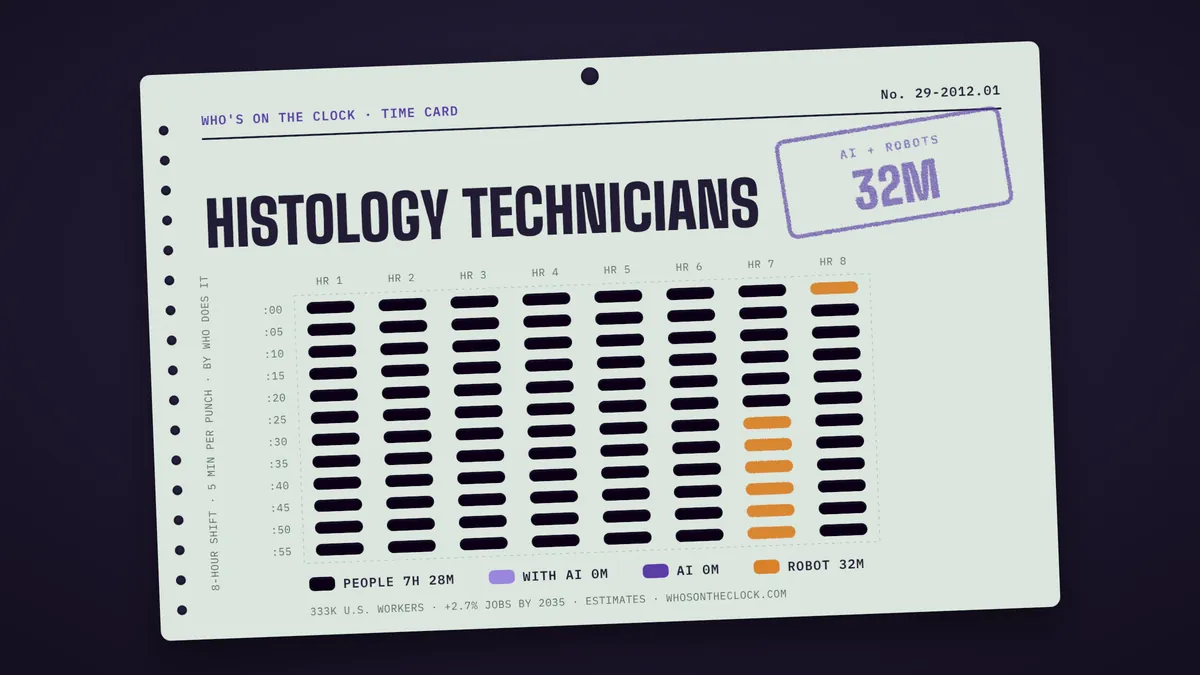
| Histology TechniciansCut sections of body tissues for microscopic examination, using microtomes. | 2h 34m | No evidence yet |
| HistotechnologistsCut sections of body tissues for microscopic examination, using microtomes. | 1h 34m | No evidence yet |
| Medical and Clinical Laboratory TechnologistsCollect and study blood samples to determine the number of cells, their morphology, or their blood group, blood type, or compatibility for transfusion purposes, using microscopic techniques. | 56m | Robots |
| Medical and Clinical Laboratory TechniciansObtain specimens, cultivating, isolating, and identifying microorganisms for analysis. | 50m | No evidence yet |
| Medical AssistantsCollect blood, tissue, or other laboratory specimens, log the specimens, and prepare them for testing. | 32m | No evidence yet |
| Cytogenetic TechnologistsHarvest cell cultures using substances such as mitotic arrestants, cell releasing agents, and cell fixatives. | 31m | No evidence yet |
| Endoscopy TechniciansCollect specimens from patients, using standard medical procedures. | 25m | No evidence yet |
| VeterinariansCollect body tissue, feces, blood, urine, or other body fluids for examination and analysis. | 21m | No evidence yet |
| Veterinary Technologists and TechniciansCollect, prepare, and label samples for laboratory testing, culture, or microscopic examination. | 19m | No evidence yet |
| Naturopathic PhysiciansPerform venipuncture or skin pricking to collect blood samples. | 14m | Robots |
| Veterinary Assistants and Laboratory Animal CaretakersCollect laboratory specimens, such as blood, urine, or feces, for testing. | 13m | No evidence yet |
| PhlebotomistsCollect fluid or tissue samples, using appropriate collection procedures. | 13m | No evidence yet |
| Critical Care NursesCollect specimens for laboratory tests. | 13m | No evidence yet |
| Licensed Practical and Licensed Vocational NursesCollect samples, such as blood, urine, or sputum from patients, and perform routine laboratory tests on samples. | 13m | No evidence yet |
| Psychiatric AidesPerform nursing duties, such as administering medications, measuring vital signs, collecting specimens, or drawing blood samples. | 13m | No evidence yet |
| Acute Care NursesObtain specimens or samples for laboratory work. | 12m | No evidence yet |
| Nursing AssistantsCollect specimens, such as urine, feces, or sputum. | 7m | No evidence yet |
| Nurse AnesthetistsInsert arterial catheters or perform arterial punctures to obtain arterial blood samples. | 6m | No evidence yet |
| MidwivesCollect specimens for use in laboratory tests. | 5m | No evidence yet |
| Anesthesiologist AssistantsCollect samples or specimens for diagnostic testing. | 5m | No evidence yet |
| PathologistsObtain specimens by performing procedures, such as biopsies or fine needle aspirations (FNAs) of superficial nodules. | 5m | No evidence yet |
How to read this
This task type comes from O*NET's detailed work activities, which link similar tasks across jobs. A label applies to one job's version of the task: AI use comes from real AI conversations (Anthropic Economic Index) and robot evidence from deployments in real workplaces. "No evidence yet" may just mean the task is rare in the data. How we keep time.
See all 250 shared tasks, or find any job on the big clock.