Will AI replace hydrologists?

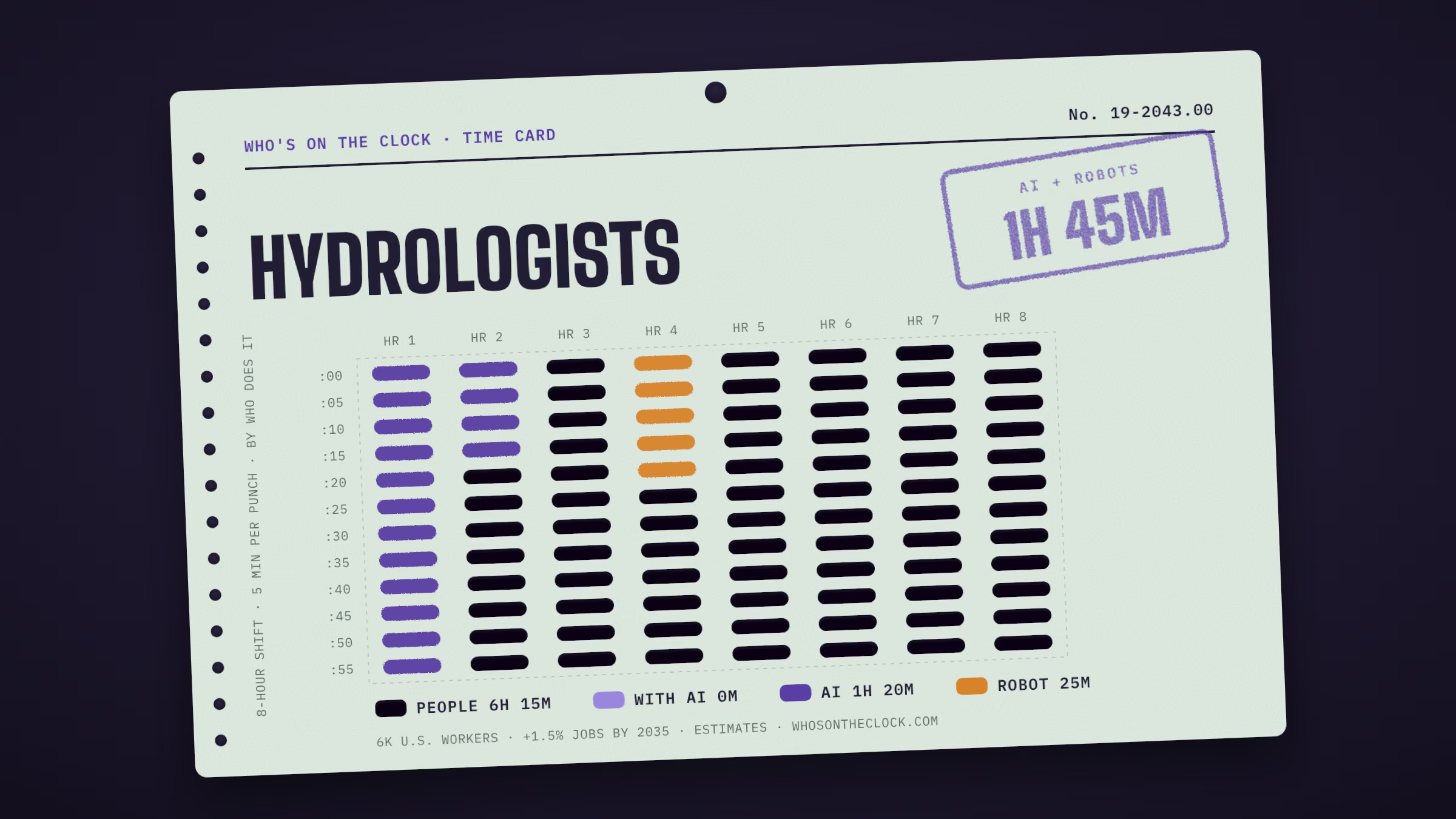
Not replace, but it is changing the job. About 1h 44m of an 8-hour shift goes to tasks touched by AI working on its own. The breakdown: 1h 20m that AI mostly does alone, 25m that robots have done in real workplaces. The other 6h 16m (78%) stays with people. Separately, BLS expects about 1.5% more of these jobs by 2035 (all jobs: +3.5%).

Time card for hydrologists showing a typical 8-hour shift: 6h 16m done by people, 1h 20m by AI, 25m by robots.
Each mark is 5 minutes of a typical shift for hydrologists, colored by who does that task today. Estimates from O*NET tasks and Anthropic Economic Index data. How it's made

Home / Science / Hydrologists

Research the distribution, circulation, and physical properties of underground and surface waters; and study the form and intensity of precipitation and its rate of infiltration into the soil, movement through the earth, and return to the ocean and atmosphere.

Time card

Untick tasks you don't do, or set your own times.
MineTask, by time spentHumanWith AIAIRobot
Prepare written and oral reports describing research results, using illustrations, maps, appendices, and other information.1h 20m a shift · Observed in AI use
Design and conduct scientific hydrogeological investigations to ensure that accurate and appropriate information is available for use in water resource management decisions.55m a shift · No AI or robot evidence found
Develop computer models for hydrologic predictions.43m a shift · No AI or robot evidence found
Measure and graph phenomena such as lake levels, stream flows, and changes in water volumes.25m a shift · Robots deployed · e.g. USGS streamgage network (stage recorders with satellite telemetry)
Coordinate and supervise the work of professional and technical staff, including research assistants, technologists, and technicians.25m a shift · No AI or robot evidence found
Study and document quantities, distribution, disposition, and development of underground and surface waters.25m a shift · No AI or robot evidence found
Evaluate research data in terms of its impact on issues such as soil and water conservation, flood control planning, and water supply forecasting.25m a shift · No AI or robot evidence found
Conduct research and communicate information to promote the conservation and preservation of water resources.18m a shift · No AI or robot evidence found
Study public water supply issues, including flood and drought risks, water quality, wastewater, and impacts on wetland habitats.18m a shift · No AI or robot evidence found
Apply research findings to help minimize the environmental impacts of pollution, waterborne diseases, erosion, and sedimentation.18m a shift · No AI or robot evidence found
Install, maintain, and calibrate instruments such as those that monitor water levels, rainfall, and sediments.18m a shift · No AI or robot evidence found
Collect and analyze water samples as part of field investigations or to validate data from automatic monitors.18m a shift · Robots only in factory cells
Study and analyze the physical aspects of the earth in terms of hydrological components, including atmosphere, hydrosphere, and interior structure.12m a shift · No AI or robot evidence found
Prepare hydrogeologic evaluations of known or suspected hazardous waste sites and land treatment and feedlot facilities.12m a shift · No AI or robot evidence found
Evaluate data and provide recommendations regarding the feasibility of municipal projects, such as hydroelectric power plants, irrigation systems, flood warning systems, and waste treatment facilities.12m a shift · No AI or robot evidence found
Develop or modify methods for conducting hydrologic studies.12m a shift · No AI or robot evidence found
Review applications for site plans and permits and recommend approval, denial, modification, or further investigative action.12m a shift · No AI or robot evidence found
Answer questions and provide technical assistance and information to contractors or the public regarding issues such as well drilling, code requirements, hydrology, and geology.12m a shift · No AI or robot evidence found
Monitor the work of well contractors, exploratory borers, and engineers and enforce rules regarding their activities.6m a shift · No AI or robot evidence found
Investigate properties, origins, and activities of glaciers, ice, snow, and permafrost.6m a shift · No AI or robot evidence found
Conduct short- and long-term climate assessments and study storm occurrences.6m a shift · No AI or robot evidence found
Administer programs designed to ensure the proper sealing of abandoned wells.6m a shift · No AI or robot evidence found
Investigate complaints or conflicts related to the alteration of public waters, gathering information, recommending alternatives, informing participants of progress, and preparing draft orders.6m a shift · No AI or robot evidence found
Design civil works associated with hydrographic activities and supervise their construction, installation, and maintenance.6m a shift · No AI or robot evidence found
Compile and evaluate hydrologic information to prepare navigational charts and maps and to predict atmospheric conditions.time not estimated · No AI or robot evidence found

On the floor

No company news tracked for this job yet. New stories are added as they happen.

Ask the clock

Will AI replace hydrologists?

Not replace, but it is changing the job. About 1h 44m of an 8-hour shift goes to tasks touched by AI working on its own. The breakdown: 1h 20m that AI mostly does alone, 25m that robots have done in real workplaces. The other 6h 16m (78%) stays with people. Separately, BLS expects about 1.5% more of these jobs by 2035 (all jobs: +3.5%).

What parts of the job can AI already do?

AI shows up regularly in 1 of 25 tasks, about 1h 20m of a typical shift. The biggest ones:

  • Prepare written and oral reports describing research results, using illustrations, maps, appendices, and other information. (1h 20m a shift, AI mostly does it alone)
Can a robot do this job?

For some tasks, yes. Robots have done 1 of this job's tasks in workplaces like this one, about 25m of a typical shift. 1 more task has only been done in factory setups built around the machine, so it stays with people here. For 2 physical tasks, no robot has shown it can do the work yet.

  • Measure and graph phenomena such as lake levels, stream flows, and changes in water volumes. (25m a shift; e.g. USGS streamgage network (stage recorders with satellite telemetry), in use)
What parts of the job are still done by people?

6h 16m of a typical shift, or 78%, goes to tasks with no AI or robot evidence yet. No AI usage or robot deployment has shown up for these so far. The biggest:

  • Design and conduct scientific hydrogeological investigations to ensure that accurate and appropriate information is available for use in water resource management decisions. (55m a shift)
  • Develop computer models for hydrologic predictions. (43m a shift)
  • Coordinate and supervise the work of professional and technical staff, including research assistants, technologists, and technicians. (25m a shift)
  • Study and document quantities, distribution, disposition, and development of underground and surface waters. (25m a shift)
  • Evaluate research data in terms of its impact on issues such as soil and water conservation, flood control planning, and water supply forecasting. (25m a shift)
Why does a person still do this work?

Part of the answer is the setting, not just the tasks. Work that is in person, hands on or high stakes is where AI and robots have made the least headway so far. In the official O*NET survey of people in this job:

  • 55% talk face to face with others every day
Are employers still hiring for this job?

On Indeed, job postings in the Scientific Research & Development sector are at 84% of their February 2020 level (all U.S. postings: 104%), up 19.9% from a year earlier, as of Oct 9, 2026. BLS separately expects about 400 openings a year in this job through 2035. Across all U.S. postings, 7.3% now mention AI skills. Sector postings cover more than this one job and move for many reasons besides AI.

How much do hydrologists make?

The median pay is about $96,600 a year ($46.44 an hour), 89% above the median for all U.S. jobs ($50,980). Most people in this job earn between $64,020 and $153,130 a year; that range covers the middle 80%. Pay figures are from BLS, May 2025, and vary a lot by state and employer. Pick a state to compare:

Is this job growing or shrinking?

BLS projects growth of 1.5% from 2025 to 2035, compared with 3.5% growth for all jobs. That's about 6,400 jobs in 2035. It expects about 400 openings a year, mostly from people retiring or changing careers. These projections don't single out AI as a cause.

How many people do this job?

About 5,850 people in the U.S., roughly 0.00% of all workers (BLS, May 2025). That makes it the 719th largest of the 796 jobs on this site. BLS expects about 6,400 in 2035.

What do you need to become one?

The most common requirement is a master's degree: about 52% of people in the job said so in the official O*NET survey. O*NET rates the job at level 5 of 5 for preparation, which usually means: graduate degree. Requirements vary by state and employer, especially for licensed work.

What should I learn to stay ahead?

These come from the job's official skill ratings and from the tasks that AI and robots touch least today. Building them keeps you strong in the parts of the work that still need a person:

  • Skills that matter more here than in most jobs: Science, Mathematics, Systems Analysis, Complex Problem Solving
  • Get strong at the parts of the job that stay with people (listed above), which take 6h 16m of a typical shift
  • Tools employers list: The MathWorks MATLAB, R, Python, Microsoft PowerPoint, Microsoft Office software
  • Learn to use AI well on the tasks where it already shows up in this job (listed above)
What similar jobs could I move into?

These use similar skills, with less of a typical shift touched by AI or robots. Matches come from 109 official ratings of skills, knowledge and work activities, and each needs the same or less preparation unless the official list relates the jobs directly:

  • Geoscientists (19m touched, $102k median pay)
  • Remote Sensing Scientists and Technologists (34m touched, $123k median pay)
  • Atmospheric and Space Scientists (48m touched, $99k median pay)
  • Water Resource Specialists (32m touched, $167k median pay)
  • Biochemists and Biophysicists (43m touched, $127k median pay)
How solid are these numbers?

Each task carries its own evidence label. For this job: 1 observed in real AI use, 1 with robots in real deployments, 23 with no AI or robot evidence found. The minutes per task are estimates, not measured hours, and "no evidence" doesn't prove a task is safe.

Tools in demand

  • The MathWorks MATLAB
  • R
  • Python
  • Microsoft PowerPoint
  • Microsoft Office software
  • Microsoft Excel
  • ESRI ArcGIS software
  • Autodesk AutoCAD Civil 3D

Also called

Groundwater Consultant, Hydraulic Engineer, Hydrogeologist, Hydrologic Engineer, Hydrologist, Isotope Hydrologist, Physical Scientist, Project Hydrogeologist, Research Hydrologist, Scientist, Seismologist, Source Water Protection Specialist, Surface Hydrologist, Volcanologist