Will AI replace lighting technicians?

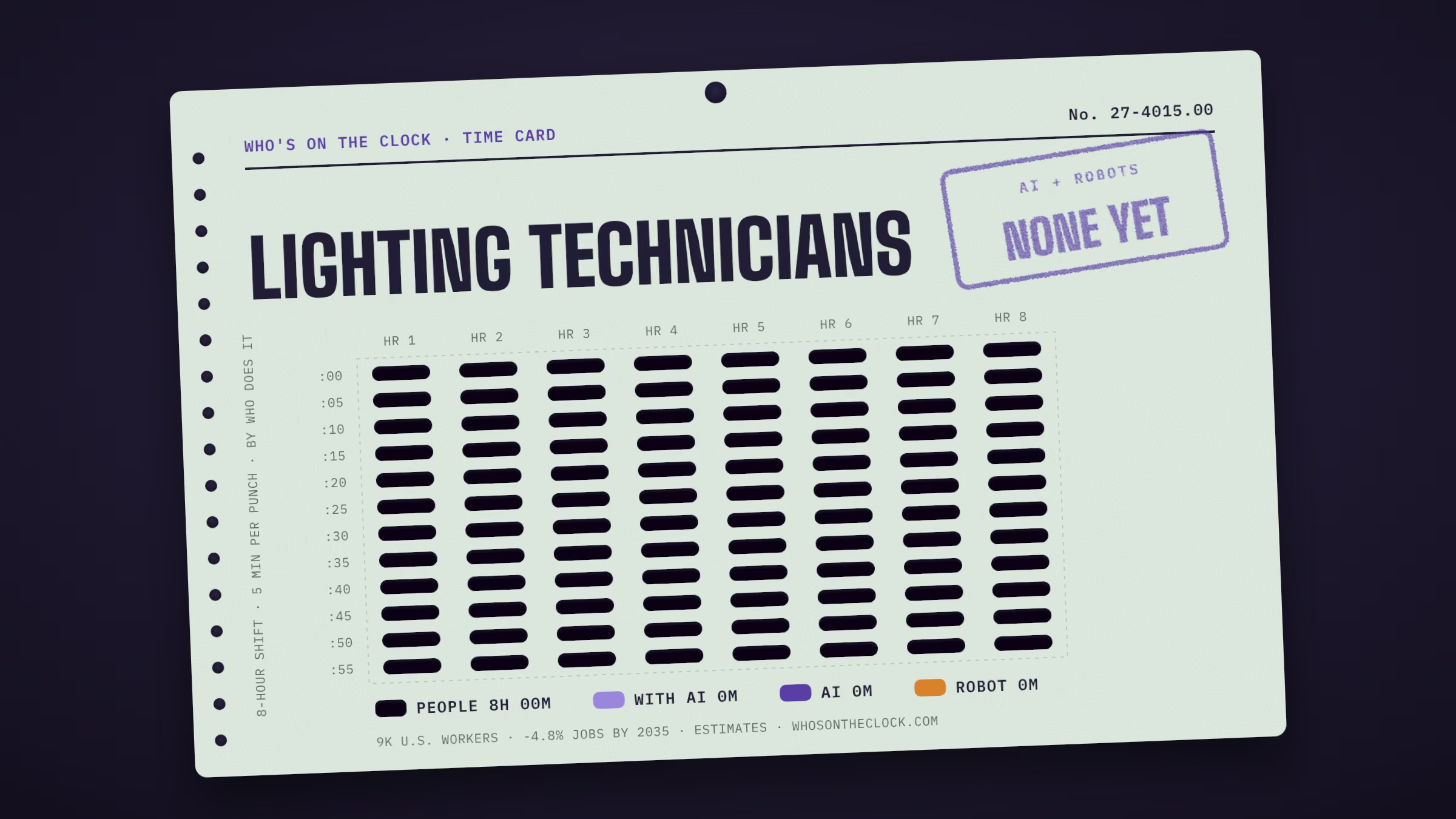
Not on current evidence. Less than 30 minutes of a typical shift goes to tasks that AI or robots are doing today. The other 8h (100%) stays with people. Separately, BLS expects about 4.8% fewer of these jobs by 2035 (all jobs: +3.5%).

Time card for lighting technicians showing a typical 8-hour shift: 8h done by people.
Each mark is 5 minutes of a typical shift for lighting technicians, colored by who does that task today. Estimates from O*NET tasks and Anthropic Economic Index data. How it's made

Home / Arts, media & sports / Lighting Technicians

Set up, maintain, and dismantle light fixtures, lighting control devices, and the associated lighting electrical and rigging equipment used for photography, television, film, video, and live productions. May focus or operate light fixtures, or attach color filters or other lighting accessories.

Time card

Untick tasks you don't do, or set your own times.
MineTask, by time spentHumanWith AIAIRobot
Set up and focus light fixtures to meet requirements of television, theater, concerts, or other productions.1h 21m a shift · No AI or robot evidence found
Load, unload, or position lighting equipment.58m a shift · Robots only in factory cells
Disassemble and store equipment after performances.46m a shift · Robots only in factory cells
Install electrical cables or wire fixtures.46m a shift · No AI or robot evidence found
Operate manual or automated systems to control lighting throughout productions.46m a shift · Robots only in factory cells
Perform minor repairs or routine maintenance on lighting equipment, such as replacing lamps or damaged color filters.29m a shift · Robots only in factory cells
Program lighting consoles or load automated lighting control systems onto consoles.29m a shift · No AI or robot evidence found
Consult with lighting director or production staff to determine lighting requirements.23m a shift · No AI or robot evidence found
Patch or wire lights to dimmers or other electronic consoles.23m a shift · Robots only in factory cells
Test lighting equipment function and desired lighting effects.23m a shift · Robots only in factory cells
Install color effects or image patterns, such as color filters, onto lighting fixtures.17m a shift · Robots only in factory cells
Match light fixture settings, such as brightness and color, to lighting design plans.17m a shift · Robots only in factory cells
Assess safety of wiring or equipment set-up to determine the risk of fire or electrical shock.12m a shift · No AI or robot evidence found
Set up scaffolding or cranes to assist with setting up of lighting equipment.12m a shift · No AI or robot evidence found
Visit and assess structural and electrical layout of locations before setting up lighting equipment.12m a shift · No AI or robot evidence found
Notify supervisors when major lighting equipment repairs are needed.6m a shift · No AI or robot evidence found

On the floor

No company news tracked for this job yet. New stories are added as they happen.

Ask the clock

Will AI replace lighting technicians?

Not on current evidence. Less than 30 minutes of a typical shift goes to tasks that AI or robots are doing today. The other 8h (100%) stays with people. Separately, BLS expects about 4.8% fewer of these jobs by 2035 (all jobs: +3.5%).

What can AI already do for lighting technicians?

None of this job's tasks show regular AI use yet. That can mean the work is hands-on or in person, or simply that it rarely comes up in AI usage data.

Where do robots fit in?

Not in workplaces like this one, based on a 2026 review of robot deployments. 8 more tasks have only been done in factory setups built around the machine, so they stay with people here. For 5 physical tasks, no robot has shown it can do the work yet.

What still needs a person?

8h of a typical shift, or 100%, goes to tasks with no AI or robot evidence yet. No AI usage or robot deployment has shown up for these so far. The biggest:

  • Set up and focus light fixtures to meet requirements of television, theater, concerts, or other productions. (1h 21m a shift)
  • Load, unload, or position lighting equipment. (58m a shift)
  • Disassemble and store equipment after performances. (46m a shift)
  • Install electrical cables or wire fixtures. (46m a shift)
  • Operate manual or automated systems to control lighting throughout productions. (46m a shift)
Are employers still hiring lighting technicians?

On Indeed, job postings in the Media & Communications sector are at 69% of their February 2020 level (all U.S. postings: 104%), up 6.8% from a year earlier, as of Oct 9, 2026. BLS separately expects about 600 openings a year in this job through 2035. Across all U.S. postings, 7.3% now mention AI skills. Sector postings cover more than this one job and move for many reasons besides AI.

How much do lighting technicians make?

The median pay is about $68,060 a year ($32.72 an hour), 34% above the median for all U.S. jobs ($50,980). Most people in this job earn between $42,310 and $130,760 a year; that range covers the middle 80%. Pay figures are from BLS, May 2025, and vary a lot by state and employer. Pick a state to compare:

Is this job growing or shrinking?

BLS projects a decline of 4.8% from 2025 to 2035, compared with 3.5% growth for all jobs. That's about 9,400 jobs in 2035. Even so, it expects about 600 openings a year, mostly from people retiring or changing careers. These projections don't single out AI as a cause.

How many lighting technicians are there in the U.S.?

About 8,900 people in the U.S., roughly 0.01% of all workers (BLS, May 2025). That makes it the 681st largest of the 796 jobs on this site. BLS expects about 9,400 in 2035.

What training do lighting technicians need?

O*NET rates the job at level 3 of 5 for preparation, which usually means: vocational school or associate's degree. Requirements vary by state and employer, especially for licensed work.

What should I learn to stay ahead of AI?

These come from the job's official skill ratings and from the tasks that AI and robots touch least today. Building them keeps you strong in the parts of the work that still need a person:

  • Get strong at the parts of the job that stay with people (listed above), which take 8h of a typical shift
  • Tools employers list: Microsoft Office software, Autodesk AutoCAD, Microsoft Access, Microsoft Excel, Microsoft Outlook
What other jobs could lighting technicians move into?

These use similar skills. Matches come from 109 official ratings of skills, knowledge and work activities, and each needs the same or less preparation unless the official list relates the jobs directly:

  • Electricians (0m touched, $63k median pay)
  • Electrical and Electronics Installers and Repairers, Transportation Equipment (0m touched, $85k median pay)
  • Electrical and Electronic Engineering Technologists and Technicians (19m touched, $78k median pay)
  • Electrical and Electronic Equipment Assemblers (48m touched, $46k median pay)
  • Electrical and Electronics Repairers, Commercial and Industrial Equipment (0m touched, $74k median pay)
How solid are these numbers?

Each task carries its own evidence label. For this job: 16 with no AI or robot evidence found. The minutes per task are estimates, not measured hours, and "no evidence" doesn't prove a task is safe.

Tools in demand

  • Microsoft Office software
  • Autodesk AutoCAD
  • Microsoft Access
  • Microsoft Excel
  • Microsoft Outlook
  • Microsoft PowerPoint
  • Microsoft Project

Also called

Dimmer Board Operator, Electrical Lighting Technician (ELT), Entertainment Lighting Technician, Gaffer, Lamp Operator, Light Technician (Light Tech), Lighting Controls Technician, Lighting Designer, Lighting Engineer, Lighting Operator, Lighting Service Technician (Lighting Service Tech), Lighting Specialist, Lighting Technician (Lighting Tech), Production Technician