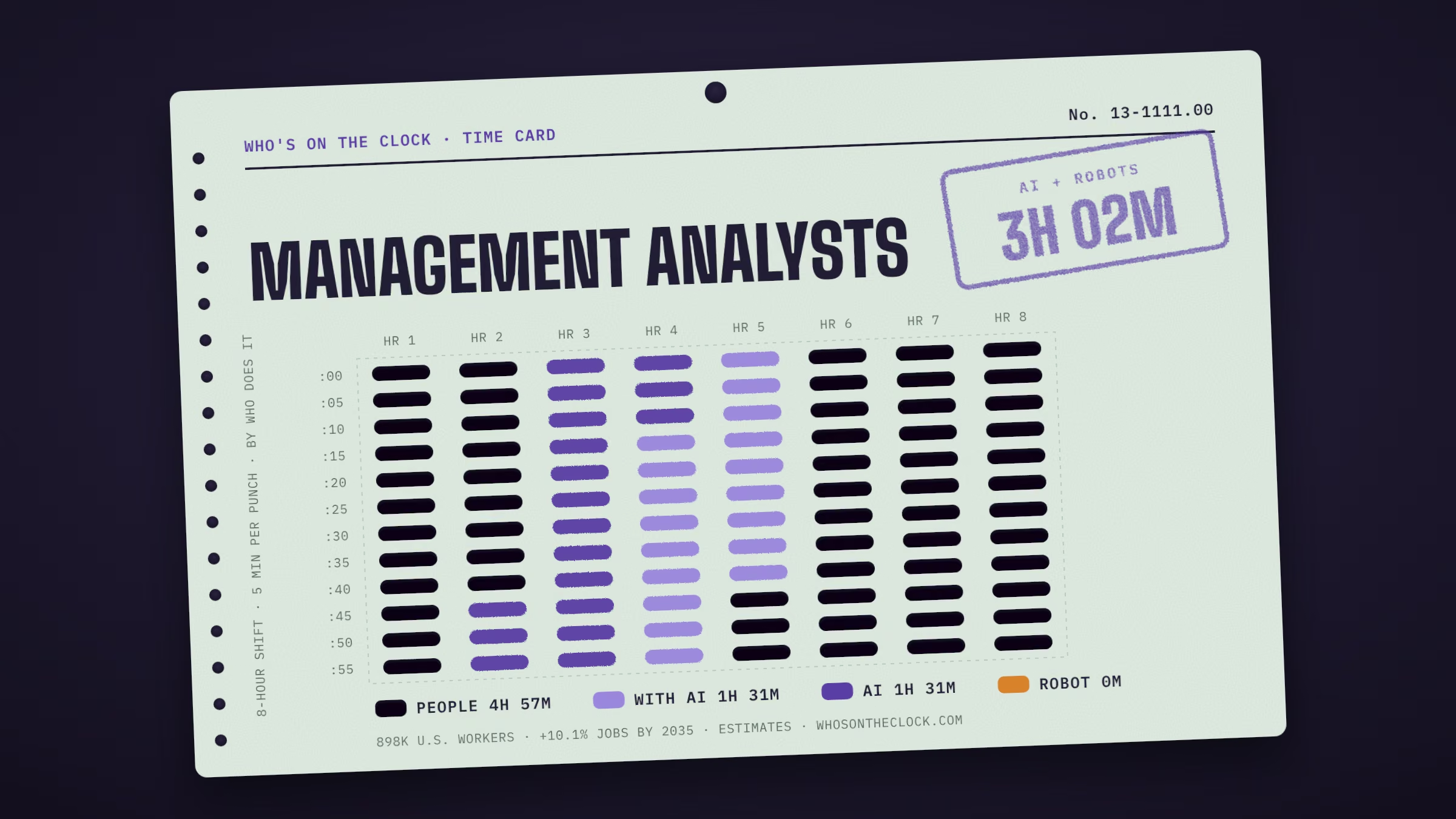
Unlikely, though parts of the work are changing. About 3h 2m of an 8-hour shift goes to tasks touched by AI that people use as a helper. The breakdown: 1h 31m done by people with AI help, 1h 31m that AI mostly does alone. The other 4h 57m (62%) stays with people. Separately, BLS expects about 10.1% more of these jobs by 2035 (all jobs: +3.5%).
⤢ Full sizeEach mark is 5 minutes of a typical shift for management analysts, colored by who does that task today. Estimates from O*NET tasks and Anthropic Economic Index data. How it's made
Conduct organizational studies and evaluations, design systems and procedures, conduct work simplification and measurement studies, and prepare operations and procedures manuals to assist management in operating more efficiently and effectively. Includes program analysts and management consultants.
Time card
Untick tasks you don't do, or set your own times.
Mine
Task, by time spent
Human
With AI
AI
Robot
Analyze data gathered and develop solutions or alternative methods of proceeding.1h 43m a shift · No AI or robot evidence found
Gather and organize information on problems or procedures.1h 31m a shift · Observed in AI useTypical AI request: about 1h 46m alone, 13m with AI
Document findings of study and prepare recommendations for implementation of new systems, procedures, or organizational changes.1h 31m a shift · Observed in AI useTypical AI request: about 11h 23m alone, 1h 1m with AI
Confer with personnel concerned to ensure successful functioning of newly implemented systems or procedures.46m a shift · No AI or robot evidence found
Interview personnel and conduct on-site observation to ascertain unit functions, work performed, and methods, equipment, and personnel used.46m a shift · No AI or robot evidence found
Plan study of work problems and procedures, such as organizational change, communications, information flow, integrated production methods, inventory control, or cost analysis.40m a shift · No AI or robot evidence found
Prepare manuals and train workers in use of new forms, reports, procedures or equipment, according to organizational policy.23m a shift · No AI or robot evidence found
Review forms and reports and confer with management and users about format, distribution, and purpose, identifying problems and improvements.23m a shift · No AI or robot evidence found
Design, evaluate, recommend, and approve changes of forms and reports.11m a shift · No AI or robot evidence found
Develop and implement records management program for filing, protection, and retrieval of records, and assure compliance with program.6m a shift · No AI or robot evidence found
Recommend purchase of storage equipment and design area layout to locate equipment in space available.time not estimated · No AI or robot evidence found
McKinsey says its workforce now includes 20,000 AI agents
CEO Bob Sternfels said McKinsey has 40,000 humans and 20,000 AI agents, up from about 3,000 agents a year and a half earlier, with human headcount unchanged. He expects every employee to be supported by one or more agents within 18 months.
Accenture cuts staff it says cannot be reskilled for AI
Accenture headcount fell from about 791,000 to over 779,000 in three months, with about $865 million in expected restructuring costs. CEO Julie Sweet said reskilling "is not a viable path for the skills we need" for some workers.
Unlikely, though parts of the work are changing. About 3h 2m of an 8-hour shift goes to tasks touched by AI that people use as a helper. The breakdown: 1h 31m done by people with AI help, 1h 31m that AI mostly does alone. The other 4h 57m (62%) stays with people. Separately, BLS expects about 10.1% more of these jobs by 2035 (all jobs: +3.5%).
What can AI already do for management analysts?
AI shows up regularly in 2 of 11 tasks, about 3h 2m of a typical shift. The biggest ones:
Gather and organize information on problems or procedures. (1h 31m a shift, AI mostly does it alone)
Document findings of study and prepare recommendations for implementation of new systems, procedures, or organizational changes. (1h 31m a shift, people use AI to help)
What still needs a person?
4h 57m of a typical shift, or 62%, goes to tasks with no AI or robot evidence yet. No AI usage or robot deployment has shown up for these so far. The biggest:
Analyze data gathered and develop solutions or alternative methods of proceeding. (1h 43m a shift)
Confer with personnel concerned to ensure successful functioning of newly implemented systems or procedures. (46m a shift)
Interview personnel and conduct on-site observation to ascertain unit functions, work performed, and methods, equipment, and personnel used. (46m a shift)
Plan study of work problems and procedures, such as organizational change, communications, information flow, integrated production methods, inventory control, or cost analysis. (40m a shift)
Prepare manuals and train workers in use of new forms, reports, procedures or equipment, according to organizational policy. (23m a shift)
Why is that work hard to automate?
Much of it comes down to where and how the work happens. In-person, hands-on and high-stakes work is where AI and robots have made the least headway so far. In the official O*NET survey of people in this job:
74% talk face to face with others every day
57% say dealing with the public is very or extremely important
What are companies actually doing?
We track 2 sourced company moves that affect this job. Most recent:
Jan 15, 2026: McKinsey says its workforce now includes 20,000 AI agents (Rolling out)
Sep 26, 2025: Accenture cuts staff it says cannot be reskilled for AI (Rolling out)
How much time does AI save on these tasks?
For the 2 tasks in this job where AI shows up and timing data exists, a typical request takes about 6h 34m for a person alone and about 37m with AI. These are Claude's own estimates from real conversations in April and May 2026 (Anthropic Economic Index). They describe single requests, not whole workdays, and time saved on a task doesn't mean jobs are cut. The biggest gaps:
Document findings of study and prepare recommendations for implementation of new systems, procedures, or organizational changes (about 11h 23m alone, 1h 1m with AI)
Gather and organize information on problems or procedures (about 1h 46m alone, 13m with AI)
Are employers still hiring management analysts?
On Indeed, job postings in the Management sector are at 104% of their February 2020 level (all U.S. postings: 104%), up 8.3% from a year earlier, as of Oct 9, 2026. BLS separately expects about 94,000 openings a year in this job through 2035. Across all U.S. postings, 7.3% now mention AI skills. Sector postings cover more than this one job and move for many reasons besides AI.
How much do management analysts make?
The median pay is about $101,860 a year ($48.97 an hour), 100% above the median for all U.S. jobs ($50,980). Most people in this job earn between $60,640 and $171,640 a year; that range covers the middle 80%. Pay figures are from BLS, May 2025, and vary a lot by state and employer. Pick a state to compare:
Is this job growing or shrinking?
BLS projects growth of 10.1% from 2025 to 2035, compared with 3.5% growth for all jobs. That's about 1.2 million jobs in 2035. It expects about 94,000 openings a year, mostly from people retiring or changing careers. These projections don't single out AI as a cause.
How many management analysts are there in the U.S.?
About 898,000 people in the U.S., roughly 0.58% of all workers (BLS, May 2025). That makes it the 44th largest of the 796 jobs on this site. BLS expects about 1.2 million in 2035.
What training do management analysts need?
The most common requirement is a bachelor's degree: about 57% of people in the job said so in the official O*NET survey. O*NET rates the job at level 4 of 5 for preparation, which usually means: bachelor's degree. Requirements vary by state and employer, especially for licensed work.
What should I learn to stay ahead of AI?
These come from the job's official skill ratings and from the tasks that AI and robots touch least today. Building them keeps you strong in the parts of the work that still need a person:
Skills that matter more here than in most jobs: Systems Evaluation, Coordination, Systems Analysis, Judgment and Decision Making
Get strong at the parts of the job that stay with people (listed above), which take 4h 57m of a typical shift
Tools employers list: Tableau, Structured query language SQL, Salesforce software, Python, Microsoft Visio
Learn to use AI well on the tasks where it already shows up in this job (listed above)
What other jobs could management analysts move into?
These use similar skills, with less of a typical shift touched by AI or robots. Matches come from 109 official ratings of skills, knowledge and work activities, and each needs the same or less preparation unless the official list relates the jobs directly:
Logisticians (46m touched, $82k median pay)
Sustainability Specialists (19m touched, $83k median pay)
Fraud Examiners, Investigators and Analysts (1h 10m touched, $81k median pay)
Security Management Specialists (1h 57m touched, $83k median pay)
How solid are these numbers?
Each task carries its own evidence label. For this job: 2 observed in real AI use, 9 with no AI or robot evidence found. The minutes per task are estimates, not measured hours, and "no evidence" doesn't prove a task is safe.
Tools in demand
Tableau
Structured query language SQL
Salesforce software
Python
Microsoft Visio
Microsoft SharePoint
Microsoft PowerPoint
Microsoft Power BI
Also called
Administrative Analyst, Administrative Support Coordinator, Business Analyst, Business Consultant, Business Development Analyst, Business Management Analyst, Business Management Consultant, Business Operations Analyst, Business Process Analyst, Business Process Consultant, Clerical Methods Analyst, Commercial Specialist, Dealer Analyst, Employment Programs Analyst