Home / Tasks / Collect medical information from patients, family members, or other medical professionals
In 18 of the 36 jobs that do this, AI or robots already show up on it, most often as help from AI. In the other 18, there's no evidence yet. Jobs spend a median of 37m of an 8-hour shift on it, and about 8.0 million U.S. workers hold these jobs.
Every job that does this
Each job words the task its own way. Minutes are that job's estimate for a typical shift; the label is the evidence for that job's version.
| Job and its version of the task | Per shift | Evidence |
|---|---|---|
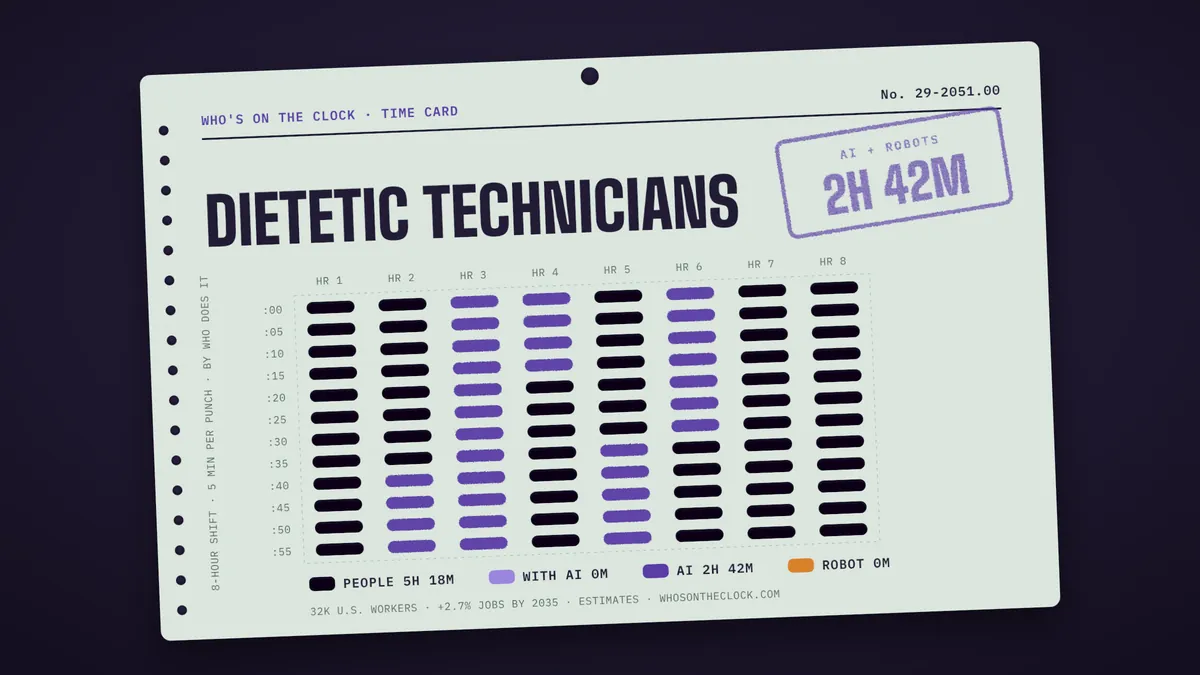
| Dietetic TechniciansConduct nutritional assessments of individuals, including obtaining and evaluating individuals' dietary histories, to plan nutritional programs. | 1h 40m | Often handed to AI |
| Medical Records SpecialistsIdentify, compile, abstract, and code patient data, using standard classification systems. | 1h 37m | Often handed to AI |
| Physician AssistantsObtain, compile, and record patient medical data, including health history, progress notes, and results of physical examination. | 1h 35m | No evidence yet |
| Family Medicine PhysiciansCollect, record, and maintain patient information, such as medical history, reports, or examination results. | 1h 34m | With AI |
| Health Information Technologists and Medical RegistrarsIdentify, compile, abstract, and code patient data, using standard classification systems. | 1h 34m | Often handed to AI |
| PsychiatristsGather and maintain patient information and records, including social or medical history obtained from patients, relatives, or other professionals. | 1h 23m | Often handed to AI |
| Emergency Medicine PhysiciansCollect and record patient information, such as medical history or examination results, in electronic or handwritten medical records. | 1h 21m | No evidence yet |
| General PediatriciansCollect, record, and maintain patient information, such as medical history, reports, or examination results. | 1h 11m | With AI |
| Obstetricians and GynecologistsCollect, record, and maintain patient information, such as medical histories, reports, or examination results. | 1h 9m | With AI |
| Ophthalmic Medical TechniciansTake and document patients' medical histories. | 1h 6m | With AI |
| Orthotists and ProsthetistsExamine, interview, and measure patients to determine their appliance needs and to identify factors that could affect appliance fit. | 1h 5m | No evidence yet |
| CardiologistsObtain and record patient information, including patient identification, medical history, and examination results. | 55m | With AI |
| NeurologistsInterview patients to obtain information, such as complaints, symptoms, medical histories, and family histories. | 54m | With AI |
| Naturopathic PhysiciansInterview patients to document symptoms and health histories. | 54m | No evidence yet |
| Ophthalmic Medical TechnologistsTake and document patients' medical histories. | 44m | With AI |
| Genetic CounselorsInterview patients or review medical records to obtain comprehensive patient or family medical histories, and document findings. | 39m | With AI |
| Cardiovascular Technologists and TechniciansObtain and record patient identification, medical history, or test results. | 38m | Often handed to AI |
| Magnetic Resonance Imaging TechnologistsConduct screening interviews of patients to identify contraindications, such as ferrous objects, pregnancy, prosthetic heart valves, cardiac pacemakers, or tattoos. | 37m | No evidence yet |
| Recreational TherapistsObtain information from medical records, medical staff, family members and the patients, themselves, to assess patients' capabilities, needs and interests. | 37m | No evidence yet |
| General Internal Medicine PhysiciansCollect, record, and maintain patient information, such as medical history, reports, or examination results. | 33m | With AI |
| AcupuncturistsCollect medical histories and general health and lifestyle information from patients. | 30m | With AI |
| Exercise PhysiologistsInterview participants to obtain medical history or assess participant goals. | 27m | No evidence yet |
| Neurodiagnostic TechnologistsIndicate artifacts or interferences derived from sources outside of the brain, such as poor electrode contact or patient movement, on electroneurodiagnostic recordings. | 25m | No evidence yet |
| RadiologistsObtain patients' histories from electronic records, patient interviews, dictated reports, or by communicating with referring clinicians. | 24m | No evidence yet |
| Nurse AnesthetistsPerform pre-anesthetic screenings, including physical evaluations and patient interviews, and document results. | 23m | No evidence yet |
| ChiropractorsObtain and record patients' medical histories. | 22m | Often handed to AI |
| Clinical Nurse SpecialistsObserve, interview, and assess patients to identify care needs. | 18m | No evidence yet |
| MidwivesObtain complete health and medical histories from patients including medical, surgical, reproductive, or mental health histories. | 16m | No evidence yet |
| Art TherapistsGather client information from sources such as case documentation, client observation, or interviews of client or family members. | 13m | No evidence yet |
| Music TherapistsGather diagnostic data from sources such as case documentation, observations of clients, or interviews with clients or family members. | 13m | No evidence yet |
| Psychiatric TechniciansInterview new patients to complete admission forms, to assess their mental health status, or to obtain their mental health and treatment history. | 13m | No evidence yet |
| Mental Health CounselorsAssess patients for risk of suicide attempts. | 12m | No evidence yet |
| Nursing AssistantsGather information from caregivers, nurses, or physicians about patient condition, treatment plans, or appropriate activities. | 7m | No evidence yet |
| PhlebotomistsDetermine donor suitability, according to interview results, vital signs, and medical history. | 7m | No evidence yet |
| Radiologic Technologists and TechniciansTake thorough and accurate patient medical histories. | 6m | With AI |
| Medical DosimetristsMeasure the amount of radioactivity in patients or equipment, using radiation monitoring devices. | under 1m | Robots |
How to read this
This task type comes from O*NET's detailed work activities, which link similar tasks across jobs. A label applies to one job's version of the task: AI use comes from real AI conversations (Anthropic Economic Index) and robot evidence from deployments in real workplaces. "No evidence yet" may just mean the task is rare in the data. How we keep time.
See all 250 shared tasks, or find any job on the big clock.