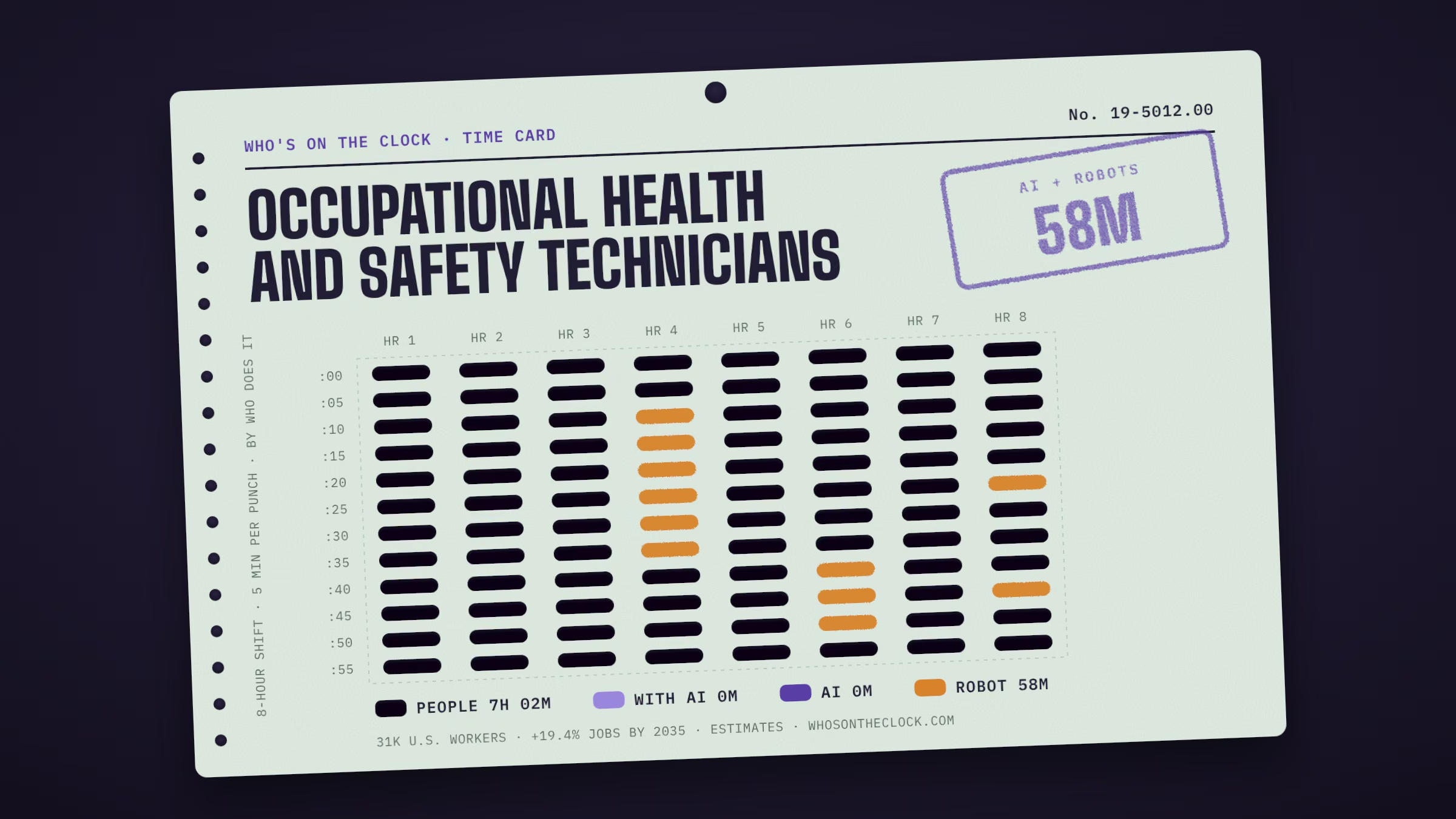
Collect data on work environments for analysis by occupational health and safety specialists. Implement and conduct evaluation of programs designed to limit chemical, physical, biological, and ergonomic risks to workers.
Time card
Untick tasks you don't do, or set your own times.
| Mine | Task, by time spent | Human | With AI | AI | Robot |
|---|---|---|---|---|---|
Test workplaces for environmental hazards, such as exposure to radiation, chemical or biological hazards, or excessive noise.1h 10m a shift · No AI or robot evidence foundWhy this label?This is physical work, and no robot has been shown doing it yet. How labels work | |||||
Maintain all required environmental records and documentation.45m a shift · No AI or robot evidence foundWhy this label?No AI use or robot deployment showed up for this task in our data. That isn't proof it's safe; it may just be rare in the data. How labels work | |||||
Supply, operate, or maintain personal protective equipment.38m a shift · Robots only in factory cellsWhy this label?Robots have done this only in factory setups built around the machine, so it stays Human for occupational health and safety technicians. How labels work | |||||
Provide consultation to organizations or agencies on the workplace application of safety principles, practices, or techniques.32m a shift · No AI or robot evidence foundWhy this label?No AI use or robot deployment showed up for this task in our data. That isn't proof it's safe; it may just be rare in the data. How labels work | |||||
Verify availability or monitor use of safety equipment, such as hearing protection or respirators.32m a shift · Robots deployed · e.g. Boston Dynamics Spot with Orbit AI visual inspectionWhy this label?Marked Robot because Boston Dynamics Spot with Orbit AI visual inspection (in real use) has done this task in a real workplace. It shows a robot can do it somewhere, not that most occupational health and safety technicians work alongside one. How labels work | |||||
Recommend corrective measures to be applied based on results of environmental contaminant analyses.32m a shift · No AI or robot evidence foundWhy this label?No AI use or robot deployment showed up for this task in our data. That isn't proof it's safe; it may just be rare in the data. How labels work | |||||
Review records or reports concerning laboratory results, staffing, floor plans, fire inspections, or sanitation to gather information for the development or enforcement of safety activities.32m a shift · No AI or robot evidence foundWhy this label?No AI use or robot deployment showed up for this task in our data. That isn't proof it's safe; it may just be rare in the data. How labels work | |||||
Prepare or calibrate equipment used to collect or analyze samples.26m a shift · Robots only in factory cellsWhy this label?Robots have done this only in factory setups built around the machine, so it stays Human for occupational health and safety technicians. How labels work | |||||
Maintain logbooks of daily activities, including areas visited or activities performed.19m a shift · No AI or robot evidence foundWhy this label?No AI use or robot deployment showed up for this task in our data. That isn't proof it's safe; it may just be rare in the data. How labels work | |||||
Train workers in safety procedures related to green jobs, such as the use of fall protection devices or maintenance of proper ventilation during wind turbine construction.13m a shift · No AI or robot evidence foundWhy this label?No AI use or robot deployment showed up for this task in our data. That isn't proof it's safe; it may just be rare in the data. How labels work | |||||
Inspect fire suppression systems or portable fire systems to ensure proper working order.13m a shift · Robots deployed · e.g. Spot (with Spot CAM+IR, EAP, MUVE C360)Why this label?Marked Robot because Spot (with Spot CAM+IR, EAP, MUVE C360) (in real use) has done this task in a real workplace. It shows a robot can do it somewhere, not that most occupational health and safety technicians work alongside one. How labels work | |||||
Prepare or review specifications or orders for the purchase of safety equipment, ensuring that proper features are present and that items conform to health and safety standards.13m a shift · No AI or robot evidence foundWhy this label?No AI use or robot deployment showed up for this task in our data. That isn't proof it's safe; it may just be rare in the data. How labels work | |||||
Conduct worker studies to determine whether specific instances of disease or illness are job-related.13m a shift · No AI or robot evidence foundWhy this label?No AI use or robot deployment showed up for this task in our data. That isn't proof it's safe; it may just be rare in the data. How labels work | |||||
Plan emergency response drills.13m a shift · No AI or robot evidence foundWhy this label?No AI use or robot deployment showed up for this task in our data. That isn't proof it's safe; it may just be rare in the data. How labels work | |||||
Educate the public about health issues or enforce health legislation to prevent disease, to promote health, or to help people understand health protection procedures and regulations.13m a shift · No AI or robot evidence foundWhy this label?No AI use or robot deployment showed up for this task in our data. That isn't proof it's safe; it may just be rare in the data. How labels work | |||||
Conduct interviews to obtain information or evidence regarding communicable diseases or violations of health or sanitation regulations.13m a shift · No AI or robot evidence foundWhy this label?No AI use or robot deployment showed up for this task in our data. That isn't proof it's safe; it may just be rare in the data. How labels work | |||||
Evaluate situations or make determinations when a worker has refused to work on the grounds that danger or potential harm exists.6m a shift · No AI or robot evidence foundWhy this label?No AI use or robot deployment showed up for this task in our data. That isn't proof it's safe; it may just be rare in the data. How labels work | |||||
Examine credentials, licenses, or permits to ensure compliance with licensing requirements.6m a shift · No AI or robot evidence foundWhy this label?No AI use or robot deployment showed up for this task in our data. That isn't proof it's safe; it may just be rare in the data. How labels work | |||||
Prepare documents to be used in legal proceedings, testifying in such proceedings when necessary.6m a shift · No AI or robot evidence foundWhy this label?No AI use or robot deployment showed up for this task in our data. That isn't proof it's safe; it may just be rare in the data. How labels work | |||||
Collect data regarding potential hazards from new equipment or products linked to green practices.6m a shift · Robots deployed · e.g. Boston Dynamics Spot with FLIR MUVE C360 gas sensor and Spot CAM+IR (MFE Inspection Solutions integration)Why this label?Marked Robot because Boston Dynamics Spot with FLIR MUVE C360 gas sensor and Spot CAM+IR (MFE Inspection Solutions integration) (in real use) has done this task in a real workplace. It shows a robot can do it somewhere, not that most occupational health and safety technicians work alongside one. How labels work | |||||
Help direct rescue or firefighting operations in the event of a fire or an explosion.6m a shift · No AI or robot evidence foundWhy this label?No AI use or robot deployment showed up for this task in our data. That isn't proof it's safe; it may just be rare in the data. How labels work | |||||
Test or balance newly installed HVAC systems to determine whether indoor air quality standards are met.6m a shift · Robots only in factory cellsWhy this label?Robots have done this only in factory setups built around the machine, so it stays Human for occupational health and safety technicians. How labels work | |||||
Confer with schools, state authorities, or community groups to develop health standards or programs.6m a shift · No AI or robot evidence foundWhy this label?No AI use or robot deployment showed up for this task in our data. That isn't proof it's safe; it may just be rare in the data. How labels work | |||||
Collect data related to ecological or human health risks at brownfield sites.6m a shift · Robots deployed · e.g. Spot with FLIR MUVE C360 and CAM+IR, Enhanced Autonomy PayloadWhy this label?Marked Robot because Spot with FLIR MUVE C360 and CAM+IR, Enhanced Autonomy Payload (in real use) has done this task in a real workplace. It shows a robot can do it somewhere, not that most occupational health and safety technicians work alongside one. How labels work | |||||
Perform tests to identify any potential hazards related to recycled products used at green building sites.6m a shift · Robots only in factory cellsWhy this label?Robots have done this only in factory setups built around the machine, so it stays Human for occupational health and safety technicians. How labels work | |||||
Examine practices at green building sites to determine whether adherence to green building standards alters risks to workers.6m a shift · No AI or robot evidence foundWhy this label?This is physical work, and no robot has been shown doing it yet. How labels work |