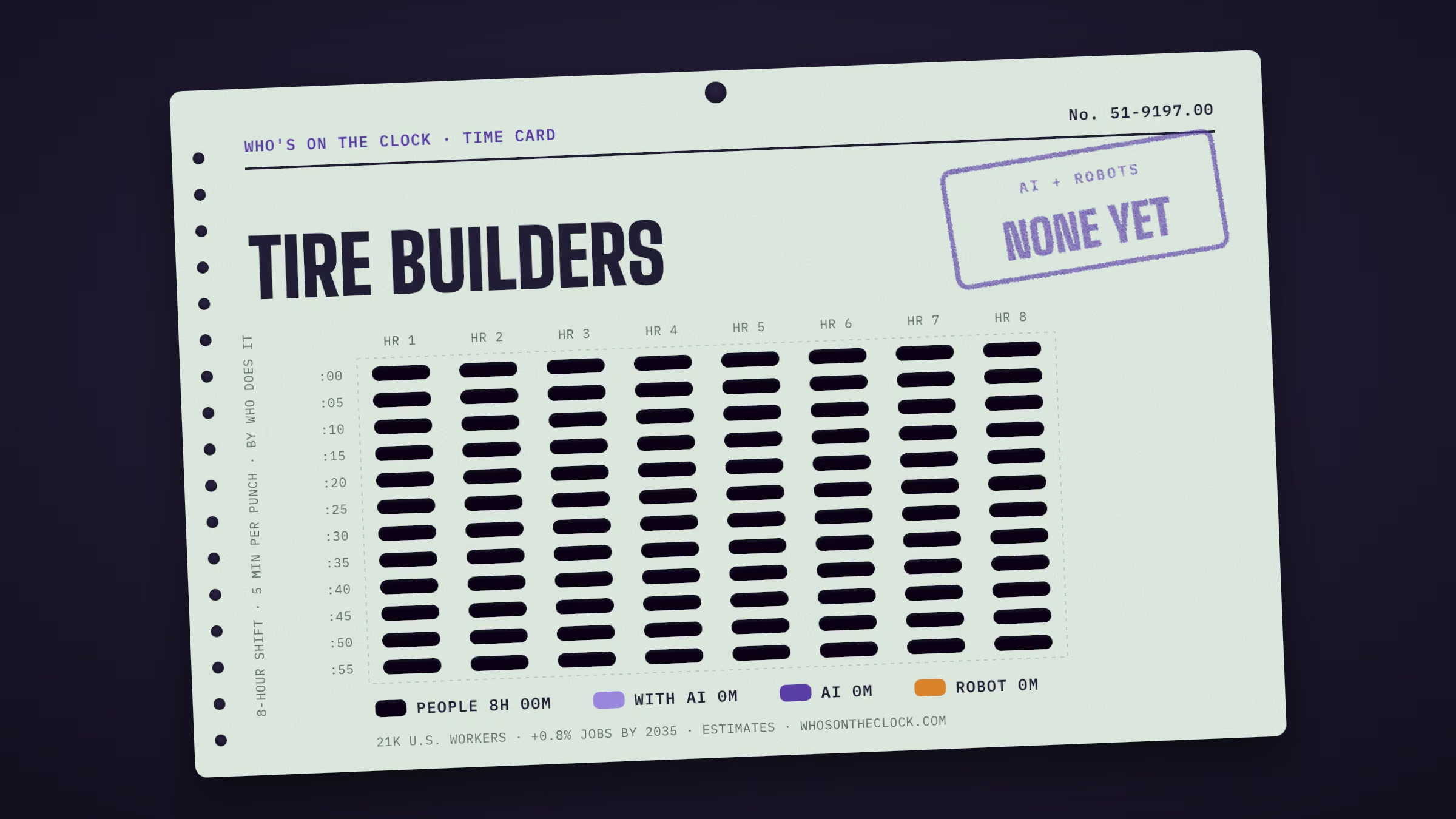
Not on current evidence. Less than 30 minutes of a typical shift goes to tasks that AI or robots are doing today. The other 8h (100%) stays with people. Separately, BLS expects about 0.8% more of these jobs by 2035 (all jobs: +3.5%).
⤢ Full sizeEach mark is 5 minutes of a typical shift for tire builders, colored by who does that task today. Estimates from O*NET tasks and Anthropic Economic Index data. How it's made
Depress pedals to rotate drums, and wind specified numbers of plies around drums to form tire bodies.1h 4m a shift · Robots only in factory cells
Build semi-raw rubber treads onto buffed tire casings to prepare tires for vulcanization in recapping or retreading processes.51m a shift · Robots only in factory cells
Buff tires according to specifications for width and undertread depth.38m a shift · Robots only in factory cells
Align treads with guides, start drums to wind treads onto plies, and slice ends.32m a shift · Robots only in factory cells
Pull plies from supply racks, and align plies with edges of drums.32m a shift · Robots only in factory cells
Start rollers that bond tread and plies as drums revolve.26m a shift · Robots only in factory cells
Inspect worn tires for faults, cracks, cuts, and nail holes, and to determine if tires are suitable for retreading.26m a shift · Robots only in factory cells
Cut plies at splice points, and press ends together to form continuous bands.26m a shift · Robots only in factory cells
Trim excess rubber and imperfections during retreading processes.19m a shift · Robots only in factory cells
Fill cuts and holes in tires, using hot rubber.19m a shift · Robots only in factory cells
Place tires into molds for new tread.19m a shift · Robots only in factory cells
Fit inner tubes and final layers of rubber onto tires.19m a shift · Robots only in factory cells
Brush or spray solvents onto plies to ensure adhesion, and repeat process as specified, alternating direction of each ply to strengthen tires.19m a shift · Robots only in factory cells
Position ply stitcher rollers and drums according to width of stock, using hand tools and gauges.19m a shift · Robots only in factory cells
Wind chafers and breakers onto plies.19m a shift · Robots only in factory cells
Roll hand rollers over rebuilt casings, exerting pressure to ensure adhesion between camelbacks and casings.13m a shift · Robots only in factory cells
Rub cement sticks on drum edges to provide adhesive surfaces for plies.13m a shift · Robots only in factory cells
Depress pedals to collapse drums after processing is complete.13m a shift · Robots only in factory cells
Measure tires to determine mold size requirements.6m a shift · Robots only in factory cells
Clean and paint completed tires.6m a shift · Robots only in factory cells
On the floor
No company news tracked for this job yet. New stories are added as they happen.
Ask the clock
Will AI replace tire builders?
Not on current evidence. Less than 30 minutes of a typical shift goes to tasks that AI or robots are doing today. The other 8h (100%) stays with people. Separately, BLS expects about 0.8% more of these jobs by 2035 (all jobs: +3.5%).
What can AI already do for tire builders?
None of this job's tasks show regular AI use yet. That can mean the work is hands-on or in person, or simply that it rarely comes up in AI usage data.
Where do robots fit in?
Not in workplaces like this one, based on a 2026 review of robot deployments. 20 more tasks have only been done in factory setups built around the machine, so they stay with people here.
What still needs a person?
8h of a typical shift, or 100%, goes to tasks with no AI or robot evidence yet. No AI usage or robot deployment has shown up for these so far. The biggest:
Depress pedals to rotate drums, and wind specified numbers of plies around drums to form tire bodies. (1h 4m a shift)
Build semi-raw rubber treads onto buffed tire casings to prepare tires for vulcanization in recapping or retreading processes. (51m a shift)
Buff tires according to specifications for width and undertread depth. (38m a shift)
Align treads with guides, start drums to wind treads onto plies, and slice ends. (32m a shift)
Pull plies from supply racks, and align plies with edges of drums. (32m a shift)
Why is that work hard to automate?
Much of it comes down to where and how the work happens. In-person, hands-on and high-stakes work is where AI and robots have made the least headway so far. In the official O*NET survey of people in this job:
100% spend more than half the day on their feet
97% use their hands on tools, objects or controls more than half the time
76% work at arm's length or closer to other people
Are employers still hiring tire builders?
On Indeed, job postings in the Production & Manufacturing sector are at 124% of their February 2020 level (all U.S. postings: 104%), up 12.6% from a year earlier, as of Oct 9, 2026. BLS separately expects about 1,900 openings a year in this job through 2035. Across all U.S. postings, 7.3% now mention AI skills. Sector postings cover more than this one job and move for many reasons besides AI.
How much do tire builders make?
The median pay is about $57,390 a year ($27.59 an hour), 13% above the median for all U.S. jobs ($50,980). Most people in this job earn between $40,150 and $74,680 a year; that range covers the middle 80%. Pay figures are from BLS, May 2025, and vary a lot by state and employer. Pick a state to compare:
Is this job growing or shrinking?
BLS projects growth of 0.8% from 2025 to 2035, compared with 3.5% growth for all jobs. That's about 21,000 jobs in 2035. It expects about 1,900 openings a year, mostly from people retiring or changing careers. These projections don't single out AI as a cause.
How many tire builders are there in the U.S.?
About 21,000 people in the U.S., roughly 0.01% of all workers (BLS, May 2025). That makes it the 542nd largest of the 796 jobs on this site. BLS expects about 21,000 in 2035.
What training do tire builders need?
The most common requirement is a high school diploma: about 66% of people in the job said so in the official O*NET survey. O*NET rates the job at level 2 of 5 for preparation, which usually means: high school diploma, some training. Requirements vary by state and employer, especially for licensed work.
What should I learn to stay ahead of AI?
These come from the job's official skill ratings and from the tasks that AI and robots touch least today. Building them keeps you strong in the parts of the work that still need a person:
Skills that matter more here than in most jobs: Operation and Control, Operations Monitoring, Monitoring, Critical Thinking
Get strong at the parts of the job that stay with people (listed above), which take 8h of a typical shift
Tools employers list: Microsoft Excel, Microsoft Office software, Microsoft Outlook, Microsoft PowerPoint, Microsoft Project
What other jobs could tire builders move into?
These use similar skills. Matches come from 109 official ratings of skills, knowledge and work activities, and each needs the same or less preparation unless the official list relates the jobs directly:
Structural Metal Fabricators and Fitters (0m touched, $51k median pay)
Textile Knitting and Weaving Machine Setters, Operators, and Tenders (3h 1m touched, $40k median pay)
Welding, Soldering, and Brazing Machine Setters, Operators, and Tenders (53m touched, $48k median pay)
Molders, Shapers, and Casters (6m touched, $46k median pay)
Cleaning, Washing, and Metal Pickling Equipment Operators and Tenders (2h 36m touched, $44k median pay)
How solid are these numbers?
Each task carries its own evidence label. For this job: 20 with no AI or robot evidence found. The minutes per task are estimates, not measured hours, and "no evidence" doesn't prove a task is safe.