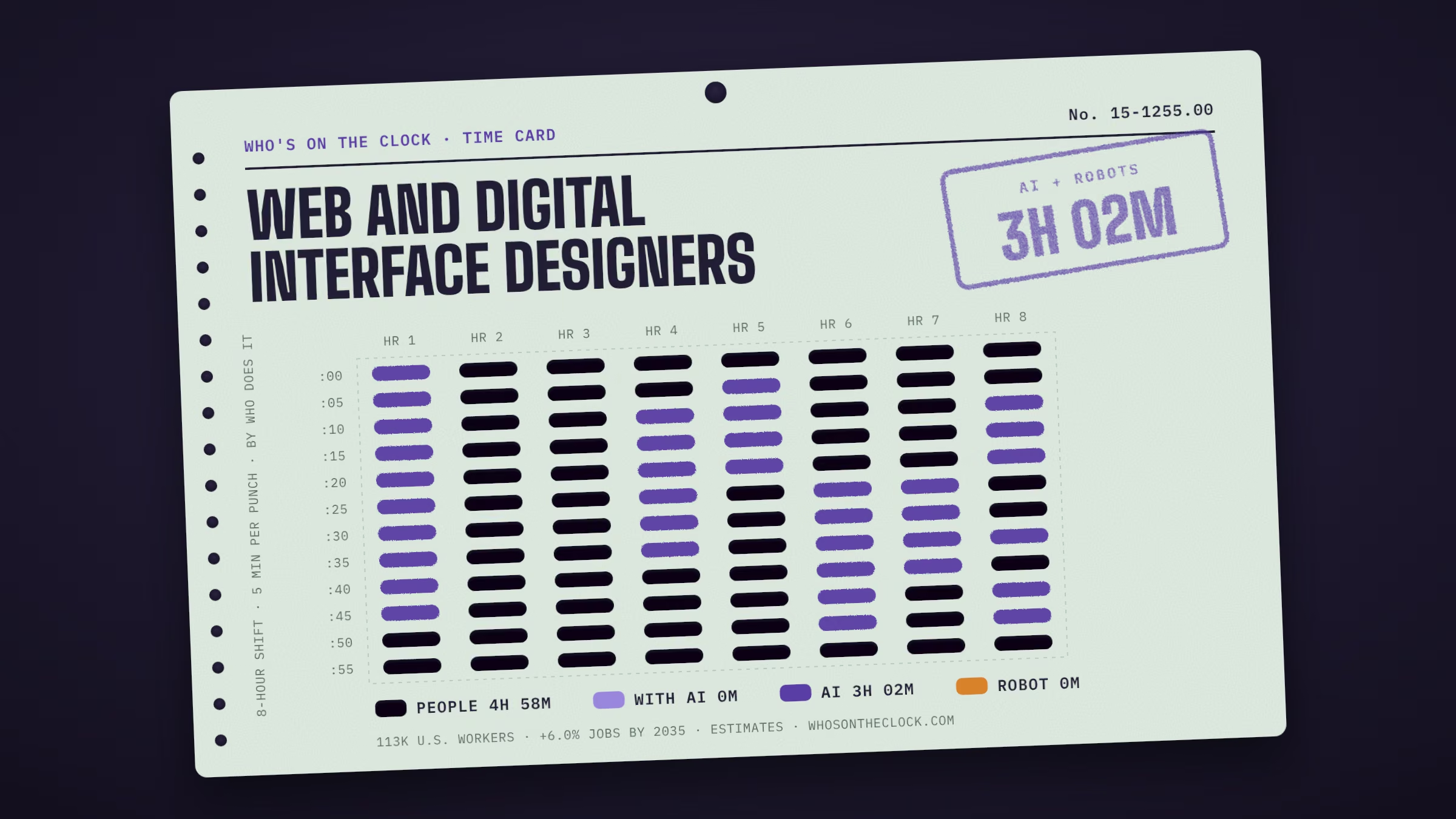
Design digital user interfaces or websites. Develop and test layouts, interfaces, functionality, and navigation menus to ensure compatibility and usability across browsers or devices. May use web framework applications as well as client-side code and processes. May evaluate web design following web and accessibility standards, and may analyze web use metrics and optimize websites for marketability and search engine ranking. May design and test interfaces that facilitate the human-computer interaction and maximize the usability of digital devices, websites, and software with a focus on aesthetics and design. May create graphics used in websites and manage website content and links.
Time card
Untick tasks you don't do, or set your own times.
| Mine | Task, by time spent | Human | With AI | AI | Robot |
|---|---|---|---|---|---|
Design, build, or maintain Web sites, using authoring or scripting languages, content creation tools, management tools, and digital media.49m a shift · Observed in AI useTypical AI request: about 9h 55m alone, 40m with AIWhy this label?Marked AI because this task shows up regularly in real AI conversations (Anthropic Economic Index, 2025 usage), and in most of them AI does the task on its own rather than helping a person. Many workplaces may not use AI for it at all. How labels work | |||||
Develop new visual design concepts and modify concepts based on stakeholder feedback.43m a shift · No AI or robot evidence foundWhy this label?No AI use or robot deployment showed up for this task in our data. That isn't proof it's safe; it may just be rare in the data. How labels work | |||||
Create Web models or prototypes that include physical, interface, logical, or data models.36m a shift · No AI or robot evidence foundWhy this label?No AI use or robot deployment showed up for this task in our data. That isn't proof it's safe; it may just be rare in the data. How labels work | |||||
Collaborate with web development professionals, such as front-end or back-end developers, to complete the full scope of Web development projects.30m a shift · No AI or robot evidence foundWhy this label?No AI use or robot deployment showed up for this task in our data. That isn't proof it's safe; it may just be rare in the data. How labels work | |||||
Conduct user research to determine design requirements and analyze user feedback to improve design quality.30m a shift · No AI or robot evidence foundWhy this label?No AI use or robot deployment showed up for this task in our data. That isn't proof it's safe; it may just be rare in the data. How labels work | |||||
Write supporting code for Web applications or Web sites.30m a shift · Observed in AI useTypical AI request: about 11h 26m alone, 46m with AIWhy this label?Marked AI because this task shows up regularly in real AI conversations (Anthropic Economic Index, 2025 usage), and in most of them AI does the task on its own rather than helping a person. Many workplaces may not use AI for it at all. How labels work | |||||
Confer with management or development teams to prioritize needs, resolve conflicts, develop content criteria, or choose solutions.24m a shift · No AI or robot evidence foundWhy this label?No AI use or robot deployment showed up for this task in our data. That isn't proof it's safe; it may just be rare in the data. How labels work | |||||
Develop Web site maps, application models, image templates, or page templates that meet project goals, user needs, or industry standards.18m a shift · Observed in AI useTypical AI request: about 8h 20m alone, 29m with AIWhy this label?Marked AI because this task shows up regularly in real AI conversations (Anthropic Economic Index, 2025 usage), and in most of them AI does the task on its own rather than helping a person. Many workplaces may not use AI for it at all. How labels work | |||||
Identify problems uncovered by testing or customer feedback, and correct problems or refer problems to appropriate personnel for correction.18m a shift · No AI or robot evidence foundWhy this label?No AI use or robot deployment showed up for this task in our data. That isn't proof it's safe; it may just be rare in the data. How labels work | |||||
Perform or direct Web site updates.18m a shift · No AI or robot evidence foundWhy this label?No AI use or robot deployment showed up for this task in our data. That isn't proof it's safe; it may just be rare in the data. How labels work | |||||
Perform Web site tests according to planned schedules, or after any Web site or product revision.18m a shift · No AI or robot evidence foundWhy this label?No AI use or robot deployment showed up for this task in our data. That isn't proof it's safe; it may just be rare in the data. How labels work | |||||
Collaborate with management or users to develop e-commerce strategies and to integrate these strategies with Web sites.12m a shift · Observed in AI useWhy this label?Marked AI because this task shows up regularly in real AI conversations (Anthropic Economic Index, 2025 usage), and in most of them AI does the task on its own rather than helping a person. Many workplaces may not use AI for it at all. How labels work | |||||
Develop and document style guidelines for Web site content.12m a shift · Observed in AI useTypical AI request: about 8h 58m alone, 56m with AIWhy this label?Marked AI because this task shows up regularly in real AI conversations (Anthropic Economic Index, 2025 usage), and in most of them AI does the task on its own rather than helping a person. Many workplaces may not use AI for it at all. How labels work | |||||
Direct and execute pre-production activities, such as creating moodboards or storyboards and establishing a project timeline.12m a shift · No AI or robot evidence foundWhy this label?No AI use or robot deployment showed up for this task in our data. That isn't proof it's safe; it may just be rare in the data. How labels work | |||||
Incorporate technical considerations into Web site design plans, such as budgets, equipment, performance requirements, or legal issues including accessibility and privacy.12m a shift · No AI or robot evidence foundWhy this label?No AI use or robot deployment showed up for this task in our data. That isn't proof it's safe; it may just be rare in the data. How labels work | |||||
Maintain understanding of current Web technologies or programming practices through continuing education, reading, or participation in professional conferences, workshops, or groups.12m a shift · Observed in AI useWhy this label?Marked AI because this task shows up regularly in real AI conversations (Anthropic Economic Index, 2025 usage), and in most of them AI does the task on its own rather than helping a person. Many workplaces may not use AI for it at all. How labels work | |||||
Provide clear, detailed descriptions of Web site specifications, such as product features, activities, software, communication protocols, programming languages, and operating systems software and hardware.12m a shift · Observed in AI useTypical AI request: about 9h 15m alone, 1h with AIWhy this label?Marked AI because this task shows up regularly in real AI conversations (Anthropic Economic Index, 2025 usage), and in most of them AI does the task on its own rather than helping a person. Many workplaces may not use AI for it at all. How labels work | |||||
Research and apply innovative solutions for product design, visuals, and user experience to meet the needs of individual Web development projects.12m a shift · No AI or robot evidence foundWhy this label?No AI use or robot deployment showed up for this task in our data. That isn't proof it's safe; it may just be rare in the data. How labels work | |||||
Write and edit technical documentation for digital interface products and designs, such as user manuals, testing protocols, and reports.12m a shift · No AI or robot evidence foundWhy this label?No AI use or robot deployment showed up for this task in our data. That isn't proof it's safe; it may just be rare in the data. How labels work | |||||
Communicate with network personnel or Web site hosting agencies to address hardware or software issues affecting Web sites.6m a shift · No AI or robot evidence foundWhy this label?No AI use or robot deployment showed up for this task in our data. That isn't proof it's safe; it may just be rare in the data. How labels work | |||||
Create searchable indices for Web page content.6m a shift · Observed in AI useWhy this label?Marked AI because this task shows up regularly in real AI conversations (Anthropic Economic Index, 2025 usage), and in most of them AI does the task on its own rather than helping a person. Many workplaces may not use AI for it at all. How labels work | |||||
Develop or implement procedures for ongoing Web site revision.6m a shift · Observed in AI useTypical AI request: about 9h 10m alone, 1h 9m with AIWhy this label?Marked AI because this task shows up regularly in real AI conversations (Anthropic Economic Index, 2025 usage), and in most of them AI does the task on its own rather than helping a person. Many workplaces may not use AI for it at all. How labels work | |||||
Develop system interaction or sequence diagrams.6m a shift · Observed in AI useTypical AI request: about 5h 56m alone, 28m with AIWhy this label?Marked AI because this task shows up regularly in real AI conversations (Anthropic Economic Index, 2025 usage), and in most of them AI does the task on its own rather than helping a person. Many workplaces may not use AI for it at all. How labels work | |||||
Develop, validate, and document test routines and schedules to ensure that test cases mimic external interfaces and address all browser and device types.6m a shift · No AI or robot evidence foundWhy this label?No AI use or robot deployment showed up for this task in our data. That isn't proof it's safe; it may just be rare in the data. How labels work | |||||
Document technical factors such as server load, bandwidth, database performance, and browser and device types.6m a shift · No AI or robot evidence foundWhy this label?No AI use or robot deployment showed up for this task in our data. That isn't proof it's safe; it may just be rare in the data. How labels work | |||||
Identify or maintain links to and from other Web sites and check links to ensure proper functioning.6m a shift · Observed in AI useTypical AI request: about 4h 22m alone, 22m with AIWhy this label?Marked AI because this task shows up regularly in real AI conversations (Anthropic Economic Index, 2025 usage), and in most of them AI does the task on its own rather than helping a person. Many workplaces may not use AI for it at all. How labels work | |||||
Register Web sites with search engines to increase Web site traffic.6m a shift · No AI or robot evidence foundWhy this label?No AI use or robot deployment showed up for this task in our data. That isn't proof it's safe; it may just be rare in the data. How labels work | |||||
Research, document, rate, or select alternatives for Web architecture or technologies.6m a shift · Observed in AI useTypical AI request: about 7h 11m alone, 43m with AIWhy this label?Marked AI because this task shows up regularly in real AI conversations (Anthropic Economic Index, 2025 usage), and in most of them AI does the task on its own rather than helping a person. Many workplaces may not use AI for it at all. How labels work | |||||
Respond to user email inquiries, or set up automated systems to send responses.6m a shift · Observed in AI useTypical AI request: about 2h 43m alone, 41m with AIWhy this label?Marked AI because this task shows up regularly in real AI conversations (Anthropic Economic Index, 2025 usage), and in most of them AI does the task on its own rather than helping a person. Many workplaces may not use AI for it at all. How labels work | |||||
Select programming languages, design tools, or applications.6m a shift · No AI or robot evidence foundWhy this label?No AI use or robot deployment showed up for this task in our data. That isn't proof it's safe; it may just be rare in the data. How labels work |