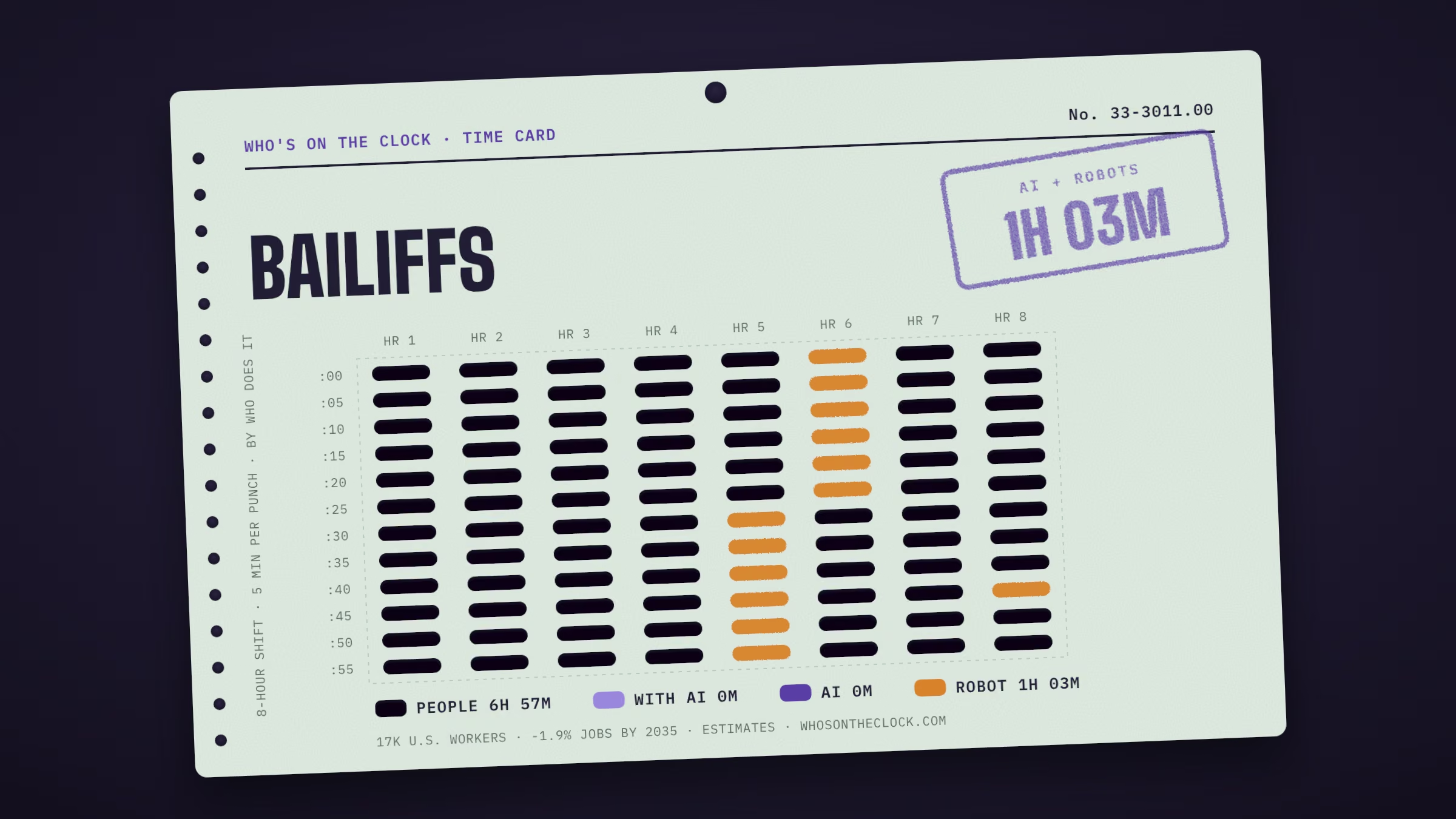
Unlikely, though parts of the work are changing. About 1h 3m of an 8-hour shift goes to tasks touched by robots. The other 6h 57m (87%) stays with people. Separately, BLS expects about 1.9% fewer of these jobs by 2035 (all jobs: +3.5%).
⤢ Full sizeEach mark is 5 minutes of a typical shift for bailiffs, colored by who does that task today. Estimates from O*NET tasks and Anthropic Economic Index data. How it's made
Maintain order in courtroom during trial and guard jury from outside contact.2h 19m a shift · No AI or robot evidence found
Screen persons entering courthouse using magnetometers, x-ray machines, and other devices to collect and retain unauthorized firearms and other contraband.1h 3m a shift · No AI or robot evidence found
Escort prisoners to and from courthouse and maintain custody of prisoners during court proceedings.1h 3m a shift · No AI or robot evidence found
Provide security by patrolling interior and exterior of courthouse and escorting judges and other court employees.57m a shift · Robots deployed · e.g. Knightscope K5
Check courtroom for security and cleanliness and assure availability of sundry supplies, such as notepads, for use by judge, jurors, and attorneys.32m a shift · Robots only in factory cells
Provide assistance to the public, such as directions to court offices.32m a shift · No AI or robot evidence found
Enforce courtroom rules of behavior and warn persons not to smoke or disturb court procedure.25m a shift · No AI or robot evidence found
Screen, control, and handle evidence and exhibits during court proceedings.19m a shift · Robots only in factory cells
Maintain court docket.19m a shift · No AI or robot evidence found
Arrest persons in court when arrest warrants have been issued.6m a shift · No AI or robot evidence found
Report need for police or medical assistance to sheriff's office.6m a shift · No AI or robot evidence found
Announce entrance of judge.6m a shift · No AI or robot evidence found
Provide jury escort to restaurant and other areas outside of courtroom to prevent jury contact with public.6m a shift · No AI or robot evidence found
Guard lodging of sequestered jury.time not estimated · No AI or robot evidence found
On the floor
No company news tracked for this job yet. New stories are added as they happen.
Ask the clock
Will AI replace bailiffs?
Unlikely, though parts of the work are changing. About 1h 3m of an 8-hour shift goes to tasks touched by robots. The other 6h 57m (87%) stays with people. Separately, BLS expects about 1.9% fewer of these jobs by 2035 (all jobs: +3.5%).
What can AI already do for bailiffs?
None of this job's tasks show regular AI use yet. That can mean the work is hands-on or in person, or simply that it rarely comes up in AI usage data.
Where do robots fit in?
For some tasks, yes. Robots have done 2 of this job's tasks in workplaces like this one, about 1h 3m of a typical shift. 2 more tasks have only been done in factory setups built around the machine, so they stay with people here. For 7 physical tasks, no robot has shown it can do the work yet.
Provide security by patrolling interior and exterior of courthouse and escorting judges and other court employees. (57m a shift; e.g. Knightscope K5, in use)
Stop people from entering courtroom while judge charges jury. (6m a shift; e.g. Security revolving doors / mantrap portals (Capability Level 4 security entrances), in use)
What still needs a person?
6h 57m of a typical shift, or 87%, goes to tasks with no AI or robot evidence yet. No AI usage or robot deployment has shown up for these so far. The biggest:
Maintain order in courtroom during trial and guard jury from outside contact. (2h 19m a shift)
Screen persons entering courthouse using magnetometers, x-ray machines, and other devices to collect and retain unauthorized firearms and other contraband. (1h 3m a shift)
Escort prisoners to and from courthouse and maintain custody of prisoners during court proceedings. (1h 3m a shift)
Check courtroom for security and cleanliness and assure availability of sundry supplies, such as notepads, for use by judge, jurors, and attorneys. (32m a shift)
Provide assistance to the public, such as directions to court offices. (32m a shift)
Why is that work hard to automate?
Much of it comes down to where and how the work happens. In-person, hands-on and high-stakes work is where AI and robots have made the least headway so far. In the official O*NET survey of people in this job:
80% are in constant contact with other people
70% talk face to face with others every day
67% work at arm's length or closer to other people
Are employers still hiring bailiffs?
On Indeed, job postings in the Security & Public Safety sector are at 119% of their February 2020 level (all U.S. postings: 104%), up 4.4% from a year earlier, as of Oct 9, 2026. BLS separately expects about 1,600 openings a year in this job through 2035. Across all U.S. postings, 7.3% now mention AI skills. Sector postings cover more than this one job and move for many reasons besides AI.
How much do bailiffs make?
The median pay is about $56,600 a year ($27.21 an hour), 11% above the median for all U.S. jobs ($50,980). Most people in this job earn between $32,140 and $96,770 a year; that range covers the middle 80%. Pay figures are from BLS, May 2025, and vary a lot by state and employer. Pick a state to compare:
Is this job growing or shrinking?
BLS projects a decline of 1.9% from 2025 to 2035, compared with 3.5% growth for all jobs. That's about 18,000 jobs in 2035. Even so, it expects about 1,600 openings a year, mostly from people retiring or changing careers. These projections don't single out AI as a cause.
How many bailiffs are there in the U.S.?
About 17,000 people in the U.S., roughly 0.01% of all workers (BLS, May 2025). That makes it the 573rd largest of the 796 jobs on this site. BLS expects about 18,000 in 2035.
What training do bailiffs need?
The most common requirement is a high school diploma: about 40% of people in the job said so in the official O*NET survey. O*NET rates the job at level 3 of 5 for preparation, which usually means: vocational school or associate's degree. Requirements vary by state and employer, especially for licensed work.
What should I learn to stay ahead of AI?
These come from the job's official skill ratings and from the tasks that AI and robots touch least today. Building them keeps you strong in the parts of the work that still need a person:
Skills that matter more here than in most jobs: Social Perceptiveness, Monitoring, Judgment and Decision Making, Time Management
Get strong at the parts of the job that stay with people (listed above), which take 6h 57m of a typical shift
Tools employers list: Microsoft Office software, Adobe Acrobat, Microsoft Access, Microsoft Excel, Microsoft Outlook
What other jobs could bailiffs move into?
These use similar skills, with less of a typical shift touched by AI or robots. Matches come from 109 official ratings of skills, knowledge and work activities, and each needs the same or less preparation unless the official list relates the jobs directly:
Probation Officers and Correctional Treatment Specialists (0m touched, $66k median pay)
Correctional Officers and Jailers (5m touched, $59k median pay)
How solid are these numbers?
Each task carries its own evidence label. For this job: 2 with robots in real deployments, 13 with no AI or robot evidence found. The minutes per task are estimates, not measured hours, and "no evidence" doesn't prove a task is safe.