Will AI replace probation officers and correctional treatment specialists?

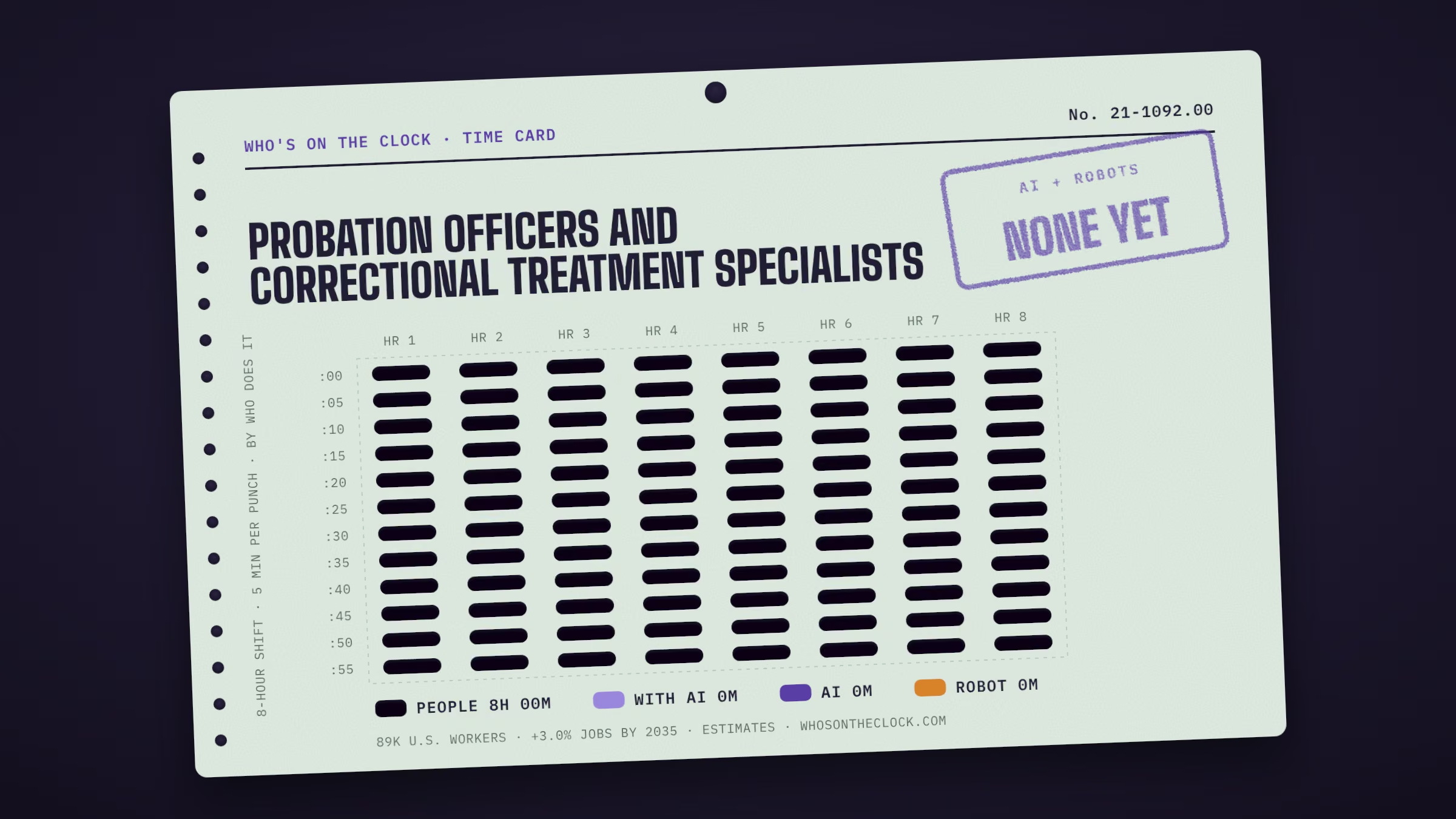
Not on current evidence. Less than 30 minutes of a typical shift goes to tasks that AI or robots are doing today. The other 8h (100%) stays with people. Separately, BLS expects about 3% more of these jobs by 2035 (all jobs: +3.5%).

Time card for probation officers and correctional treatment specialists showing a typical 8-hour shift: 8h done by people.
Each mark is 5 minutes of a typical shift for probation officers and correctional treatment specialists, colored by who does that task today. Estimates from O*NET tasks and Anthropic Economic Index data. How it's made

Home / Social services / Probation Officers and Correctional Treatment Specialists

Provide social services to assist in rehabilitation of law offenders in custody or on probation or parole. Make recommendations for actions involving formulation of rehabilitation plan and treatment of offender, including conditional release and education and employment stipulations.

Time card

Untick tasks you don't do, or set your own times.
MineTask, by time spentHumanWith AIAIRobot
Prepare and maintain case folder for each assigned inmate or offender.1h 4m a shift · No AI or robot evidence found
Interview probationers and parolees regularly to evaluate their progress in accomplishing goals and maintaining the terms specified in their probation contracts and rehabilitation plans.1h 4m a shift · No AI or robot evidence found
Supervise people on community-based sentences, such as electronically monitored home detention, and provide field supervision of probationers by conducting curfew checks or visits to home, work, or school.53m a shift · No AI or robot evidence found
Conduct prehearing and presentencing investigations and testify in court regarding offenders' backgrounds and recommended sentences and sentencing conditions.35m a shift · No AI or robot evidence found
Write reports describing offenders' progress.29m a shift · No AI or robot evidence found
Gather information about offenders' backgrounds by talking to offenders, their families and friends, and other people who have relevant information.23m a shift · No AI or robot evidence found
Investigate alleged parole violations, using interviews, surveillance, and search and seizure.23m a shift · No AI or robot evidence found
Recommend remedial action or initiate court action in response to noncompliance with terms of probation or parole.23m a shift · No AI or robot evidence found
Arrange for medical, mental health, or substance abuse treatment services according to individual needs or court orders.23m a shift · No AI or robot evidence found
Administer drug and alcohol tests, including random drug screens of offenders, to verify compliance with substance abuse treatment programs.23m a shift · Robots only in factory cells
Develop rehabilitation programs for assigned offenders or inmates, establishing rules of conduct, goals, and objectives.23m a shift · No AI or robot evidence found
Discuss with offenders how such issues as drug and alcohol abuse and anger management problems might have played roles in their criminal behavior.18m a shift · No AI or robot evidence found
Develop liaisons and networks with other parole officers, community agencies, correctional institutions, psychiatric facilities, and aftercare agencies to plan for helping offenders with life adjustments.18m a shift · No AI or robot evidence found
Inform offenders or inmates of requirements of conditional release, such as office visits, restitution payments, or educational and employment stipulations.18m a shift · No AI or robot evidence found
Arrange for postrelease services, such as employment, housing, counseling, education, and social activities.12m a shift · No AI or robot evidence found
Participate in decisions about whether cases should go before courts and which court should hear them.6m a shift · No AI or robot evidence found
Provide offenders or inmates with assistance in matters concerning detainers, sentences in other jurisdictions, writs, and applications for social assistance.6m a shift · No AI or robot evidence found
Develop and prepare packets containing information about social service agencies, assistance organizations, and programs that might be useful for inmates or offenders.6m a shift · No AI or robot evidence found
Assess the suitability of penitentiary inmates for release under parole and statutory release programs and submit recommendations to parole boards.6m a shift · No AI or robot evidence found
Identify and approve work placements for offenders with community service sentences.6m a shift · No AI or robot evidence found
Recommend appropriate penitentiary for initial placement of an offender.time not estimated · No AI or robot evidence found

On the floor

No company news tracked for this job yet. New stories are added as they happen.

Ask the clock

Will AI replace probation officers and correctional treatment specialists?

Not on current evidence. Less than 30 minutes of a typical shift goes to tasks that AI or robots are doing today. The other 8h (100%) stays with people. Separately, BLS expects about 3% more of these jobs by 2035 (all jobs: +3.5%).

What can AI already do for probation officers and correctional treatment specialists?

None of this job's tasks show regular AI use yet. That can mean the work is hands-on or in person, or simply that it rarely comes up in AI usage data.

Where do robots fit in?

Not in workplaces like this one, based on a 2026 review of robot deployments. 1 more task has only been done in factory setups built around the machine, so it stays with people here. For 2 physical tasks, no robot has shown it can do the work yet.

What still needs a person?

8h of a typical shift, or 100%, goes to tasks with no AI or robot evidence yet. No AI usage or robot deployment has shown up for these so far. The biggest:

  • Prepare and maintain case folder for each assigned inmate or offender. (1h 4m a shift)
  • Interview probationers and parolees regularly to evaluate their progress in accomplishing goals and maintaining the terms specified in their probation contracts and rehabilitation plans. (1h 4m a shift)
  • Supervise people on community-based sentences, such as electronically monitored home detention, and provide field supervision of probationers by conducting curfew checks or visits to home, work, or school. (53m a shift)
  • Conduct prehearing and presentencing investigations and testify in court regarding offenders' backgrounds and recommended sentences and sentencing conditions. (35m a shift)
  • Write reports describing offenders' progress. (29m a shift)
Why is that work hard to automate?

Much of it comes down to where and how the work happens. In-person, hands-on and high-stakes work is where AI and robots have made the least headway so far. In the official O*NET survey of people in this job:

  • 96% are in constant contact with other people
  • 93% say dealing with the public is very or extremely important
  • 86% handle conflict at least once a week
Are employers still hiring probation officers and correctional treatment specialists?

On Indeed, job postings in the Community & Social Service sector are at 105% of their February 2020 level (all U.S. postings: 104%), down 6.2% from a year earlier, as of Oct 9, 2026. BLS separately expects about 7,900 openings a year in this job through 2035. Across all U.S. postings, 7.3% now mention AI skills. Sector postings cover more than this one job and move for many reasons besides AI.

How much do probation officers and correctional treatment specialists make?

The median pay is about $66,270 a year ($31.86 an hour), 30% above the median for all U.S. jobs ($50,980). Most people in this job earn between $46,840 and $107,790 a year; that range covers the middle 80%. Pay figures are from BLS, May 2025, and vary a lot by state and employer. Pick a state to compare:

Is this job growing or shrinking?

BLS projects growth of 3% from 2025 to 2035, compared with 3.5% growth for all jobs. That's about 97,000 jobs in 2035. It expects about 7,900 openings a year, mostly from people retiring or changing careers. These projections don't single out AI as a cause.

How many probation officers and correctional treatment specialists are there in the U.S.?

About 89,000 people in the U.S., roughly 0.06% of all workers (BLS, May 2025). That makes it the 293rd largest of the 796 jobs on this site. BLS expects about 97,000 in 2035.

What training do probation officers and correctional treatment specialists need?

The most common requirement is a bachelor's degree: about 88% of people in the job said so in the official O*NET survey. O*NET rates the job at level 4 of 5 for preparation, which usually means: bachelor's degree. Requirements vary by state and employer, especially for licensed work.

What should I learn to stay ahead of AI?

These come from the job's official skill ratings and from the tasks that AI and robots touch least today. Building them keeps you strong in the parts of the work that still need a person:

  • Skills that matter more here than in most jobs: Social Perceptiveness, Monitoring, Complex Problem Solving, Negotiation
  • Get strong at the parts of the job that stay with people (listed above), which take 8h of a typical shift
  • Tools employers list: Microsoft Office software, Microsoft Excel, Facebook, Microsoft Access, Microsoft Outlook
What other jobs could probation officers and correctional treatment specialists move into?

These use similar skills. Matches come from 109 official ratings of skills, knowledge and work activities, and each needs the same or less preparation unless the official list relates the jobs directly:

  • Mental Health and Substance Abuse Social Workers (1h 14m touched, $60k median pay)
  • Child, Family, and School Social Workers (0m touched, $60k median pay)
  • Social and Human Service Assistants (0m touched, $46k median pay)
  • Rehabilitation Counselors (0m touched, $47k median pay)
  • First-Line Supervisors of Correctional Officers (1h 31m touched, $78k median pay)
How solid are these numbers?

Each task carries its own evidence label. For this job: 21 with no AI or robot evidence found. The minutes per task are estimates, not measured hours, and "no evidence" doesn't prove a task is safe.

Tools in demand

  • Microsoft Office software
  • Microsoft Excel
  • Facebook
  • Microsoft Access
  • Microsoft Outlook
  • Microsoft PowerPoint
  • Microsoft Word

Also called

Adult Probation Officer, Adult Probation and Parole Officer, Attendance Officer, Community Corrections Specialist, Community Supervision Officer, Correctional Case Manager, Correctional Casework Specialist, Correctional Counselor, Correctional Officer, Correctional Probation Officer, Correctional Probation Specialist, Correctional Specialist, Correctional Treatment Case Manager, Correctional Treatment Specialist