Will AI replace blockchain engineers?

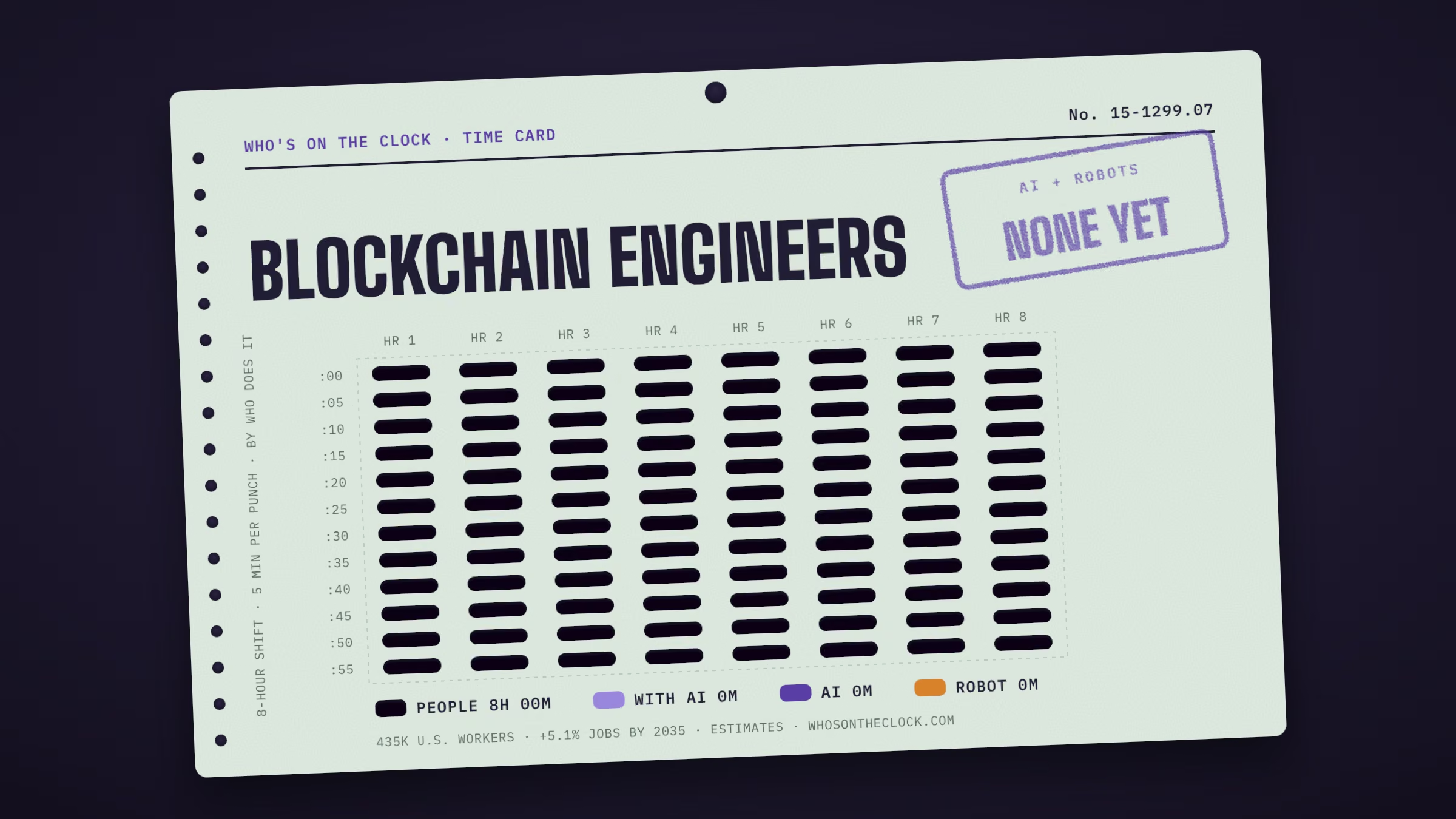
Not on current evidence. Less than 30 minutes of a typical shift goes to tasks that AI or robots are doing today. The other 8h (100%) stays with people. Separately, BLS expects about 5.1% more of these jobs by 2035 (all jobs: +3.5%).

Time card for blockchain engineers showing a typical 8-hour shift: 8h done by people.
Each mark is 5 minutes of a typical shift for blockchain engineers, colored by who does that task today. Estimates from O*NET tasks and Anthropic Economic Index data. How it's made

Home / Computers & math / Blockchain Engineers

Maintain and support distributed and decentralized blockchain-based networks or block-chain applications such as cryptocurrency exchange, payment processing, document sharing, and digital voting. Design and deploy secure block-chain design patterns and solutions over geographically distributed networks using advanced technologies. May assist with infrastructure setup and testing for application transparency and security.

Time card

Untick tasks you don't do, or set your own times.
MineTask, by time spentHumanWith AIAIRobot
Develop a maintainable code base using object-oriented design principles, practices, or patterns.1h 9m a shift · No AI or robot evidence found
Design and develop blockchain technologies for industries such as finance and music.58m a shift · No AI or robot evidence found
Design and deploy blockchain design patterns to make transactions secure, transparent, and immutable.46m a shift · No AI or robot evidence found
Update client and server applications responsible for integration and business logic.40m a shift · No AI or robot evidence found
Discuss and plan systems with solution architects, system engineers, or cybersecurity experts to meet customer requirements.35m a shift · No AI or robot evidence found
Automate the deployment of software updates over geographically distributed network nodes.29m a shift · No AI or robot evidence found
Test the security and performance of blockchain infrastructures.29m a shift · No AI or robot evidence found
Design and verify cryptographic protocols to protect private information.23m a shift · No AI or robot evidence found
Discuss data needs with engineers, product managers, or data scientists to identify blockchain requirements.23m a shift · No AI or robot evidence found
Run infrastructure tests to examine the behavior of large peer-to-peer networks.23m a shift · No AI or robot evidence found
Assess blockchain threats, such as untested code and unprotected keys.17m a shift · No AI or robot evidence found
Design and implement data repositories to integrate data.17m a shift · No AI or robot evidence found
Evaluate blockchain processes or risks based on security assessments or control matrix reviews.17m a shift · No AI or robot evidence found
Evaluate new blockchain technologies and vendor products.17m a shift · No AI or robot evidence found
Design and implement dashboard and data visualizations to meet customer reporting needs.12m a shift · No AI or robot evidence found
Determine specifications for, or implement, logging.12m a shift · No AI or robot evidence found
Implement catastrophic failure handlers to identify security breaches and prevent serious damage.12m a shift · No AI or robot evidence found

On the floor

No company news tracked for this job yet. New stories are added as they happen.

Ask the clock

Will AI replace blockchain engineers?

Not on current evidence. Less than 30 minutes of a typical shift goes to tasks that AI or robots are doing today. The other 8h (100%) stays with people. Separately, BLS expects about 5.1% more of these jobs by 2035 (all jobs: +3.5%).

What can AI already do for blockchain engineers?

None of this job's tasks show regular AI use yet. That can mean the work is hands-on or in person, or simply that it rarely comes up in AI usage data.

What still needs a person?

8h of a typical shift, or 100%, goes to tasks with no AI or robot evidence yet. No AI usage or robot deployment has shown up for these so far. The biggest:

  • Develop a maintainable code base using object-oriented design principles, practices, or patterns. (1h 9m a shift)
  • Design and develop blockchain technologies for industries such as finance and music. (58m a shift)
  • Design and deploy blockchain design patterns to make transactions secure, transparent, and immutable. (46m a shift)
  • Update client and server applications responsible for integration and business logic. (40m a shift)
  • Discuss and plan systems with solution architects, system engineers, or cybersecurity experts to meet customer requirements. (35m a shift)
Are employers still hiring blockchain engineers?

On Indeed, job postings in the IT Systems & Solutions sector are at 77% of their February 2020 level (all U.S. postings: 104%), up 10.8% from a year earlier, as of Oct 9, 2026. BLS separately expects about 27,000 openings a year in this job through 2035. Across all U.S. postings, 7.3% now mention AI skills. Sector postings cover more than this one job and move for many reasons besides AI.

How much do blockchain engineers make?

The median pay is about $116,580 a year ($56.05 an hour), 129% above the median for all U.S. jobs ($50,980). Most people in this job earn between $55,940 and $188,470 a year; that range covers the middle 80%. Pay figures are from BLS, May 2025, and vary a lot by state and employer. Pick a state to compare:

Is this job growing or shrinking?

BLS projects growth of 5.1% from 2025 to 2035, compared with 3.5% growth for all jobs. That's about 495,000 jobs in 2035. It expects about 27,000 openings a year, mostly from people retiring or changing careers. These projections don't single out AI as a cause.

How many blockchain engineers are there in the U.S.?

About 435,000 people in the U.S., roughly 0.28% of all workers (BLS, May 2025). That makes it the 94th largest of the 796 jobs on this site. BLS expects about 495,000 in 2035.

What training do blockchain engineers need?

O*NET rates the job at level 4 of 5 for preparation, which usually means: bachelor's degree. Requirements vary by state and employer, especially for licensed work.

What should I learn to stay ahead of AI?

These come from the job's official skill ratings and from the tasks that AI and robots touch least today. Building them keeps you strong in the parts of the work that still need a person:

  • Get strong at the parts of the job that stay with people (listed above), which take 8h of a typical shift
  • Tools employers list: TypeScript, Structured query language SQL, React, Python, Oracle Java
What other jobs could blockchain engineers move into?

These use similar skills. Matches come from 109 official ratings of skills, knowledge and work activities, and each needs the same or less preparation unless the official list relates the jobs directly:

  • Software Developers (3h 20m touched, $136k median pay)
  • Computer Systems Engineers/Architects (3h 8m touched, $117k median pay)
  • Database Architects (5h touched, $140k median pay)
  • Database Administrators (3h 35m touched, $105k median pay)
  • Information Security Engineers (17m touched, $117k median pay)
How solid are these numbers?

Each task carries its own evidence label. For this job: 17 with no AI or robot evidence found. The minutes per task are estimates, not measured hours, and "no evidence" doesn't prove a task is safe.

Tools in demand

  • TypeScript
  • Structured query language SQL
  • React
  • Python
  • Oracle Java
  • Node.js
  • MySQL
  • Kubernetes

Also called

Algorithm Engineer, Automation Engineer, Blockchain Analyst, Blockchain Architect, Blockchain Developer, Blockchain Engineer, Blockchain Penetration Tester, Blockchain Software Developer, Blockchain Software Engineer, Blockchain Threat Investigator, Blockchain Web Designer, Codebase Engineer, Engineer, Firmware Engineer