Will AI replace bridge and lock tenders?

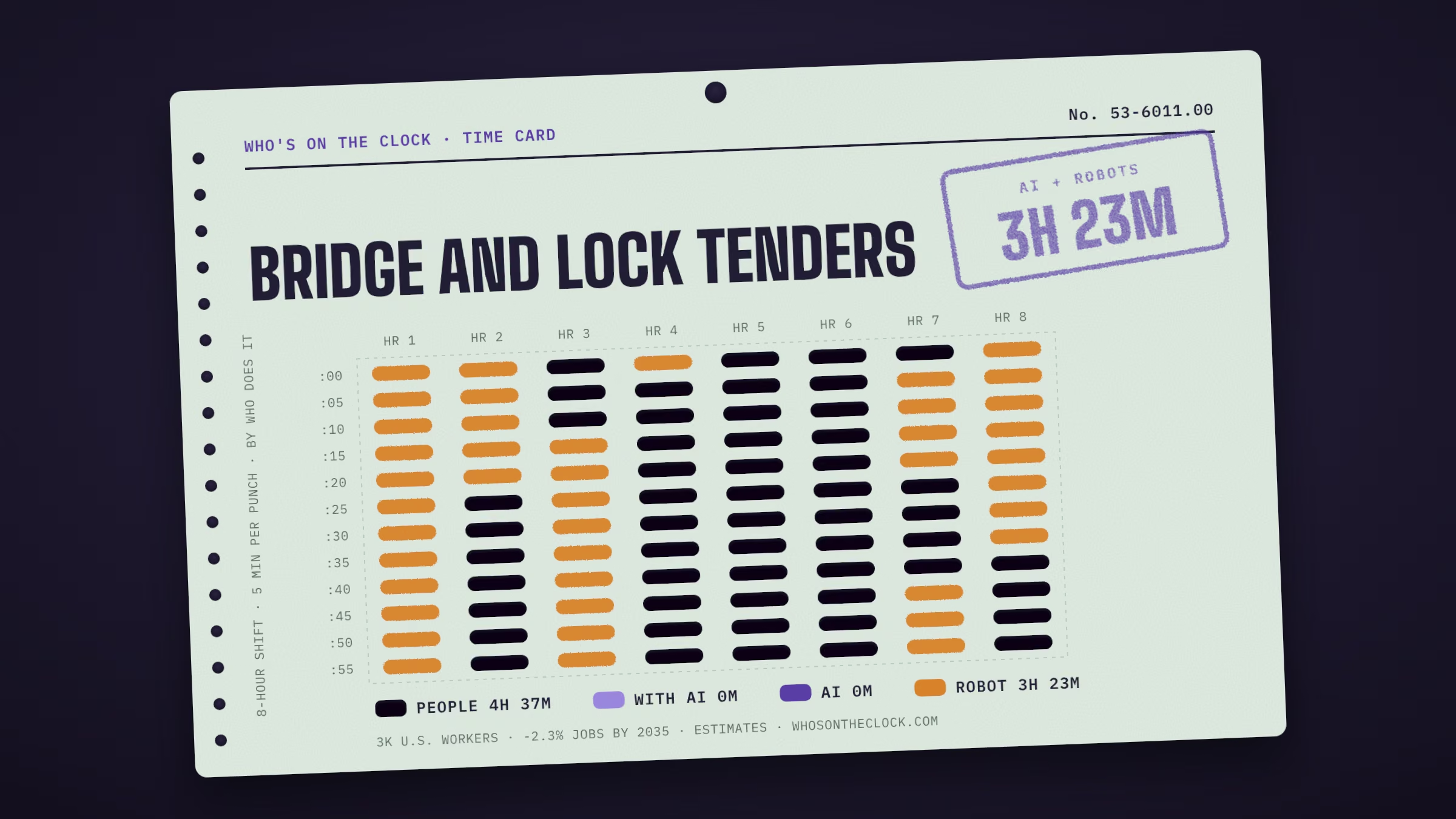
Some tasks are already handled by AI or machines; the rest still needs a person. About 3h 23m of an 8-hour shift goes to tasks that AI or robots largely take over. The other 4h 37m (58%) stays with people. Separately, BLS expects about 2.3% fewer of these jobs by 2035 (all jobs: +3.5%).

Time card for bridge and lock tenders showing a typical 8-hour shift: 4h 37m done by people, 3h 23m by robots.
Each mark is 5 minutes of a typical shift for bridge and lock tenders, colored by who does that task today. Estimates from O*NET tasks and Anthropic Economic Index data. How it's made

Home / Transportation & warehouse / Bridge and Lock Tenders

Operate and tend bridges, canal locks, and lighthouses to permit marine passage on inland waterways, near shores, and at danger points in waterway passages. May supervise such operations. Includes drawbridge operators, lock operators, and slip bridge operators.

Time card

Untick tasks you don't do, or set your own times.
MineTask, by time spentHumanWith AIAIRobot
Maintain and guard stations in bridges to check waterways for boat traffic.1h 26m a shift · Robots deployed · e.g. Knightscope K5 / K5v5 ASR
Control machinery to open and close canal locks and dams, railroad or highway drawbridges, or horizontally or vertically adjustable bridges.49m a shift · Robots only in factory cells
Perform maintenance duties, such as sweeping, painting, and yard work to keep facilities clean and in order.49m a shift · Robots deployed · e.g. Avidbots Neo
Direct movements of vessels in locks or bridge areas, using signals, telecommunication equipment, or loudspeakers.37m a shift · No AI or robot evidence found
Observe approaching vessels to determine size and speed, and listen for whistle signals indicating desire to pass.37m a shift · No AI or robot evidence found
Observe position and progress of vessels to ensure best use of lock spaces or bridge opening spaces.31m a shift · No AI or robot evidence found
Clean and lubricate equipment, and make minor repairs and adjustments.31m a shift · Robots only in factory cells
Record names, types, and destinations of vessels passing through bridge openings or locks, and numbers of trains or vehicles crossing bridges.25m a shift · No AI or robot evidence found
Raise drawbridges and observe passage of water traffic or lower drawbridges and raise automobile gates.25m a shift · Robots only in factory cells
Turn valves to increase or decrease water levels in locks.18m a shift · Robots deployed · e.g. VNF automated locks (ecluses automatisees, telecommande unique)
Check that bridges are clear of vehicles and pedestrians prior to opening.18m a shift · No AI or robot evidence found
Stop automobile and pedestrian traffic on bridges, and lower automobile gates prior to moving bridges.18m a shift · Robots deployed · e.g. Four-quadrant automatic gate warning systems with vehicle presence detection (highway-rail grade crossings)
Inspect canal and bridge equipment, and areas, such as roadbeds, for damage or defects, reporting problems to supervisors as necessary.18m a shift · Robots deployed · e.g. Spot (Boston Dynamics) at Consumers Energy substations
Move levers to activate traffic signals, navigation lights, and alarms.12m a shift · Robots deployed · e.g. FEC Loxahatchee River automated railroad bridge (33 CFR 117.299)
Log data, such as water levels and weather conditions.12m a shift · No AI or robot evidence found
Write and submit maintenance work requisitions.6m a shift · No AI or robot evidence found
Attach ropes or cable lines to bitts on lock decks or wharfs to secure vessels.6m a shift · Robots only in factory cells
Prepare accident reports.time not estimated · No AI or robot evidence found

On the floor

No company news tracked for this job yet. New stories are added as they happen.

Ask the clock

Will AI replace bridge and lock tenders?

Some tasks are already handled by AI or machines; the rest still needs a person. About 3h 23m of an 8-hour shift goes to tasks that AI or robots largely take over. The other 4h 37m (58%) stays with people. Separately, BLS expects about 2.3% fewer of these jobs by 2035 (all jobs: +3.5%).

What can AI already do for bridge and lock tenders?

None of this job's tasks show regular AI use yet. That can mean the work is hands-on or in person, or simply that it rarely comes up in AI usage data.

Where do robots fit in?

For some tasks, yes. Robots have done 6 of this job's tasks in workplaces like this one, about 3h 23m of a typical shift. 4 more tasks have only been done in factory setups built around the machine, so they stay with people here.

  • Maintain and guard stations in bridges to check waterways for boat traffic. (1h 26m a shift; e.g. Knightscope K5 / K5v5 ASR, in use)
  • Perform maintenance duties, such as sweeping, painting, and yard work to keep facilities clean and in order. (49m a shift; e.g. Avidbots Neo, in use)
  • Turn valves to increase or decrease water levels in locks. (18m a shift; e.g. VNF automated locks (ecluses automatisees, telecommande unique), in use)
  • Stop automobile and pedestrian traffic on bridges, and lower automobile gates prior to moving bridges. (18m a shift; e.g. Four-quadrant automatic gate warning systems with vehicle presence detection (highway-rail grade crossings), in use)
What still needs a person?

4h 37m of a typical shift, or 58%, goes to tasks with no AI or robot evidence yet. No AI usage or robot deployment has shown up for these so far. The biggest:

  • Control machinery to open and close canal locks and dams, railroad or highway drawbridges, or horizontally or vertically adjustable bridges. (49m a shift)
  • Direct movements of vessels in locks or bridge areas, using signals, telecommunication equipment, or loudspeakers. (37m a shift)
  • Observe approaching vessels to determine size and speed, and listen for whistle signals indicating desire to pass. (37m a shift)
  • Observe position and progress of vessels to ensure best use of lock spaces or bridge opening spaces. (31m a shift)
  • Clean and lubricate equipment, and make minor repairs and adjustments. (31m a shift)
Why is that work hard to automate?

Much of it comes down to where and how the work happens. In-person, hands-on and high-stakes work is where AI and robots have made the least headway so far. In the official O*NET survey of people in this job:

  • 79% say a mistake would be very or extremely serious
  • 65% carry high or very high responsibility for other workers' safety
  • 58% work outdoors in all weather every day
How much do bridge and lock tenders make?

The median pay is about $57,700 a year ($27.74 an hour), 13% above the median for all U.S. jobs ($50,980). Most people in this job earn between $28,090 and $75,360 a year; that range covers the middle 80%. Pay figures are from BLS, May 2025, and vary a lot by state and employer. Pick a state to compare:

Is this job growing or shrinking?

BLS projects a decline of 2.3% from 2025 to 2035, compared with 3.5% growth for all jobs. That's about 3,100 jobs in 2035. Even so, it expects about 300 openings a year, mostly from people retiring or changing careers. These projections don't single out AI as a cause.

How many bridge and lock tenders are there in the U.S.?

About 3,040 people in the U.S., roughly 0.00% of all workers (BLS, May 2025). That makes it the 758th largest of the 796 jobs on this site. BLS expects about 3,100 in 2035.

What training do bridge and lock tenders need?

The most common requirement is a high school diploma: about 65% of people in the job said so in the official O*NET survey. O*NET rates the job at level 2 of 5 for preparation, which usually means: high school diploma, some training. Requirements vary by state and employer, especially for licensed work.

What should I learn to stay ahead of AI?

These come from the job's official skill ratings and from the tasks that AI and robots touch least today. Building them keeps you strong in the parts of the work that still need a person:

  • Skills that matter more here than in most jobs: Operation and Control, Operations Monitoring, Monitoring, Coordination
  • Get strong at the parts of the job that stay with people (listed above), which take 4h 37m of a typical shift
  • Tools employers list: Microsoft Excel, Microsoft Office software, Microsoft Outlook, Microsoft Word, Oracle PeopleSoft
What other jobs could bridge and lock tenders move into?

These use similar skills. Matches come from 109 official ratings of skills, knowledge and work activities, and each needs the same or less preparation unless the official list relates the jobs directly:

  • Refuse and Recyclable Material Collectors (5h 14m touched, $50k median pay)
  • Parking Attendants (2h 26m touched, $35k median pay)
  • Machine Feeders and Offbearers (3h 26m touched, $41k median pay)
How solid are these numbers?

Each task carries its own evidence label. For this job: 6 with robots in real deployments, 12 with no AI or robot evidence found. The minutes per task are estimates, not measured hours, and "no evidence" doesn't prove a task is safe.

Tools in demand

  • Microsoft Excel
  • Microsoft Office software
  • Microsoft Outlook
  • Microsoft Word
  • Oracle PeopleSoft
  • SAP software

Also called

Bridge Crew Member, Bridge Leverman, Bridge Opener, Bridge Operator, Bridge Saw Operator, Bridge Tender, Bridgeman, Crossing Tender, Crossing Watchman, Dam Attendant, Dam Operator, Dam Repairer, Dam Tender, Draw Operator