Will AI replace financial examiners?

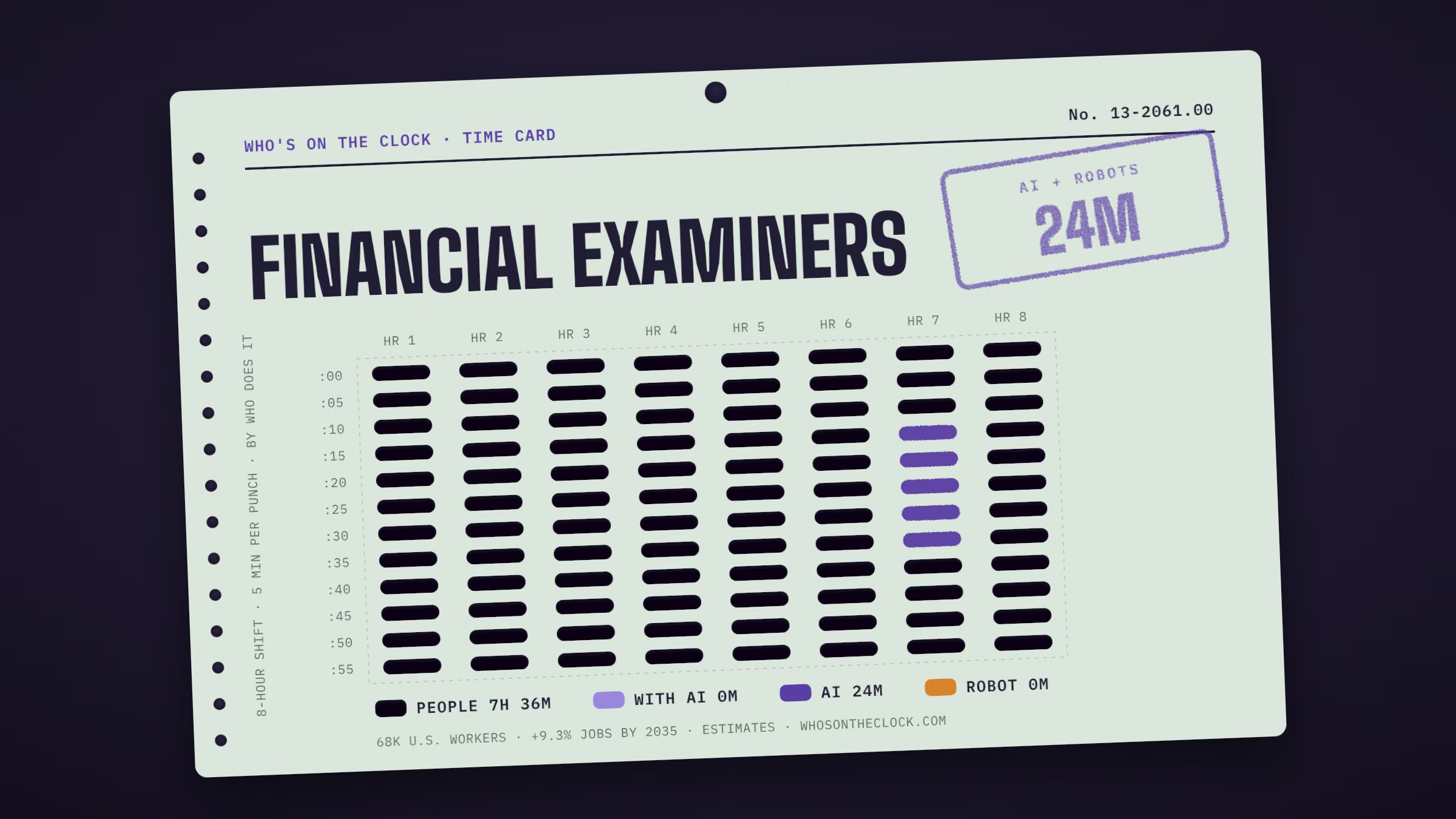
Not on current evidence. Less than 30 minutes of a typical shift goes to tasks that AI or robots are doing today. The other 7h 36m (95%) stays with people. Separately, BLS expects about 9.3% more of these jobs by 2035 (all jobs: +3.5%).

Time card for financial examiners showing a typical 8-hour shift: 7h 36m done by people, 24m by AI.
Each mark is 5 minutes of a typical shift for financial examiners, colored by who does that task today. Estimates from O*NET tasks and Anthropic Economic Index data. How it's made

Home / Business & finance / Financial Examiners

Enforce or ensure compliance with laws and regulations governing financial and securities institutions and financial and real estate transactions. May examine, verify, or authenticate records.

Time card

Untick tasks you don't do, or set your own times.
MineTask, by time spentHumanWith AIAIRobot
Prepare reports, exhibits, and other supporting schedules that detail an institution's safety and soundness, compliance with laws and regulations, and recommended solutions to questionable financial conditions.1h 17m a shift · No AI or robot evidence found
Review balance sheets, operating income and expense accounts, and loan documentation to confirm institution assets and liabilities.1h 11m a shift · No AI or robot evidence found
Investigate activities of institutions to enforce laws and regulations and to ensure legality of transactions and operations or financial solvency.1h 5m a shift · No AI or robot evidence found
Direct and participate in formal and informal meetings with bank directors, trustees, senior management, counsels, outside accountants, and consultants to gather information and discuss findings.41m a shift · No AI or robot evidence found
Recommend actions to ensure compliance with laws and regulations, or to protect solvency of institutions.36m a shift · No AI or robot evidence found
Resolve problems concerning the overall financial integrity of banking institutions including loan investment portfolios, capital, earnings, and specific or large troubled accounts.36m a shift · No AI or robot evidence found
Plan, supervise, and review work of assigned subordinates.24m a shift · No AI or robot evidence found
Review audit reports of internal and external auditors to monitor adequacy of scope of reports or to discover specific weaknesses in internal routines.24m a shift · No AI or robot evidence found
Review and analyze new, proposed, or revised laws, regulations, policies, and procedures to interpret their meaning and determine their impact.24m a shift · Observed in AI useTypical AI request: about 6h 31m alone, 33m with AI
Examine the minutes of meetings of directors, stockholders, and committees to investigate the specific authority extended at various levels of management.12m a shift · No AI or robot evidence found
Train other examiners in the financial examination process.12m a shift · No AI or robot evidence found
Establish guidelines for procedures and policies that comply with new and revised regulations and direct their implementation.12m a shift · No AI or robot evidence found
Evaluate data processing applications for institutions under examination to develop recommendations for coordinating existing systems with examination procedures.12m a shift · No AI or robot evidence found
Verify and inspect cash reserves, assigned collateral, and bank-owned securities to check internal control procedures.12m a shift · No AI or robot evidence found
Confer with officials of real estate, securities, or financial institution industries to exchange views and discuss issues or pending cases.12m a shift · No AI or robot evidence found
Provide regulatory compliance training to employees.6m a shift · No AI or robot evidence found
Review applications for mergers, acquisitions, establishment of new institutions, acceptance in Federal Reserve System, or registration of securities sales to determine their public interest value and conformance to regulations, and recommend acceptance or rejection.6m a shift · No AI or robot evidence found

On the floor

No company news tracked for this job yet. New stories are added as they happen.

Ask the clock

Will AI replace financial examiners?

Not on current evidence. Less than 30 minutes of a typical shift goes to tasks that AI or robots are doing today. The other 7h 36m (95%) stays with people. Separately, BLS expects about 9.3% more of these jobs by 2035 (all jobs: +3.5%).

What can AI already do for financial examiners?

AI shows up regularly in 1 of 17 tasks, about 24m of a typical shift. The biggest ones:

  • Review and analyze new, proposed, or revised laws, regulations, policies, and procedures to interpret their meaning and determine their impact. (24m a shift, AI mostly does it alone)
What still needs a person?

7h 36m of a typical shift, or 95%, goes to tasks with no AI or robot evidence yet. No AI usage or robot deployment has shown up for these so far. The biggest:

  • Prepare reports, exhibits, and other supporting schedules that detail an institution's safety and soundness, compliance with laws and regulations, and recommended solutions to questionable financial conditions. (1h 17m a shift)
  • Review balance sheets, operating income and expense accounts, and loan documentation to confirm institution assets and liabilities. (1h 11m a shift)
  • Investigate activities of institutions to enforce laws and regulations and to ensure legality of transactions and operations or financial solvency. (1h 5m a shift)
  • Direct and participate in formal and informal meetings with bank directors, trustees, senior management, counsels, outside accountants, and consultants to gather information and discuss findings. (41m a shift)
  • Recommend actions to ensure compliance with laws and regulations, or to protect solvency of institutions. (36m a shift)
Why is that work hard to automate?

Much of it comes down to where and how the work happens. In-person, hands-on and high-stakes work is where AI and robots have made the least headway so far. In the official O*NET survey of people in this job:

  • 78% talk face to face with others every day
  • 65% are in constant contact with other people
  • 57% say dealing with the public is very or extremely important
How much time does AI save on these tasks?

For the 1 task in this job where AI shows up and timing data exists, a typical request takes about 6h 31m for a person alone and about 33m with AI. These are Claude's own estimates from real conversations in April and May 2026 (Anthropic Economic Index). They describe single requests, not whole workdays, and time saved on a task doesn't mean jobs are cut. The biggest gaps:

  • Review and analyze new, proposed, or revised laws, regulations, policies, and procedures to interpret their meaning and determine their impact (about 6h 31m alone, 33m with AI)
Are employers still hiring financial examiners?

On Indeed, job postings in the Banking & Finance sector are at 106% of their February 2020 level (all U.S. postings: 104%), up 10.8% from a year earlier, as of Oct 9, 2026. BLS separately expects about 4,500 openings a year in this job through 2035. Across all U.S. postings, 7.3% now mention AI skills. Sector postings cover more than this one job and move for many reasons besides AI.

How much do financial examiners make?

The median pay is about $94,160 a year ($45.27 an hour), 85% above the median for all U.S. jobs ($50,980). Most people in this job earn between $56,230 and $174,200 a year; that range covers the middle 80%. Pay figures are from BLS, May 2025, and vary a lot by state and employer. Pick a state to compare:

Is this job growing or shrinking?

BLS projects growth of 9.3% from 2025 to 2035, compared with 3.5% growth for all jobs. That's about 77,000 jobs in 2035. It expects about 4,500 openings a year, mostly from people retiring or changing careers. These projections don't single out AI as a cause.

How many financial examiners are there in the U.S.?

About 68,000 people in the U.S., roughly 0.04% of all workers (BLS, May 2025). That makes it the 334th largest of the 796 jobs on this site. BLS expects about 77,000 in 2035.

What training do financial examiners need?

The most common requirement is a bachelor's degree: about 87% of people in the job said so in the official O*NET survey. O*NET rates the job at level 4 of 5 for preparation, which usually means: bachelor's degree. Requirements vary by state and employer, especially for licensed work.

What should I learn to stay ahead of AI?

These come from the job's official skill ratings and from the tasks that AI and robots touch least today. Building them keeps you strong in the parts of the work that still need a person:

  • Skills that matter more here than in most jobs: Mathematics, Management of Personnel Resources, Systems Evaluation, Systems Analysis
  • Get strong at the parts of the job that stay with people (listed above), which take 7h 36m of a typical shift
  • Tools employers list: R, Microsoft PowerPoint, Microsoft Outlook, Microsoft Office software, Microsoft Excel
  • Learn to use AI well on the tasks where it already shows up in this job (listed above)
What other jobs could financial examiners move into?

These use similar skills. Matches come from 109 official ratings of skills, knowledge and work activities, and each needs the same or less preparation unless the official list relates the jobs directly:

  • Accountants and Auditors (2h 42m touched, $84k median pay)
  • Treasurers and Controllers (2h 11m touched, $167k median pay)
  • Credit Analysts (2h 5m touched, $84k median pay)
How solid are these numbers?

Each task carries its own evidence label. For this job: 1 observed in real AI use, 16 with no AI or robot evidence found. The minutes per task are estimates, not measured hours, and "no evidence" doesn't prove a task is safe.

Tools in demand

  • R
  • Microsoft PowerPoint
  • Microsoft Outlook
  • Microsoft Office software
  • Microsoft Excel
  • Microsoft Access
  • Microsoft Project
  • Microsoft SharePoint

Also called

AML Director (Anti-Money Laundering Director), Anti Money Laundering Investigator (AML Investigator), BSA Analyst (Business Systems Analyst), BSA Officer (Bank Secrecy Act Officer), BSA Specialist (Bank Secrecy Act Specialist), Bank Compliance Officer, Bank Examiner, Bank Secrecy Act Anti-Money Laundering Officer (BSA/AML Officer), Commercial Escrow Officer, Community Reinvestment Act Officer (CRA Officer), Compliance Analyst, Compliance Coordinator, Compliance Investigator, Compliance Specialist