Will AI replace firefighters?

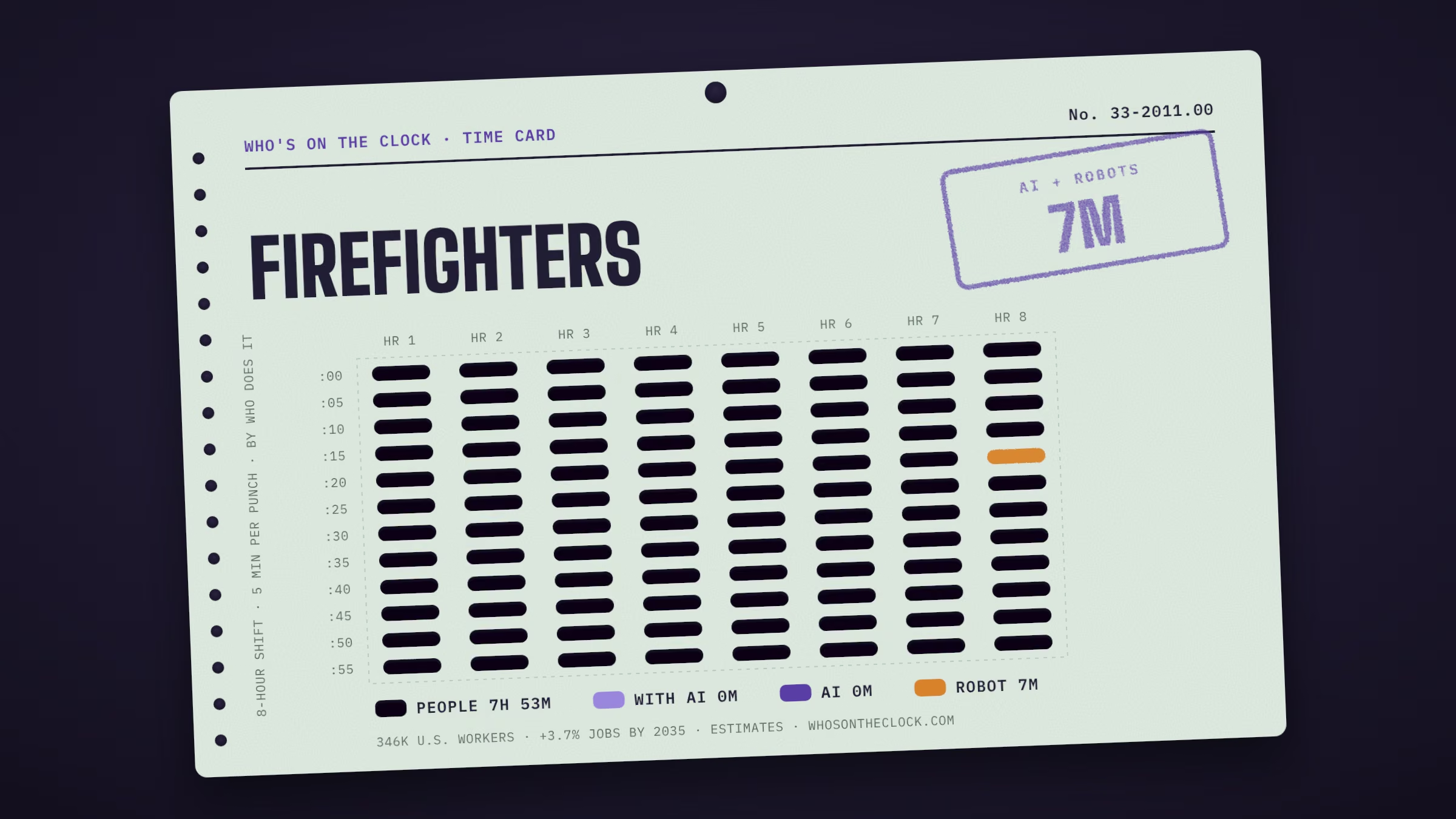
Not on current evidence. Less than 30 minutes of a typical shift goes to tasks that AI or robots are doing today. The other 7h 53m (99%) stays with people. Separately, BLS expects about 3.7% more of these jobs by 2035 (all jobs: +3.5%).

Time card for firefighters showing a typical 8-hour shift: 7h 53m done by people, 7m by robots.
Each mark is 5 minutes of a typical shift for firefighters, colored by who does that task today. Estimates from O*NET tasks and Anthropic Economic Index data. How it's made

Home / Protective services / Firefighters

Control and extinguish fires or respond to emergency situations where life, property, or the environment is at risk. Duties may include fire prevention, emergency medical service, hazardous material response, search and rescue, and disaster assistance.

Time card

Untick tasks you don't do, or set your own times.
MineTask, by time spentHumanWith AIAIRobot
Administer first aid and cardiopulmonary resuscitation to injured persons or provide emergency medical care such as basic or advanced life support.1h 15m a shift · No AI or robot evidence found
Clean and maintain fire stations and fire fighting equipment and apparatus.1h 9m a shift · Robots only in factory cells
Participate in physical training activities to maintain a high level of physical fitness.48m a shift · No AI or robot evidence found
Respond to fire alarms and other calls for assistance, such as automobile and industrial accidents.34m a shift · No AI or robot evidence found
Participate in fire drills and demonstrations of fire fighting techniques.34m a shift · No AI or robot evidence found
Prepare written reports that detail specifics of fire incidents.34m a shift · No AI or robot evidence found
Maintain knowledge of current firefighting practices by participating in drills and by attending seminars, conventions, and conferences.27m a shift · No AI or robot evidence found
Drive and operate fire fighting vehicles and equipment.21m a shift · Robots only in factory cells
Inspect buildings for fire hazards and compliance with fire prevention ordinances, testing and checking smoke alarms and fire suppression equipment as necessary.21m a shift · No AI or robot evidence found
Collaborate with other firefighters as a member of a firefighting crew.14m a shift · No AI or robot evidence found
Inform and educate the public on fire prevention.14m a shift · No AI or robot evidence found
Rescue survivors from burning buildings, accident sites, and water hazards.7m a shift · No AI or robot evidence found
Dress with equipment such as fire-resistant clothing and breathing apparatus.7m a shift · No AI or robot evidence found
Assess fires and situations and report conditions to superiors to receive instructions, using two-way radios.7m a shift · No AI or robot evidence found
Move toward the source of a fire, using knowledge of types of fires, construction design, building materials, and physical layout of properties.7m a shift · Robots only in factory cells
Inspect fire sites after flames have been extinguished to ensure that there is no further danger.7m a shift · No AI or robot evidence found
Select and attach hose nozzles, depending on fire type, and direct streams of water or chemicals onto fires.7m a shift · Robots deployed · e.g. Firefighting Robot System 'Scrum Force' (Water Cannon Robot / Hose-Laying Robot)
Operate pumps connected to high-pressure hoses.7m a shift · Robots only in factory cells
Maintain contact with fire dispatchers at all times to notify them of the need for additional firefighters and supplies, or to detail any difficulties encountered.7m a shift · No AI or robot evidence found
Patrol burned areas after fires to locate and eliminate hot spots that may restart fires.7m a shift · No AI or robot evidence found
Collaborate with police to respond to accidents, disasters, and arson investigation calls.7m a shift · No AI or robot evidence found
Take action to contain any hazardous chemicals that could catch fire, leak, or spill.7m a shift · No AI or robot evidence found
Extinguish flames and embers to suppress fires, using shovels or engine- or hand-driven water or chemical pumps.7m a shift · Robots only in factory cells
Train new employees to control and suppress fires.7m a shift · No AI or robot evidence found
Create openings in buildings for ventilation or entrance, using axes, chisels, crowbars, electric saws, or core cutters.time not estimated · Robots only in factory cells
Position and climb ladders to gain access to upper levels of buildings, or to rescue individuals from burning structures.time not estimated · No AI or robot evidence found
Protect property from water and smoke, using waterproof salvage covers, smoke ejectors, and deodorants.time not estimated · No AI or robot evidence found
Salvage property by removing broken glass, pumping out water, and ventilating buildings to remove smoke.time not estimated · No AI or robot evidence found
Orient self in relation to fire, using compass and map, and collect supplies and equipment dropped by parachute.time not estimated · Robots only in factory cells
Search to locate fire survivors.time not estimated · No AI or robot evidence found

On the floor

  1. Rolling outPano AI
    Pano AI wildfire detection cameras spread across the Mountain West

    Pano AI runs about 700 detection sites in 17 states, with close to 50 in New Mexico. New Mexico's Forestry Division and utilities PNM and Xcel Energy are among the organizations using AI cameras to spot fires for local fire agencies.

    KUNC

Ask the clock

Will AI replace firefighters?

Not on current evidence. Less than 30 minutes of a typical shift goes to tasks that AI or robots are doing today. The other 7h 53m (99%) stays with people. Separately, BLS expects about 3.7% more of these jobs by 2035 (all jobs: +3.5%).

What can AI already do for firefighters?

None of this job's tasks show regular AI use yet. That can mean the work is hands-on or in person, or simply that it rarely comes up in AI usage data.

Where do robots fit in?

For some tasks, yes. Robots have done 1 of this job's tasks in workplaces like this one, about 7m of a typical shift. 7 more tasks have only been done in factory setups built around the machine, so they stay with people here. For 18 physical tasks, no robot has shown it can do the work yet.

  • Select and attach hose nozzles, depending on fire type, and direct streams of water or chemicals onto fires. (7m a shift; e.g. Firefighting Robot System 'Scrum Force' (Water Cannon Robot / Hose-Laying Robot), in use)
What still needs a person?

7h 53m of a typical shift, or 99%, goes to tasks with no AI or robot evidence yet. No AI usage or robot deployment has shown up for these so far. The biggest:

  • Administer first aid and cardiopulmonary resuscitation to injured persons or provide emergency medical care such as basic or advanced life support. (1h 15m a shift)
  • Clean and maintain fire stations and fire fighting equipment and apparatus. (1h 9m a shift)
  • Participate in physical training activities to maintain a high level of physical fitness. (48m a shift)
  • Respond to fire alarms and other calls for assistance, such as automobile and industrial accidents. (34m a shift)
  • Participate in fire drills and demonstrations of fire fighting techniques. (34m a shift)
Why is that work hard to automate?

Much of it comes down to where and how the work happens. In-person, hands-on and high-stakes work is where AI and robots have made the least headway so far. In the official O*NET survey of people in this job:

  • 97% work at arm's length or closer to other people
  • 92% carry high or very high responsibility for other workers' safety
  • 85% say dealing with the public is very or extremely important
What are companies actually doing?

We track 1 sourced company move that affects this job. Most recent:

  • May 8, 2026: Pano AI wildfire detection cameras spread across the Mountain West (Rolling out)
Are employers still hiring firefighters?

On Indeed, job postings in the Security & Public Safety sector are at 119% of their February 2020 level (all U.S. postings: 104%), up 4.4% from a year earlier, as of Oct 9, 2026. BLS separately expects about 27,000 openings a year in this job through 2035. Across all U.S. postings, 7.3% now mention AI skills. Sector postings cover more than this one job and move for many reasons besides AI.

How much do firefighters make?

The median pay is about $59,280 a year ($28.50 an hour), 16% above the median for all U.S. jobs ($50,980). Most people in this job earn between $34,910 and $101,040 a year; that range covers the middle 80%. Pay figures are from BLS, May 2025, and vary a lot by state and employer. Pick a state to compare:

Is this job growing or shrinking?

BLS projects growth of 3.7% from 2025 to 2035, compared with 3.5% growth for all jobs. That's about 368,000 jobs in 2035. It expects about 27,000 openings a year, mostly from people retiring or changing careers. These projections don't single out AI as a cause.

How many firefighters are there in the U.S.?

About 346,000 people in the U.S., roughly 0.22% of all workers (BLS, May 2025). That makes it the 117th largest of the 796 jobs on this site. BLS expects about 368,000 in 2035.

What training do firefighters need?

The most common requirement is a high school diploma: about 36% of people in the job said so in the official O*NET survey. O*NET rates the job at level 3 of 5 for preparation, which usually means: vocational school or associate's degree. Requirements vary by state and employer, especially for licensed work.

What should I learn to stay ahead of AI?

These come from the job's official skill ratings and from the tasks that AI and robots touch least today. Building them keeps you strong in the parts of the work that still need a person:

  • Skills that matter more here than in most jobs: Service Orientation, Coordination, Operation and Control, Operations Monitoring
  • Get strong at the parts of the job that stay with people (listed above), which take 7h 53m of a typical shift
  • Tools employers list: Microsoft Access, Microsoft Excel, Microsoft Office software, Microsoft Outlook, Microsoft PowerPoint
What other jobs could firefighters move into?

These use similar skills. Matches come from 109 official ratings of skills, knowledge and work activities, and each needs the same or less preparation unless the official list relates the jobs directly:

  • First-Line Supervisors of Firefighting and Prevention Workers (1h 35m touched, $94k median pay)
  • Forest Fire Inspectors and Prevention Specialists (1h 22m touched, $57k median pay)
  • Fire Inspectors and Investigators (0m touched, $76k median pay)
How solid are these numbers?

Each task carries its own evidence label. For this job: 1 with robots in real deployments, 29 with no AI or robot evidence found. The minutes per task are estimates, not measured hours, and "no evidence" doesn't prove a task is safe.

Tools in demand

  • Microsoft Access
  • Microsoft Excel
  • Microsoft Office software
  • Microsoft Outlook
  • Microsoft PowerPoint
  • Microsoft Windows
  • Microsoft Word

Also called

Airport Firefighter, Apparatus Operator, Crash Fire Firefighter, Fire Alarm Operator, Fire Apparatus Engineer, Fire Chief's Aide, Fire Engine Pump Operator, Fire Engineer, Fire Equipment Operator, Fire Fighter, Fire Hydrant Operator, Fire Management Specialist, Fire Medic, Fire Suppression Technician