Will AI replace glaziers?

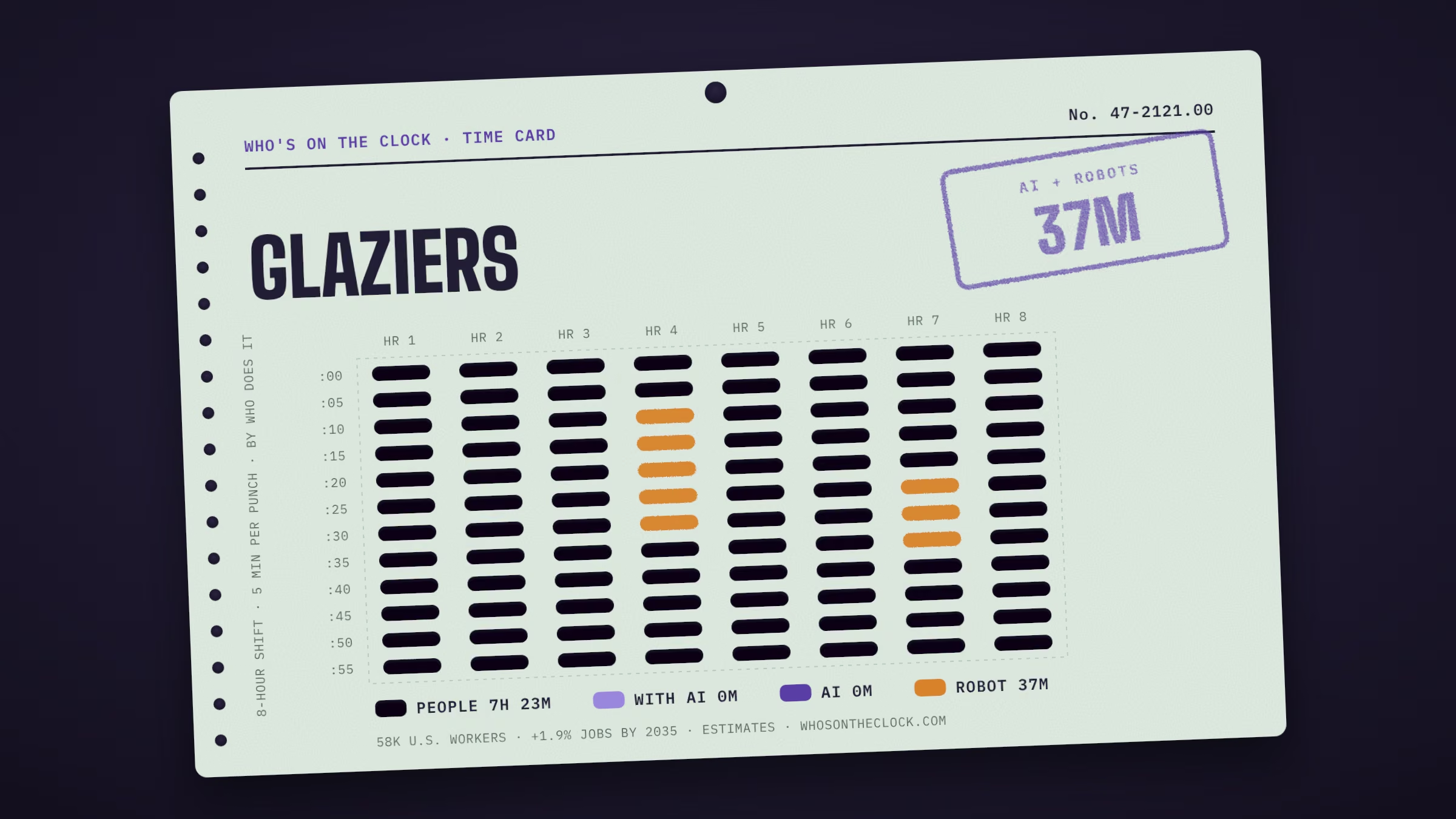
Not replace, but it is changing the job. About 37m of an 8-hour shift goes to tasks touched by robots. The other 7h 23m (92%) stays with people. Separately, BLS expects about 1.9% more of these jobs by 2035 (all jobs: +3.5%).

Time card for glaziers showing a typical 8-hour shift: 7h 23m done by people, 37m by robots.
Each mark is 5 minutes of a typical shift for glaziers, colored by who does that task today. Estimates from O*NET tasks and Anthropic Economic Index data. How it's made

Home / Construction / Glaziers

Install glass in windows, skylights, store fronts, and display cases, or on surfaces, such as building fronts, interior walls, ceilings, and tabletops.

Time card

Untick tasks you don't do, or set your own times.
MineTask, by time spentHumanWith AIAIRobot
Cut, fit, install, repair, or replace glass or glass substitutes, such as plastic or aluminum, in building interiors or exteriors or in furniture or other products.1h 37m a shift · Robots only in factory cells
Drive trucks to installation sites and unload mirrors, glass equipment, or tools.36m a shift · Robots only in factory cells
Fabricate or install metal sashes or moldings for glass installation, using aluminum or steel framing.30m a shift · Robots only in factory cells
Install pre-assembled metal or wood frameworks for windows or doors to be fitted with glass panels, using hand tools.24m a shift · Robots only in factory cells
Measure mirrors and dimensions of areas to be covered to determine work procedures.24m a shift · Robots deployed · e.g. Leica BLK ARC on Boston Dynamics Spot
Cut, assemble, fit, or attach metal-framed glass enclosures for showers, bathtubs, display cases, skylights, solariums, or other structures.24m a shift · Robots only in factory cells
Confer with customers to determine project requirements or to provide cost estimates.24m a shift · No AI or robot evidence found
Read and interpret blueprints or specifications to determine size, shape, color, type, or thickness of glass, location of framing, installation procedures, or staging or scaffolding materials required.18m a shift · No AI or robot evidence found
Set glass doors into frames and bolt metal hinges, handles, locks, or other hardware to attach doors to frames and walls.18m a shift · Robots only in factory cells
Load and arrange glass or mirrors onto delivery trucks, using suction cups or cranes to lift glass.18m a shift · Robots only in factory cells
Pack spaces between moldings and glass with glazing compounds and trim excess material with glazing knives.18m a shift · Robots only in factory cells
Assemble, erect, or dismantle scaffolds, rigging, or hoisting equipment.18m a shift · No AI or robot evidence found
Cut and remove broken glass prior to installing replacement glass.18m a shift · No AI or robot evidence found
Determine plumb of walls or ceilings, using plumb lines and levels.12m a shift · Robots deployed · e.g. Boston Dynamics Spot (laser scanning payload)
Operate cranes or hoists with suction cups to lift large, heavy pieces of glass.12m a shift · Robots only in factory cells
Secure mirrors in position, using mastic cement, putty, bolts, or screws.12m a shift · Robots only in factory cells
Measure and mark outlines or patterns on glass to indicate cutting lines.12m a shift · Robots only in factory cells
Fasten glass panes into wood sashes or frames with clips, points, or moldings, adding weather seals or putty around pane edges to seal joints.12m a shift · Robots only in factory cells
Score glass with cutters' wheels, breaking off excess glass by hand or with notched tools.12m a shift · Robots only in factory cells
Cut and attach mounting strips, metal or wood moldings, rubber gaskets, or metal clips to surfaces in preparation for mirror installation.6m a shift · Robots only in factory cells
Grind or polish glass, smoothing edges when necessary.6m a shift · Robots only in factory cells
Prepare glass for cutting by resting it on rack edges or against cutting tables and brushing thin layer of oil along cutting lines or dipping cutting tools in oil.6m a shift · Robots only in factory cells
Move furniture to clear work sites and cover floors or furnishings with drop cloths.6m a shift · Robots only in factory cells
Select the type or color of glass or mirror according to specifications.6m a shift · No AI or robot evidence found
Measure, cut, fit, and press anti-glare adhesive film to glass or spray glass with tinting solution to prevent light glare.6m a shift · Robots only in factory cells
Assemble and cement sections of stained glass together.time not estimated · No AI or robot evidence found
Create patterns on glass by etching, sandblasting, or painting designs.time not estimated · Robots only in factory cells

On the floor

No company news tracked for this job yet. New stories are added as they happen.

Ask the clock

Will AI replace glaziers?

Not replace, but it is changing the job. About 37m of an 8-hour shift goes to tasks touched by robots. The other 7h 23m (92%) stays with people. Separately, BLS expects about 1.9% more of these jobs by 2035 (all jobs: +3.5%).

What parts of the job can AI already do?

None of this job's tasks show regular AI use yet. That can mean the work is hands-on or in person, or simply that it rarely comes up in AI usage data.

Can a robot do this job?

For some tasks, yes. Robots have done 2 of this job's tasks in workplaces like this one, about 37m of a typical shift. 19 more tasks have only been done in factory setups built around the machine, so they stay with people here. For 3 physical tasks, no robot has shown it can do the work yet.

  • Measure mirrors and dimensions of areas to be covered to determine work procedures. (24m a shift; e.g. Leica BLK ARC on Boston Dynamics Spot, in use)
  • Determine plumb of walls or ceilings, using plumb lines and levels. (12m a shift; e.g. Boston Dynamics Spot (laser scanning payload), in use)
What parts of the job are still done by people?

7h 23m of a typical shift, or 92%, goes to tasks with no AI or robot evidence yet. No AI usage or robot deployment has shown up for these so far. The biggest:

  • Cut, fit, install, repair, or replace glass or glass substitutes, such as plastic or aluminum, in building interiors or exteriors or in furniture or other products. (1h 37m a shift)
  • Drive trucks to installation sites and unload mirrors, glass equipment, or tools. (36m a shift)
  • Fabricate or install metal sashes or moldings for glass installation, using aluminum or steel framing. (30m a shift)
  • Install pre-assembled metal or wood frameworks for windows or doors to be fitted with glass panels, using hand tools. (24m a shift)
  • Cut, assemble, fit, or attach metal-framed glass enclosures for showers, bathtubs, display cases, skylights, solariums, or other structures. (24m a shift)
Why does a person still do this work?

Part of the answer is the setting, not just the tasks. Work that is in person, hands on or high stakes is where AI and robots have made the least headway so far. In the official O*NET survey of people in this job:

  • 97% work at arm's length or closer to other people
  • 97% use their hands on tools, objects or controls more than half the time
  • 81% spend more than half the day on their feet
Are employers still hiring for this job?

On Indeed, job postings in the Construction sector are at 129% of their February 2020 level (all U.S. postings: 104%), up 6.4% from a year earlier, as of Oct 9, 2026. BLS separately expects about 3,900 openings a year in this job through 2035. Across all U.S. postings, 7.3% now mention AI skills. Sector postings cover more than this one job and move for many reasons besides AI.

How much do glaziers make?

The median pay is about $57,080 a year ($27.44 an hour), 12% above the median for all U.S. jobs ($50,980). Most people in this job earn between $37,300 and $89,790 a year; that range covers the middle 80%. Pay figures are from BLS, May 2025, and vary a lot by state and employer. Pick a state to compare:

Is this job growing or shrinking?

BLS projects growth of 1.9% from 2025 to 2035, compared with 3.5% growth for all jobs. That's about 60,000 jobs in 2035. It expects about 3,900 openings a year, mostly from people retiring or changing careers. These projections don't single out AI as a cause.

How many people do this job?

About 58,000 people in the U.S., roughly 0.04% of all workers (BLS, May 2025). That makes it the 359th largest of the 796 jobs on this site. BLS expects about 60,000 in 2035.

What do you need to become one?

The most common requirement is a high school diploma: about 44% of people in the job said so in the official O*NET survey. O*NET rates the job at level 2 of 5 for preparation, which usually means: high school diploma, some training. Requirements vary by state and employer, especially for licensed work.

What should I learn to stay ahead?

These come from the job's official skill ratings and from the tasks that AI and robots touch least today. Building them keeps you strong in the parts of the work that still need a person:

  • Skills that matter more here than in most jobs: Time Management, Coordination, Reading Comprehension, Speaking
  • Get strong at the parts of the job that stay with people (listed above), which take 7h 23m of a typical shift
  • Tools employers list: Microsoft Excel, Microsoft Office software, Microsoft Windows
What similar jobs could I move into?

These use similar skills, with less of a typical shift touched by AI or robots. Matches come from 109 official ratings of skills, knowledge and work activities, and each needs the same or less preparation unless the official list relates the jobs directly:

  • Helpers for Pipelayers, Plumbers, Pipefitters, and Steamfitters (0m touched, $42k median pay)
  • Reinforcing Iron and Rebar Workers (0m touched, $59k median pay)
  • Floor Sanders and Finishers (0m touched, $50k median pay)
  • Insulation Workers, Floor, Ceiling, and Wall (0m touched, $49k median pay)
  • Pile Driver Operators (0m touched, $73k median pay)
How solid are these numbers?

Each task carries its own evidence label. For this job: 2 with robots in real deployments, 25 with no AI or robot evidence found. The minutes per task are estimates, not measured hours, and "no evidence" doesn't prove a task is safe.

Tools in demand

  • Microsoft Excel
  • Microsoft Office software
  • Microsoft Windows

Also called

Architectural Glazier, Art Glass Setter, Auto Glass Tech (Automobile Glass Technician), Commercial Glazier, Field Glazier, Glass Fitter, Glass Glazier, Glass Inserter, Glass Installer, Glass Mechanic, Glass Setter, Glass Technician (Glass Tech), Glassman, Glazer