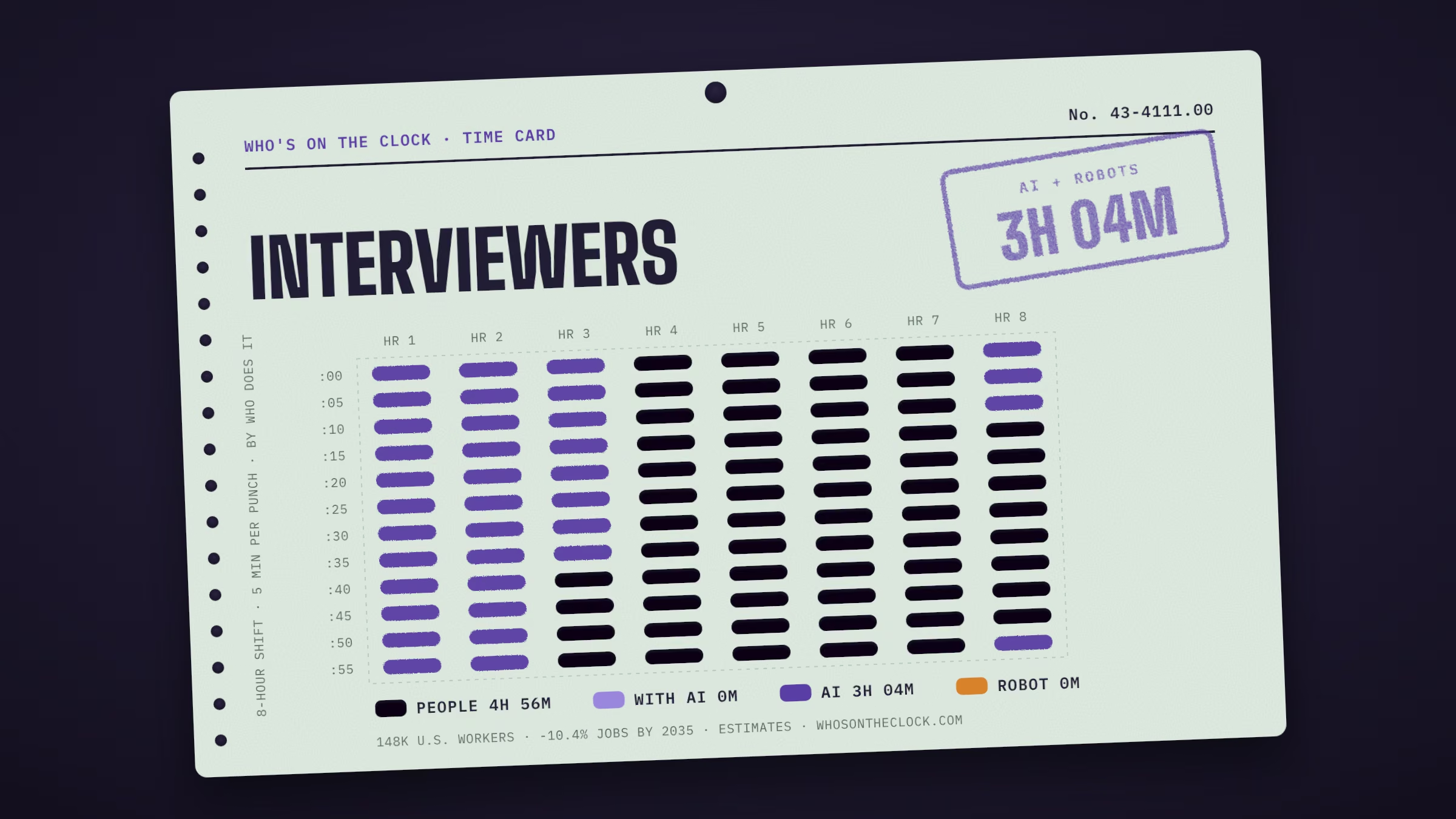
Some tasks are already handled by AI or machines; the rest still needs a person. About 3h 4m of an 8-hour shift goes to tasks that AI or robots largely take over. The other 4h 56m (62%) stays with people. Separately, BLS expects about 10.4% fewer of these jobs by 2035 (all jobs: +3.5%).
⤢ Full sizeEach mark is 5 minutes of a typical shift for interviewers, colored by who does that task today. Estimates from O*NET tasks and Anthropic Economic Index data. How it's made
Interview persons by telephone, mail, in person, or by other means for the purpose of completing forms, applications, or questionnaires. Ask specific questions, record answers, and assist persons with completing form. May sort, classify, and file forms.
Time card
Untick tasks you don't do, or set your own times.
Mine
Task, by time spent
Human
With AI
AI
Robot
Ask questions in accordance with instructions to obtain various specified information, such as person's name, address, age, religious preference, or state of residency.1h 46m a shift · Observed in AI use
Compile, record, and code results or data from interview or survey, using computer or specified form.56m a shift · Observed in AI useTypical AI request: about 5h 58m alone, 28m with AI
Assist individuals in filling out applications or questionnaires.42m a shift · No AI or robot evidence found
Ensure payment for services by verifying benefits with the person's insurance provider or working out financing options.35m a shift · No AI or robot evidence found
Perform office duties, such as telemarketing or customer service inquiries, maintaining staff records, billing patients, or receiving payments.35m a shift · No AI or robot evidence found
Review data obtained from interview for completeness and accuracy.35m a shift · No AI or robot evidence found
Perform patient services, such as answering the telephone or assisting patients with financial or medical questions.35m a shift · No AI or robot evidence found
Contact individuals to be interviewed at home, place of business, or field location, by telephone, mail, or in person.35m a shift · No AI or robot evidence found
Identify and resolve inconsistencies in interviewees' responses by means of appropriate questioning or explanation.21m a shift · No AI or robot evidence found
Explain survey objectives and procedures to interviewees and interpret survey questions to help interviewees' comprehension.21m a shift · No AI or robot evidence found
Identify and report problems in obtaining valid data.14m a shift · Observed in AI use
Locate and list addresses and households.14m a shift · No AI or robot evidence found
Supervise or train other staff members.7m a shift · No AI or robot evidence found
Prepare reports to provide answers in response to specific problems.7m a shift · No AI or robot evidence found
Meet with supervisor daily to submit completed assignments and discuss progress.7m a shift · No AI or robot evidence found
Collect and analyze data, such as studying old records, tallying the number of outpatients entering each day or week, or participating in federal, state, or local population surveys as a Census Enumerator.7m a shift · Observed in AI useTypical AI request: about 4h 54m alone, 24m with AI
YouGov launches AI-moderated interviews for research studies
YouGov Voices lets survey respondents opt into an AI conversation that asks follow-up questions, then summarises themes. It is available in the UK, the US and Australia.
Some tasks are already handled by AI or machines; the rest still needs a person. About 3h 4m of an 8-hour shift goes to tasks that AI or robots largely take over. The other 4h 56m (62%) stays with people. Separately, BLS expects about 10.4% fewer of these jobs by 2035 (all jobs: +3.5%).
What can AI already do for interviewers?
AI shows up regularly in 4 of 16 tasks, about 3h 4m of a typical shift. The biggest ones:
Ask questions in accordance with instructions to obtain various specified information, such as person's name, address, age, religious preference, or state of residency. (1h 46m a shift, AI mostly does it alone)
Compile, record, and code results or data from interview or survey, using computer or specified form. (56m a shift, AI mostly does it alone)
Identify and report problems in obtaining valid data. (14m a shift, AI mostly does it alone)
Collect and analyze data, such as studying old records, tallying the number of outpatients entering each day or week, or participating in federal, state, or local population surveys as a Census Enumerator. (7m a shift, AI mostly does it alone)
What still needs a person?
4h 56m of a typical shift, or 62%, goes to tasks with no AI or robot evidence yet. No AI usage or robot deployment has shown up for these so far. The biggest:
Assist individuals in filling out applications or questionnaires. (42m a shift)
Ensure payment for services by verifying benefits with the person's insurance provider or working out financing options. (35m a shift)
Perform office duties, such as telemarketing or customer service inquiries, maintaining staff records, billing patients, or receiving payments. (35m a shift)
Review data obtained from interview for completeness and accuracy. (35m a shift)
Perform patient services, such as answering the telephone or assisting patients with financial or medical questions. (35m a shift)
Why is that work hard to automate?
Much of it comes down to where and how the work happens. In-person, hands-on and high-stakes work is where AI and robots have made the least headway so far. In the official O*NET survey of people in this job:
100% are in constant contact with other people
85% work at arm's length or closer to other people
77% say dealing with the public is very or extremely important
What are companies actually doing?
We track 1 sourced company move that affects this job. Most recent:
Sep 17, 2026: YouGov launches AI-moderated interviews for research studies (Rolling out)
How much time does AI save on these tasks?
For the 2 tasks in this job where AI shows up and timing data exists, a typical request takes about 5h 26m for a person alone and about 26m with AI. These are Claude's own estimates from real conversations in April and May 2026 (Anthropic Economic Index). They describe single requests, not whole workdays, and time saved on a task doesn't mean jobs are cut. The biggest gaps:
Compile, record, and code results or data from interview or survey, using computer or specified form (about 5h 58m alone, 28m with AI)
Collect and analyze data, such as studying old records, tallying the number of outpatients entering each day or week, or participating in federal, state, or local population surveys as a Census Enumerator (about 4h 54m alone, 24m with AI)
Are employers still hiring interviewers?
On Indeed, job postings in the Customer Service sector are at 87% of their February 2020 level (all U.S. postings: 104%), down 1.5% from a year earlier, as of Oct 9, 2026. BLS separately expects about 13,000 openings a year in this job through 2035. Across all U.S. postings, 7.3% now mention AI skills. Sector postings cover more than this one job and move for many reasons besides AI.
How much do interviewers make?
The median pay is about $45,920 a year ($22.08 an hour), 10% below the median for all U.S. jobs ($50,980). Most people in this job earn between $33,900 and $62,810 a year; that range covers the middle 80%. Pay figures are from BLS, May 2025, and vary a lot by state and employer. Pick a state to compare:
Is this job growing or shrinking?
BLS projects a decline of 10.4% from 2025 to 2035, compared with 3.5% growth for all jobs. That's about 138,000 jobs in 2035. Even so, it expects about 13,000 openings a year, mostly from people retiring or changing careers. These projections don't single out AI as a cause.
How many interviewers are there in the U.S.?
About 148,000 people in the U.S., roughly 0.10% of all workers (BLS, May 2025). That makes it the 216th largest of the 796 jobs on this site. BLS expects about 138,000 in 2035.
What training do interviewers need?
The most common requirement is a high school diploma: about 42% of people in the job said so in the official O*NET survey. O*NET rates the job at level 3 of 5 for preparation, which usually means: vocational school or associate's degree. Requirements vary by state and employer, especially for licensed work.
What should I learn to stay ahead of AI?
These come from the job's official skill ratings and from the tasks that AI and robots touch least today. Building them keeps you strong in the parts of the work that still need a person:
Skills that matter more here than in most jobs: Active Listening, Negotiation, Speaking, Service Orientation
Get strong at the parts of the job that stay with people (listed above), which take 4h 56m of a typical shift
Tools employers list: Zoom, MEDITECH software, Microsoft Excel, Microsoft Office software, Microsoft Outlook
Learn to use AI well on the tasks where it already shows up in this job (listed above)
What other jobs could interviewers move into?
These use similar skills, with less of a typical shift touched by AI or robots. Matches come from 109 official ratings of skills, knowledge and work activities, and each needs the same or less preparation unless the official list relates the jobs directly:
Patient Representatives (1h 46m touched, $50k median pay)
Government Programs Eligibility Interviewers (32m touched, $54k median pay)
How solid are these numbers?
Each task carries its own evidence label. For this job: 4 observed in real AI use, 12 with no AI or robot evidence found. The minutes per task are estimates, not measured hours, and "no evidence" doesn't prove a task is safe.
Tools in demand
Zoom
MEDITECH software
Microsoft Excel
Microsoft Office software
Microsoft Outlook
Microsoft PowerPoint
Microsoft Word
Oracle PeopleSoft
Also called
Admissions Advisor, Admissions Associate, Admissions Clerk, Admissions Recruiter, Admissions Representative, Admissions Specialist, Admitting Clerk, Admitting Interviewer, Admitting Representative, Admitting Worker, Bilingual Field Interviewer, Canvasser, Census Clerk, Census Enumerator