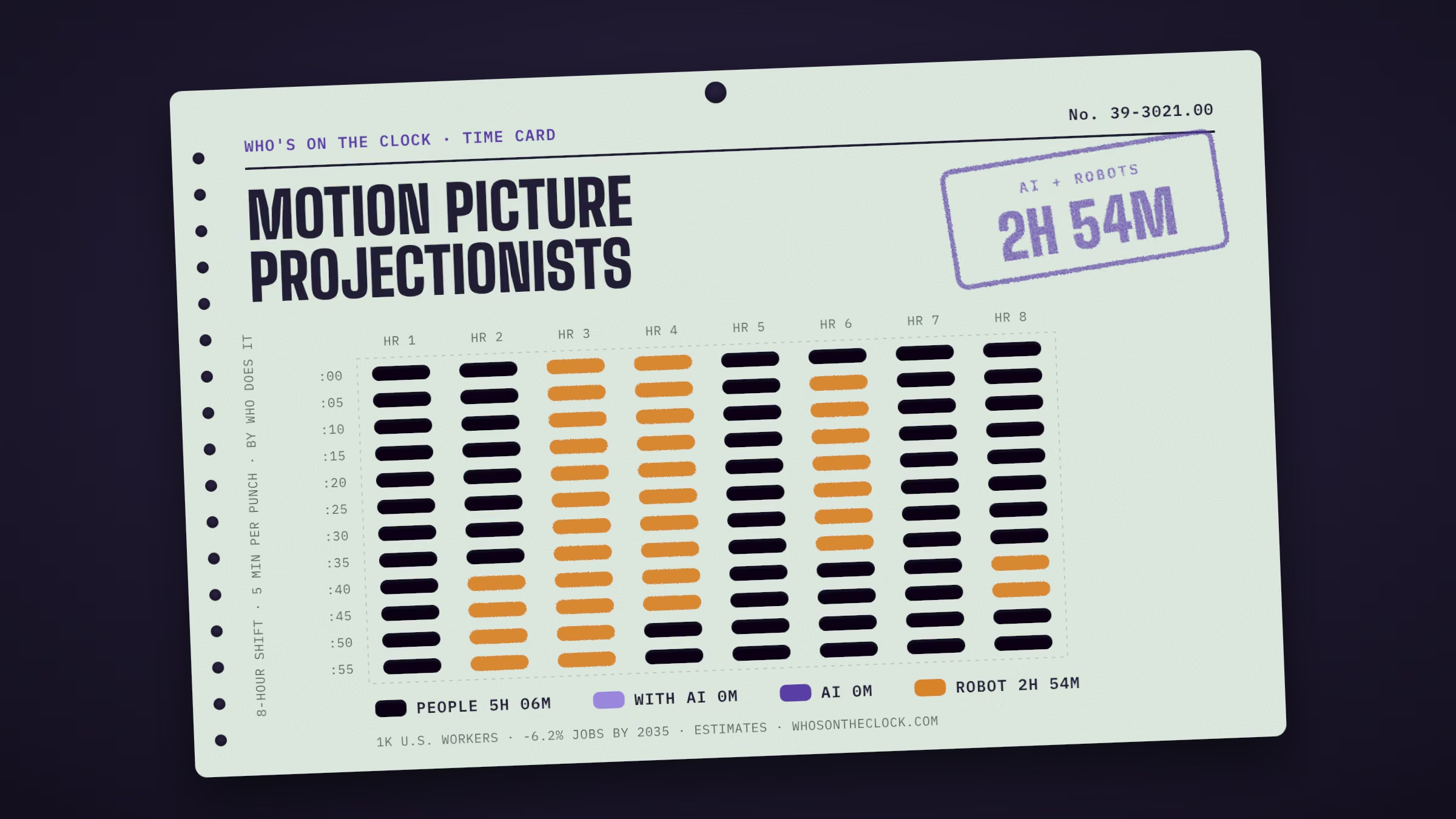
Some tasks are already handled by AI or machines; the rest still needs a person. About 2h 54m of an 8-hour shift goes to tasks that AI or robots largely take over. The other 5h 6m (64%) stays with people. Separately, BLS expects about 6.2% fewer of these jobs by 2035 (all jobs: +3.5%).
⤢ Full sizeEach mark is 5 minutes of a typical shift for motion picture projectionists, colored by who does that task today. Estimates from O*NET tasks and Anthropic Economic Index data. How it's made
Perform regular maintenance tasks, such as rotating or replacing xenon bulbs, cleaning projectors and lenses, lubricating machinery, and keeping electrical contacts clean and tight.41m a shift · Robots only in factory cells
Open and close facilities according to rules and schedules.33m a shift · Robots only in factory cells
Set up and adjust picture projectors and screens to achieve proper size, illumination, and focus of images, and proper volume and tone of sound.33m a shift · Robots deployed · e.g. Christie Mystique Cinema at Pathe Royal Theater Tuschinski
Inspect projection equipment prior to operation to ensure proper working order.25m a shift · Robots only in factory cells
Inspect movie films to ensure that they are complete and in good condition.25m a shift · Robots only in factory cells
Perform minor repairs, such as replacing worn sprockets, or notify maintenance personnel of the need for major repairs.17m a shift · Robots only in factory cells
Clean the projection booth.17m a shift · Robots only in factory cells
Prepare film inspection reports, attendance sheets, and log books.17m a shift · No AI or robot evidence found
Splice separate film reels, advertisements, and movie trailers together to form a feature-length presentation on one continuous reel.17m a shift · No AI or robot evidence found
Set up and inspect curtain and screen controls.8m a shift · Robots only in factory cells
Install and connect auxiliary equipment, such as microphones, amplifiers, disc playback machines, and lights.8m a shift · Robots only in factory cells
Remove full take-up reels and run film through rewinding machines to rewind projected films so they may be shown again.time not estimated · Robots only in factory cells
Observe projector operation to anticipate need to transfer operations from one projector to another.time not estimated · No AI or robot evidence found
On the floor
No company news tracked for this job yet. New stories are added as they happen.
Ask the clock
Will AI replace motion picture projectionists?
Some tasks are already handled by AI or machines; the rest still needs a person. About 2h 54m of an 8-hour shift goes to tasks that AI or robots largely take over. The other 5h 6m (64%) stays with people. Separately, BLS expects about 6.2% fewer of these jobs by 2035 (all jobs: +3.5%).
What parts of the job can AI already do?
None of this job's tasks show regular AI use yet. That can mean the work is hands-on or in person, or simply that it rarely comes up in AI usage data.
Where do robots fit in?
For some tasks, yes. Robots have done 4 of this job's tasks in workplaces like this one, about 2h 54m of a typical shift. 9 more tasks have only been done in factory setups built around the machine, so they stay with people here. For 1 physical task, no robot has shown it can do the work yet.
Operate equipment to show films in a number of theaters simultaneously. (1h 23m a shift; e.g. GDC TMS-2000 / Cinema Automation CA2.0, in use)
Start projectors and open shutters to project images onto screens. (50m a shift; e.g. Digital cinema automation / show control systems (industry overview), in use)
Set up and adjust picture projectors and screens to achieve proper size, illumination, and focus of images, and proper volume and tone of sound. (33m a shift; e.g. Christie Mystique Cinema at Pathe Royal Theater Tuschinski, in use)
Coordinate equipment operation with presentation of supplemental material, such as music, oral commentaries, or sound effects. (8m a shift; e.g. GDC Cinema Automation 2.0 (CA2.0) with SR-1000/SX-3000 media servers, in use)
What parts of the job are still done by people?
5h 6m of a typical shift, or 64%, goes to tasks with no AI or robot evidence yet. No AI usage or robot deployment has shown up for these so far. The biggest:
Monitor operations to ensure that standards for sound and image projection quality are met. (1h 39m a shift)
Perform regular maintenance tasks, such as rotating or replacing xenon bulbs, cleaning projectors and lenses, lubricating machinery, and keeping electrical contacts clean and tight. (41m a shift)
Open and close facilities according to rules and schedules. (33m a shift)
Inspect projection equipment prior to operation to ensure proper working order. (25m a shift)
Inspect movie films to ensure that they are complete and in good condition. (25m a shift)
Why does a person still do this work?
Part of the answer is the setting, not just the tasks. Work that is in person, hands on or high stakes is where AI and robots have made the least headway so far. In the official O*NET survey of people in this job:
59% use their hands on tools, objects or controls more than half the time
53% talk face to face with others every day
Are employers still hiring for this job?
On Indeed, job postings in the Hospitality & Tourism sector are at 83% of their February 2020 level (all U.S. postings: 104%), down 5.2% from a year earlier, as of Oct 9, 2026. BLS separately expects about 300 openings a year in this job through 2035. Across all U.S. postings, 7.3% now mention AI skills. Sector postings cover more than this one job and move for many reasons besides AI.
How much do motion picture projectionists make?
The median pay is about $38,270 a year ($18.40 an hour), 25% below the median for all U.S. jobs ($50,980). Most people in this job earn between $23,390 and $88,310 a year; that range covers the middle 80%. Pay figures are from BLS, May 2025, and vary a lot by state and employer. Pick a state to compare:
Is this job growing or shrinking?
BLS projects a decline of 6.2% from 2025 to 2035, compared with 3.5% growth for all jobs. That's about 1,400 jobs in 2035. Even so, it expects about 300 openings a year, mostly from people retiring or changing careers. These projections don't single out AI as a cause.
How many people do this job?
About 1,480 people in the U.S., roughly 0.00% of all workers (BLS, May 2025). That makes it the 781st largest of the 796 jobs on this site. BLS expects about 1,400 in 2035.
What do you need to become one?
The most common requirement is a high school diploma: about 61% of people in the job said so in the official O*NET survey. O*NET rates the job at level 2 of 5 for preparation, which usually means: high school diploma, some training. Requirements vary by state and employer, especially for licensed work.
What should I learn to stay ahead?
These come from the job's official skill ratings and from the tasks that AI and robots touch least today. Building them keeps you strong in the parts of the work that still need a person:
Skills that matter more here than in most jobs: Operation and Control, Operations Monitoring, Reading Comprehension, Speaking
Get strong at the parts of the job that stay with people (listed above), which take 5h 6m of a typical shift
Tools employers list: Apple macOS, Autodesk AutoCAD, Facebook, Microsoft Excel, Microsoft Office software
Are there new tasks in this job?
Yes. Occupational experts recently added these to the official task list, a sign of how the work itself is shifting. New tasks aren't rated for AI or robots yet:
Download digital keys to unlock digital movie files.
Ingest digital content, such as films, advertisements, or trailers, into servers or projectors.
What similar jobs could I move into?
These use similar skills. Matches come from 109 official ratings of skills, knowledge and work activities, and each needs the same or less preparation unless the official list relates the jobs directly:
Camera and Photographic Equipment Repairers (19m touched, $53k median pay)
Lighting Technicians (0m touched, $68k median pay)
Audiovisual Equipment Installers and Repairers (0m touched, $53k median pay)
Photographic Process Workers and Processing Machine Operators (2h 10m touched, $41k median pay)
Audio and Video Technicians (6m touched, $58k median pay)
How solid are these numbers?
Each task carries its own evidence label. For this job: 4 with robots in real deployments, 13 with no AI or robot evidence found. The minutes per task are estimates, not measured hours, and "no evidence" doesn't prove a task is safe.
Tools in demand
Apple macOS
Autodesk AutoCAD
Facebook
Microsoft Excel
Microsoft Office software
Microsoft Outlook
Microsoft PowerPoint
Microsoft Word
Also called
Booth Operator, Booth Usher, Cinema Operator, Cinema Projectionist, Cinematographer, Digital Projectionist, Equipment Operator, Film Projector Operator, Film Specialist, Machine Operator, Motion Picture Operator, Motion Picture Projectionist, Movie Machine Operator, Movie Operator