Will AI replace pesticide handlers, sprayers, and applicators, vegetation?
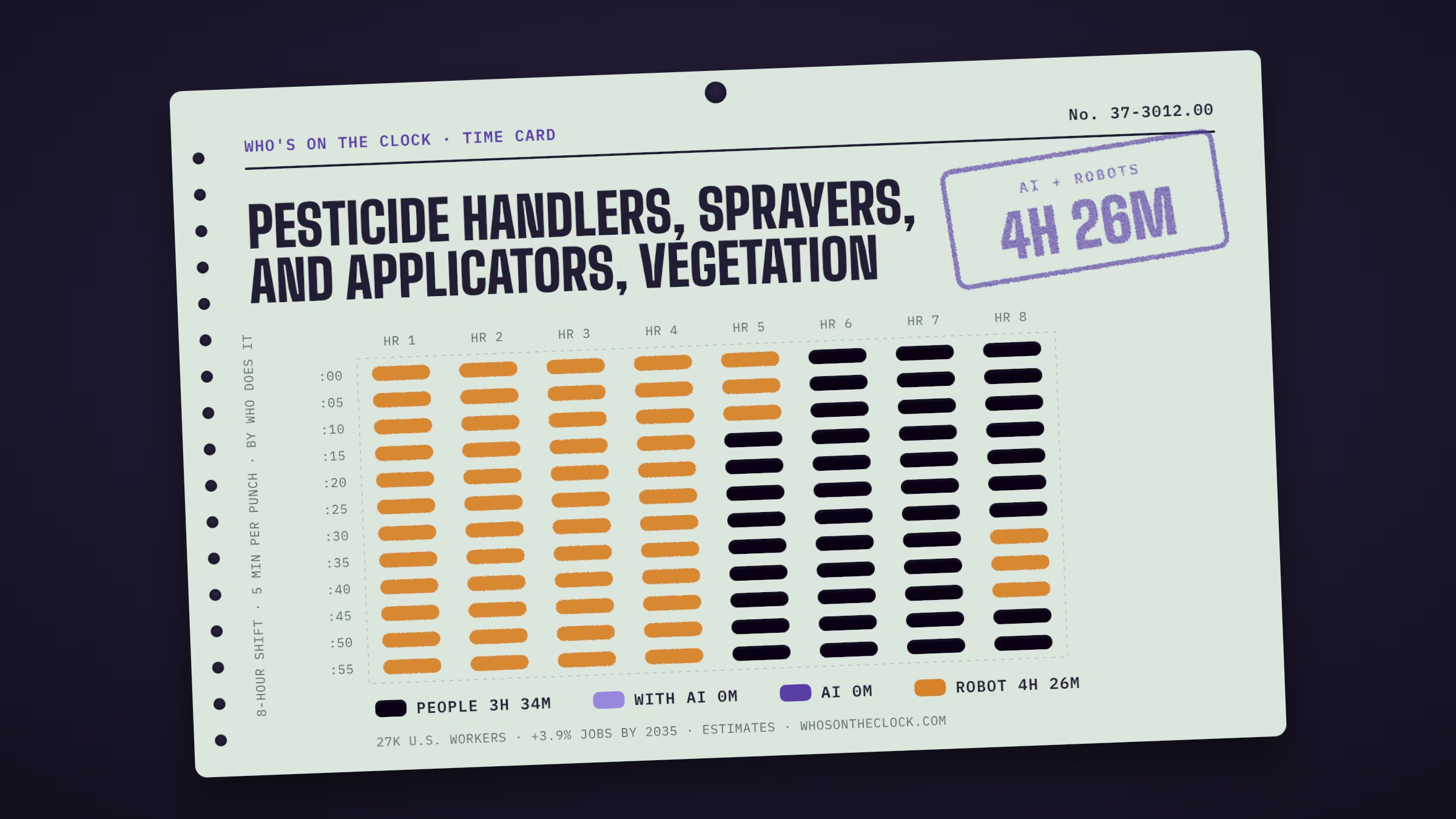
Some tasks are already handled by AI or machines; the rest still needs a person. About 4h 26m of an 8-hour shift goes to tasks that AI or robots largely take over. The other 3h 34m (45%) stays with people. Separately, BLS expects about 3.9% more of these jobs by 2035 (all jobs: +3.5%).
⤢ Full sizeEach mark is 5 minutes of a typical shift for pesticide handlers, sprayers, and applicators, vegetation, colored by who does that task today. Estimates from O*NET tasks and Anthropic Economic Index data. How it's made
Mix or apply pesticides, herbicides, fungicides, or insecticides through sprays, dusts, vapors, soil incorporation, or chemical application on trees, shrubs, lawns, or crops. Usually requires specific training and state or federal certification.
Cover areas to specified depths with pesticides, applying knowledge of weather conditions, droplet sizes, elevation-to-distance ratios, and obstructions.1h 29m a shift · Robots deployed · e.g. GUSS / Mini GUSS / Herbicide GUSS autonomous sprayers
Mix pesticides, herbicides, or fungicides for application to trees, shrubs, lawns, or botanical crops.44m a shift · Robots only in factory cells
Clean or service machinery to ensure operating efficiency, using water, gasoline, lubricants, or hand tools.44m a shift · No AI or robot evidence found
Fill sprayer tanks with water and chemicals, according to formulas.37m a shift · Robots only in factory cells
Identify lawn or plant diseases to determine the appropriate course of treatment.37m a shift · Robots only in factory cells
Connect hoses and nozzles selected according to terrain, distribution pattern requirements, types of infestations, and velocities.22m a shift · Robots only in factory cells
Plant grass with seed spreaders, and operate straw blowers to cover seeded areas with mixtures of asphalt and straw.22m a shift · Robots only in factory cells
Provide driving instructions to truck drivers to ensure complete coverage of designated areas, using hand and horn signals.7m a shift · No AI or robot evidence found
On the floor
No company news tracked for this job yet. New stories are added as they happen.
Ask the clock
Will AI replace pesticide handlers, sprayers, and applicators, vegetation?
Some tasks are already handled by AI or machines; the rest still needs a person. About 4h 26m of an 8-hour shift goes to tasks that AI or robots largely take over. The other 3h 34m (45%) stays with people. Separately, BLS expects about 3.9% more of these jobs by 2035 (all jobs: +3.5%).
What can AI already do for pesticide handlers, sprayers, and applicators, vegetation?
None of this job's tasks show regular AI use yet. That can mean the work is hands-on or in person, or simply that it rarely comes up in AI usage data.
Where do robots fit in?
For some tasks, yes. Robots have done 3 of this job's tasks in workplaces like this one, about 4h 26m of a typical shift. 5 more tasks have only been done in factory setups built around the machine, so they stay with people here. For 1 physical task, no robot has shown it can do the work yet.
Lift, push, and swing nozzles, hoses, and tubes to direct spray over designated areas. (2h 42m a shift; e.g. Turf Tank Two autonomous line-marking robot, in use)
Cover areas to specified depths with pesticides, applying knowledge of weather conditions, droplet sizes, elevation-to-distance ratios, and obstructions. (1h 29m a shift; e.g. GUSS / Mini GUSS / Herbicide GUSS autonomous sprayers, in use)
Start motors and engage machinery, such as sprayer agitators or pumps or portable spray equipment. (15m a shift; e.g. GUSS / Herbicide GUSS autonomous orchard sprayer (John Deere), in use)
What still needs a person?
3h 34m of a typical shift, or 45%, goes to tasks with no AI or robot evidence yet. No AI usage or robot deployment has shown up for these so far. The biggest:
Mix pesticides, herbicides, or fungicides for application to trees, shrubs, lawns, or botanical crops. (44m a shift)
Clean or service machinery to ensure operating efficiency, using water, gasoline, lubricants, or hand tools. (44m a shift)
Fill sprayer tanks with water and chemicals, according to formulas. (37m a shift)
Identify lawn or plant diseases to determine the appropriate course of treatment. (37m a shift)
Connect hoses and nozzles selected according to terrain, distribution pattern requirements, types of infestations, and velocities. (22m a shift)
Why is that work hard to automate?
Much of it comes down to where and how the work happens. In-person, hands-on and high-stakes work is where AI and robots have made the least headway so far. In the official O*NET survey of people in this job:
93% work outdoors in all weather every day
79% use their hands on tools, objects or controls more than half the time
77% say a mistake would be very or extremely serious
Are employers still hiring pesticide handlers, sprayers, and applicators, vegetation?
On Indeed, job postings in the Cleaning & Sanitation sector are at 102% of their February 2020 level (all U.S. postings: 104%), up 2.1% from a year earlier, as of Oct 9, 2026. BLS separately expects about 3,300 openings a year in this job through 2035. Across all U.S. postings, 7.3% now mention AI skills. Sector postings cover more than this one job and move for many reasons besides AI.
How much do pesticide handlers, sprayers, and applicators, vegetation make?
The median pay is about $46,340 a year ($22.28 an hour), 9% below the median for all U.S. jobs ($50,980). Most people in this job earn between $35,570 and $61,420 a year; that range covers the middle 80%. Pay figures are from BLS, May 2025, and vary a lot by state and employer. Pick a state to compare:
Is this job growing or shrinking?
BLS projects growth of 3.9% from 2025 to 2035, compared with 3.5% growth for all jobs. That's about 27,000 jobs in 2035. It expects about 3,300 openings a year, mostly from people retiring or changing careers. These projections don't single out AI as a cause.
How many pesticide handlers, sprayers, and applicators, vegetation are there in the U.S.?
About 27,000 people in the U.S., roughly 0.02% of all workers (BLS, May 2025). That makes it the 496th largest of the 796 jobs on this site. BLS expects about 27,000 in 2035.
What training do pesticide handlers, sprayers, and applicators, vegetation need?
The most common requirement is a high school diploma: about 56% of people in the job said so in the official O*NET survey. O*NET rates the job at level 2 of 5 for preparation, which usually means: high school diploma, some training. Requirements vary by state and employer, especially for licensed work.
What should I learn to stay ahead of AI?
These come from the job's official skill ratings and from the tasks that AI and robots touch least today. Building them keeps you strong in the parts of the work that still need a person:
Skills that matter more here than in most jobs: Operation and Control, Operations Monitoring, Time Management, Coordination
Get strong at the parts of the job that stay with people (listed above), which take 3h 34m of a typical shift
Tools employers list: Facebook, Google Android, Microsoft Excel, Microsoft Office software, Microsoft Outlook
What new tasks are pesticide handlers, sprayers, and applicators, vegetation taking on?
Yes. Occupational experts recently added these to the official task list, a sign of how the work itself is shifting. New tasks aren't rated for AI or robots yet:
Establish driving routes for pesticide applications.
Record information about pesticide applications, such as the type used and amount applied.
Use new technology and equipment, such as drones or GPS systems, to apply pesticides more accurately and efficiently.
What other jobs could pesticide handlers, sprayers, and applicators, vegetation move into?
These use similar skills. Matches come from 109 official ratings of skills, knowledge and work activities, and each needs the same or less preparation unless the official list relates the jobs directly:
Cleaners of Vehicles and Equipment (1h 11m touched, $36k median pay)
How solid are these numbers?
Each task carries its own evidence label. For this job: 3 with robots in real deployments, 7 with no AI or robot evidence found. The minutes per task are estimates, not measured hours, and "no evidence" doesn't prove a task is safe.
Tools in demand
Facebook
Google Android
Microsoft Excel
Microsoft Office software
Microsoft Outlook
Also called
Agricultural Service Worker, Applicator, Applicator Sprayer, Certified Pesticide Applicator, Chemical Applicator, Commercial Lawn Specialist, Crop Applicator, Eradicator, Fertilizer Applicator, Fruit Sprayer, Fumigator, Hand Spray Operator, Hand Sprayer, Herbicide Sprayer