Will AI replace substance abuse and behavioral disorder counselors?

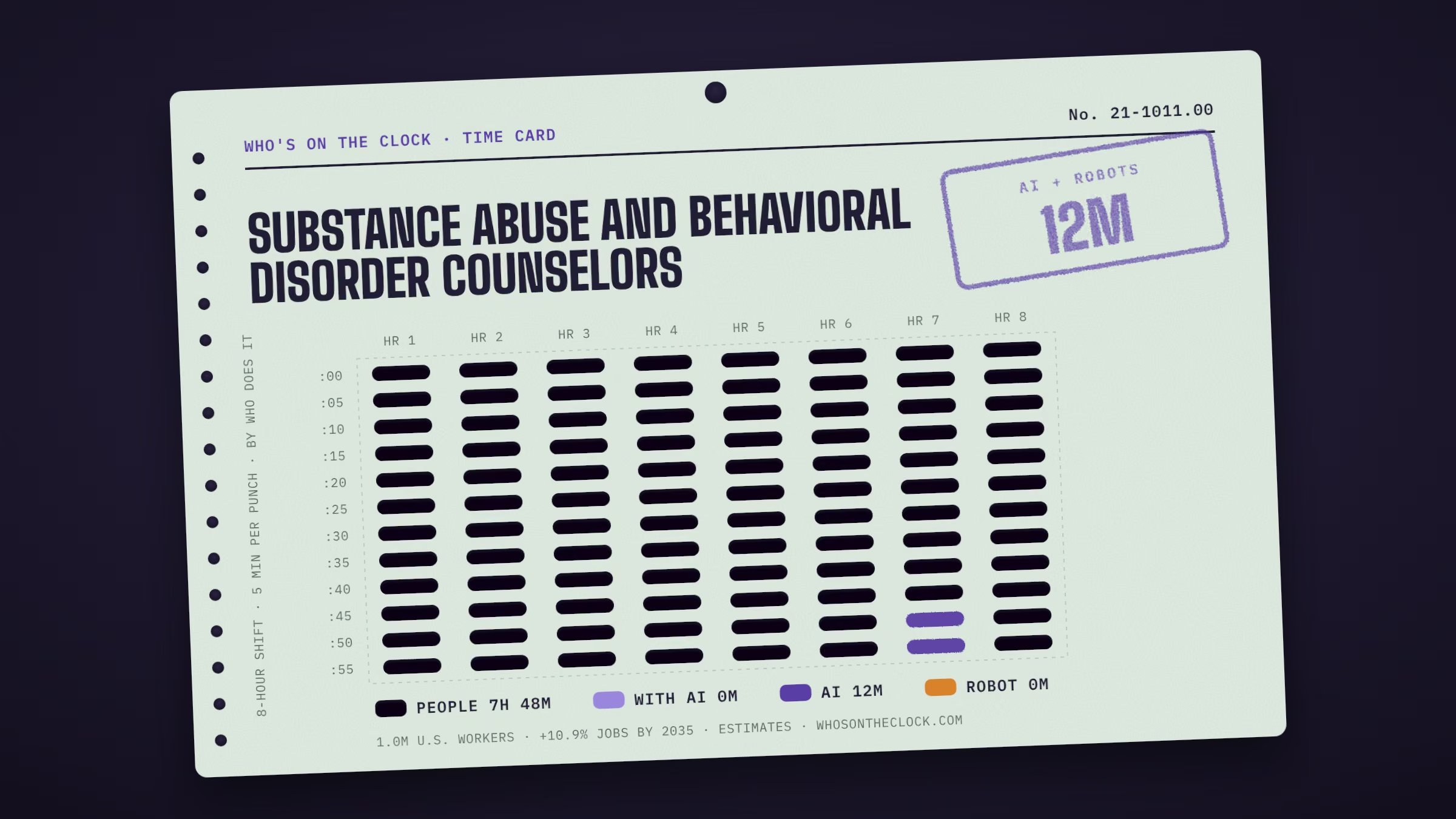
Not on current evidence. Less than 30 minutes of a typical shift goes to tasks that AI or robots are doing today. The other 7h 47m (97%) stays with people. Separately, BLS expects about 10.9% more of these jobs by 2035 (all jobs: +3.5%).

Time card for substance abuse and behavioral disorder counselors showing a typical 8-hour shift: 7h 47m done by people, 12m by AI.
Each mark is 5 minutes of a typical shift for substance abuse and behavioral disorder counselors, colored by who does that task today. Estimates from O*NET tasks and Anthropic Economic Index data. How it's made

Home / Social services / Substance Abuse and Behavioral Disorder Counselors

Counsel and advise individuals with alcohol, tobacco, drug, or other problems, such as gambling and eating disorders. May counsel individuals, families, or groups or engage in prevention programs.

Time card

Untick tasks you don't do, or set your own times.
MineTask, by time spentHumanWith AIAIRobot
Counsel clients or patients, individually or in group sessions, to assist in overcoming dependencies, adjusting to life, or making changes.2h 28m a shift · No AI or robot evidence found
Complete and maintain accurate records or reports regarding the patients' histories and progress, services provided, or other required information.1h 26m a shift · No AI or robot evidence found
Interview clients, review records, and confer with other professionals to evaluate individuals' mental and physical condition and to determine their suitability for participation in a specific program.31m a shift · No AI or robot evidence found
Participate in case conferences or staff meetings.25m a shift · No AI or robot evidence found
Review and evaluate clients' progress in relation to measurable goals described in treatment and care plans.18m a shift · No AI or robot evidence found
Develop client treatment plans based on research, clinical experience, and client histories.18m a shift · No AI or robot evidence found
Coordinate counseling efforts with mental health professionals or other health professionals, such as doctors, nurses, or social workers.18m a shift · No AI or robot evidence found
Assess individuals' degree of drug dependency by collecting and analyzing urine samples.12m a shift · No AI or robot evidence found
Coordinate activities with courts, probation officers, community services, or other post-treatment agencies.12m a shift · No AI or robot evidence found
Modify treatment plans to comply with changes in client status.12m a shift · No AI or robot evidence found
Plan or implement follow-up or aftercare programs for clients to be discharged from treatment programs.12m a shift · No AI or robot evidence found
Provide clients or family members with information about addiction issues and about available services or programs, making appropriate referrals when necessary.12m a shift · Observed in AI use
Counsel family members to assist them in understanding, dealing with, and supporting clients or patients.12m a shift · No AI or robot evidence found
Follow progress of discharged patients to determine effectiveness of treatments.6m a shift · No AI or robot evidence found
Conduct chemical dependency program orientation sessions.6m a shift · No AI or robot evidence found
Intervene as an advocate for clients or patients to resolve emergency problems in crisis situations.6m a shift · No AI or robot evidence found
Attend training sessions to increase knowledge and skills.6m a shift · No AI or robot evidence found
Instruct others in program methods, procedures, or functions.6m a shift · No AI or robot evidence found
Act as liaisons between clients and medical staff.6m a shift · No AI or robot evidence found
Train or supervise student interns or new staff members.6m a shift · No AI or robot evidence found
Confer with family members or others close to clients to keep them informed of treatment planning and progress.6m a shift · No AI or robot evidence found
Develop, implement, or evaluate public education, prevention, or health promotion programs, working in collaboration with organizations, institutions, or communities.6m a shift · No AI or robot evidence found
Supervise or direct other workers providing services to clients or patients.6m a shift · No AI or robot evidence found

On the floor

No company news tracked for this job yet. New stories are added as they happen.

Ask the clock

Will AI replace substance abuse and behavioral disorder counselors?

Not on current evidence. Less than 30 minutes of a typical shift goes to tasks that AI or robots are doing today. The other 7h 47m (97%) stays with people. Separately, BLS expects about 10.9% more of these jobs by 2035 (all jobs: +3.5%).

What parts of the job can AI already do?

AI shows up regularly in 1 of 23 tasks, about 12m of a typical shift. The biggest ones:

  • Provide clients or family members with information about addiction issues and about available services or programs, making appropriate referrals when necessary. (12m a shift, AI mostly does it alone)
Can a robot do this job?

Not in workplaces like this one, based on a 2026 review of robot deployments. For 1 physical task, no robot has shown it can do the work yet.

What parts of the job are still done by people?

7h 47m of a typical shift, or 97%, goes to tasks with no AI or robot evidence yet. No AI usage or robot deployment has shown up for these so far. The biggest:

  • Counsel clients or patients, individually or in group sessions, to assist in overcoming dependencies, adjusting to life, or making changes. (2h 28m a shift)
  • Complete and maintain accurate records or reports regarding the patients' histories and progress, services provided, or other required information. (1h 26m a shift)
  • Interview clients, review records, and confer with other professionals to evaluate individuals' mental and physical condition and to determine their suitability for participation in a specific program. (31m a shift)
  • Participate in case conferences or staff meetings. (25m a shift)
  • Review and evaluate clients' progress in relation to measurable goals described in treatment and care plans. (18m a shift)
Why does a person still do this work?

Part of the answer is the setting, not just the tasks. Work that is in person, hands on or high stakes is where AI and robots have made the least headway so far. In the official O*NET survey of people in this job:

  • 93% are in constant contact with other people
  • 85% carry high or very high responsibility for other workers' safety
  • 68% say dealing with the public is very or extremely important
Are employers still hiring for this job?

On Indeed, job postings in the Community & Social Service sector are at 105% of their February 2020 level (all U.S. postings: 104%), down 6.2% from a year earlier, as of Oct 9, 2026. BLS separately expects about 98,000 openings a year in this job through 2035. Across all U.S. postings, 7.3% now mention AI skills. Sector postings cover more than this one job and move for many reasons besides AI.

How much do substance abuse and behavioral disorder counselors make?

The median pay is about $60,320 a year ($29.00 an hour), 18% above the median for all U.S. jobs ($50,980). Most people in this job earn between $39,250 and $100,900 a year; that range covers the middle 80%. Pay figures are from BLS, May 2025, and vary a lot by state and employer.

Is this job growing or shrinking?

BLS projects growth of 10.9% from 2025 to 2035, compared with 3.5% growth for all jobs. That's about 1.3 million jobs in 2035. It expects about 98,000 openings a year, mostly from people retiring or changing careers. These projections don't single out AI as a cause.

How many people do this job?

About 1 million people in the U.S., roughly 0.67% of all workers (BLS, May 2025). That makes it the 36th largest of the 796 jobs on this site. BLS expects about 1.3 million in 2035.

What do you need to become one?

The most common requirement is a master's degree: about 41% of people in the job said so in the official O*NET survey. O*NET rates the job at level 5 of 5 for preparation, which usually means: graduate degree. Requirements vary by state and employer, especially for licensed work.

What should I learn to stay ahead?

These come from the job's official skill ratings and from the tasks that AI and robots touch least today. Building them keeps you strong in the parts of the work that still need a person:

  • Skills that matter more here than in most jobs: Persuasion, Social Perceptiveness, Monitoring, Service Orientation
  • Get strong at the parts of the job that stay with people (listed above), which take 7h 47m of a typical shift
  • Tools employers list: Microsoft Excel, Microsoft Office software, Microsoft Outlook, Microsoft PowerPoint, Microsoft Word
  • Learn to use AI well on the tasks where it already shows up in this job (listed above)
What similar jobs could I move into?

These use similar skills. Matches come from 109 official ratings of skills, knowledge and work activities, and each needs the same or less preparation unless the official list relates the jobs directly:

  • Mental Health and Substance Abuse Social Workers (1h 14m touched, $60k median pay)
  • Child, Family, and School Social Workers (0m touched, $60k median pay)
  • Mental Health Counselors (19m touched, $60k median pay)
  • Healthcare Social Workers (1h 2m touched, $68k median pay)
  • Clinical and Counseling Psychologists (19m touched, $101k median pay)
How solid are these numbers?

Each task carries its own evidence label. For this job: 1 observed in real AI use, 22 with no AI or robot evidence found. The minutes per task are estimates, not measured hours, and "no evidence" doesn't prove a task is safe.

Tools in demand

  • Microsoft Excel
  • Microsoft Office software
  • Microsoft Outlook
  • Microsoft PowerPoint
  • Microsoft Word

Also called

Addiction Counselor, Addiction Recovery Specialist, Addiction Therapist, Addictions Counselor, Alcohol and Drug Counselor, Alcoholic Counselor, Alcoholism and Substance Abuse Counselor, Assessment Specialist, Behavior Technician (Behavior Tech), Behavior Therapist, Behavioral Analyst, Behavioral Clinician, Behavioral Specialist, Behavioral Technician