Will AI replace upholsterers?

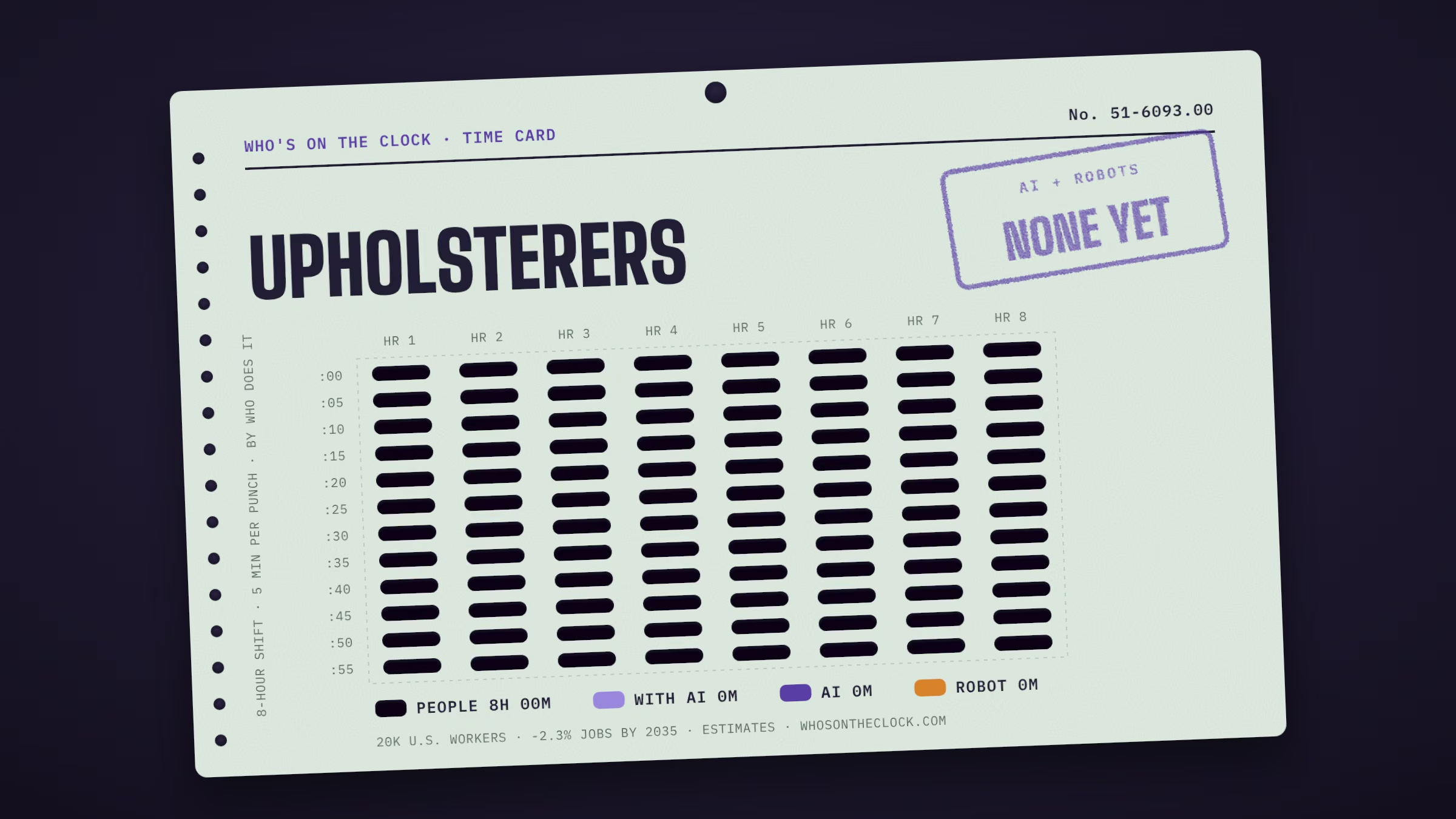
Not on current evidence. Less than 30 minutes of a typical shift goes to tasks that AI or robots are doing today. The other 8h (100%) stays with people. Separately, BLS expects about 2.3% fewer of these jobs by 2035 (all jobs: +3.5%).

Time card for upholsterers showing a typical 8-hour shift: 8h done by people.
Each mark is 5 minutes of a typical shift for upholsterers, colored by who does that task today. Estimates from O*NET tasks and Anthropic Economic Index data. How it's made

Home / Production & factory / Upholsterers

Make, repair, or replace upholstery for household furniture or transportation vehicles.

Time card

Untick tasks you don't do, or set your own times.
MineTask, by time spentHumanWith AIAIRobot
Fit, install, and secure material on frames, using hand tools, power tools, glue, cement, or staples.1h 34m a shift · No AI or robot evidence found
Measure and cut new covering materials, using patterns and measuring and cutting instruments, following sketches and design specifications.44m a shift · Robots only in factory cells
Operate sewing machines or sew upholstery by hand to seam cushions and join various sections of covering material.44m a shift · No AI or robot evidence found
Remove covering, webbing, padding, or defective springs from workpieces, using hand tools such as hammers and tack pullers.37m a shift · No AI or robot evidence found
Build furniture up with loose fiber stuffing, cotton, felt, or foam padding to form smooth, rounded surfaces.25m a shift · No AI or robot evidence found
Make, restore, or create custom upholstered furniture, using hand tools and knowledge of fabrics and upholstery methods.25m a shift · No AI or robot evidence found
Adjust or replace webbing, padding, or springs, and secure them in place.25m a shift · No AI or robot evidence found
Discuss upholstery fabrics, colors, and styles with customers, and provide cost estimates.25m a shift · No AI or robot evidence found
Read work orders, and apply knowledge and experience with materials to determine types and amounts of materials required to cover workpieces.19m a shift · No AI or robot evidence found
Make, repair, or replace automobile upholstery and convertible and vinyl tops, using knowledge of fabric and upholstery methods.19m a shift · No AI or robot evidence found
Examine furniture frames, upholstery, springs, and webbing to locate defects.12m a shift · No AI or robot evidence found
Sew rips or tears in material, or create tufting, using needles and thread.12m a shift · No AI or robot evidence found
Attach fasteners, grommets, buttons, buckles, ornamental trim, and other accessories to covers or frames, using hand tools.12m a shift · No AI or robot evidence found
Repair furniture frames and refinish exposed wood.12m a shift · No AI or robot evidence found
Interweave and fasten strips of webbing to the backs and undersides of furniture, using small hand tools and fasteners.12m a shift · No AI or robot evidence found
Draw cutting lines on material following patterns, templates, sketches, or blueprints, using chalk, pencils, paint, or other methods.12m a shift · Robots only in factory cells
Stretch webbing and fabric, using webbing stretchers.12m a shift · No AI or robot evidence found
Pick up and deliver furniture.12m a shift · Robots only in factory cells
Design upholstery cover patterns and cutting plans, based on sketches, customer descriptions, or blueprints.6m a shift · No AI or robot evidence found
Maintain records of time required to perform each job.6m a shift · No AI or robot evidence found
Attach bindings or apply solutions to edges of cut material to prevent raveling.6m a shift · Robots only in factory cells
Collaborate with interior designers to decorate rooms and coordinate furnishing fabrics.6m a shift · No AI or robot evidence found

On the floor

No company news tracked for this job yet. New stories are added as they happen.

Ask the clock

Will AI replace upholsterers?

Not on current evidence. Less than 30 minutes of a typical shift goes to tasks that AI or robots are doing today. The other 8h (100%) stays with people. Separately, BLS expects about 2.3% fewer of these jobs by 2035 (all jobs: +3.5%).

What can AI already do for upholsterers?

None of this job's tasks show regular AI use yet. That can mean the work is hands-on or in person, or simply that it rarely comes up in AI usage data.

Where do robots fit in?

Not in workplaces like this one, based on a 2026 review of robot deployments. 4 more tasks have only been done in factory setups built around the machine, so they stay with people here. For 13 physical tasks, no robot has shown it can do the work yet.

What still needs a person?

8h of a typical shift, or 100%, goes to tasks with no AI or robot evidence yet. No AI usage or robot deployment has shown up for these so far. The biggest:

  • Fit, install, and secure material on frames, using hand tools, power tools, glue, cement, or staples. (1h 34m a shift)
  • Measure and cut new covering materials, using patterns and measuring and cutting instruments, following sketches and design specifications. (44m a shift)
  • Operate sewing machines or sew upholstery by hand to seam cushions and join various sections of covering material. (44m a shift)
  • Remove covering, webbing, padding, or defective springs from workpieces, using hand tools such as hammers and tack pullers. (37m a shift)
  • Build furniture up with loose fiber stuffing, cotton, felt, or foam padding to form smooth, rounded surfaces. (25m a shift)
Why is that work hard to automate?

Much of it comes down to where and how the work happens. In-person, hands-on and high-stakes work is where AI and robots have made the least headway so far. In the official O*NET survey of people in this job:

  • 100% use their hands on tools, objects or controls more than half the time
  • 91% spend more than half the day on their feet
  • 61% work at arm's length or closer to other people
Are employers still hiring upholsterers?

On Indeed, job postings in the Production & Manufacturing sector are at 124% of their February 2020 level (all U.S. postings: 104%), up 12.6% from a year earlier, as of Oct 9, 2026. BLS separately expects about 1,700 openings a year in this job through 2035. Across all U.S. postings, 7.3% now mention AI skills. Sector postings cover more than this one job and move for many reasons besides AI.

How much do upholsterers make?

The median pay is about $46,340 a year ($22.28 an hour), 9% below the median for all U.S. jobs ($50,980). Most people in this job earn between $31,690 and $63,770 a year; that range covers the middle 80%. Pay figures are from BLS, May 2025, and vary a lot by state and employer. Pick a state to compare:

Is this job growing or shrinking?

BLS projects a decline of 2.3% from 2025 to 2035, compared with 3.5% growth for all jobs. That's about 22,000 jobs in 2035. Even so, it expects about 1,700 openings a year, mostly from people retiring or changing careers. These projections don't single out AI as a cause.

How many upholsterers are there in the U.S.?

About 20,000 people in the U.S., roughly 0.01% of all workers (BLS, May 2025). That makes it the 548th largest of the 796 jobs on this site. BLS expects about 22,000 in 2035.

What training do upholsterers need?

The most common requirement is a high school diploma: about 56% of people in the job said so in the official O*NET survey. O*NET rates the job at level 2 of 5 for preparation, which usually means: high school diploma, some training. Requirements vary by state and employer, especially for licensed work.

What should I learn to stay ahead of AI?

These come from the job's official skill ratings and from the tasks that AI and robots touch least today. Building them keeps you strong in the parts of the work that still need a person:

  • Skills that matter more here than in most jobs: Critical Thinking, Active Learning, Time Management, Complex Problem Solving
  • Get strong at the parts of the job that stay with people (listed above), which take 8h of a typical shift
  • Tools employers list: Autodesk AutoCAD, Intuit QuickBooks, Microsoft Excel, Microsoft Office software, Microsoft PowerPoint
What other jobs could upholsterers move into?

These use similar skills. Matches come from 109 official ratings of skills, knowledge and work activities, and each needs the same or less preparation unless the official list relates the jobs directly:

  • Furniture Finishers (0m touched, $45k median pay)
  • Cabinetmakers and Bench Carpenters (0m touched, $47k median pay)
  • Shoe and Leather Workers and Repairers (0m touched, $38k median pay)
  • Sawing Machine Setters, Operators, and Tenders, Wood (0m touched, $43k median pay)
  • Timing Device Assemblers and Adjusters (20m touched, $63k median pay)
How solid are these numbers?

Each task carries its own evidence label. For this job: 22 with no AI or robot evidence found. The minutes per task are estimates, not measured hours, and "no evidence" doesn't prove a task is safe.

Tools in demand

  • Autodesk AutoCAD
  • Intuit QuickBooks
  • Microsoft Excel
  • Microsoft Office software
  • Microsoft PowerPoint
  • Microsoft Windows
  • Microsoft Word

Also called

Aircraft Seat Upholsterer, Arm Maker, Arm Rest Builder, Automobile Upholsterer (Auto Upholsterer), Automotive Upholsterer, Body Trimmer Upholsterer, Box Spring Upholsterer, Car Seat Coverer, Car Seat Maker, Car Seat Upholsterer, Casket Coverer, Casket Trimmer, Chair Pad Maker, Chair Upholsterer