Will AI replace weatherization installers and technicians?

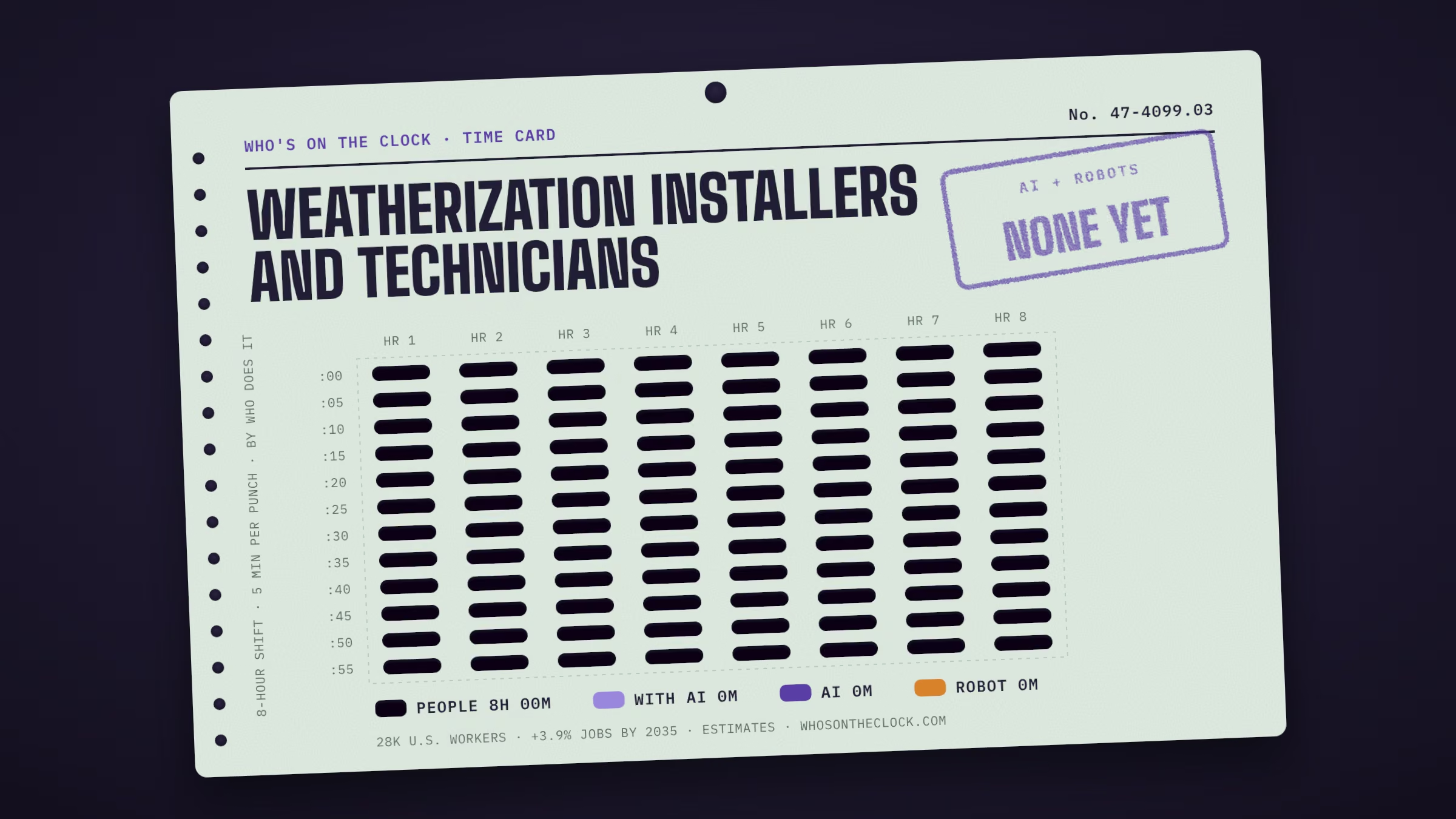
Not on current evidence. Less than 30 minutes of a typical shift goes to tasks that AI or robots are doing today. The other 8h (100%) stays with people. Separately, BLS expects about 3.9% more of these jobs by 2035 (all jobs: +3.5%).

Time card for weatherization installers and technicians showing a typical 8-hour shift: 8h done by people.
Each mark is 5 minutes of a typical shift for weatherization installers and technicians, colored by who does that task today. Estimates from O*NET tasks and Anthropic Economic Index data. How it's made

Home / Construction / Weatherization Installers and Technicians

Perform a variety of activities to weatherize homes and make them more energy efficient. Duties include repairing windows, insulating ducts, and performing heating, ventilating, and air-conditioning (HVAC) work. May perform energy audits and advise clients on energy conservation measures.

Time card

Untick tasks you don't do, or set your own times.
MineTask, by time spentHumanWith AIAIRobot
Apply insulation materials, such as loose, blanket, board, and foam insulation to attics, crawl spaces, basements, or walls.1h 37m a shift · Robots only in factory cells
Prepare and apply weather-stripping, glazing, caulking, or door sweeps to reduce energy losses.55m a shift · Robots only in factory cells
Make minor repairs using basic hand or power tools and materials, such as glass, lumber, and drywall.49m a shift · No AI or robot evidence found
Install and seal air ducts, combustion air openings, or ventilation openings to improve heating and cooling efficiency.36m a shift · Robots only in factory cells
Inspect buildings to identify required weatherization measures, including repair work, modification, or replacement.30m a shift · No AI or robot evidence found
Wrap air ducts and water lines with insulating materials, such as duct wrap and pipe insulation.24m a shift · Robots only in factory cells
Clean and maintain tools and equipment.24m a shift · No AI or robot evidence found
Apply spackling, compounding, or other materials to repair holes in walls.18m a shift · No AI or robot evidence found
Explain recommendations, policies, procedures, requirements, or other related information to residents or building owners.18m a shift · No AI or robot evidence found
Maintain activity logs, financial transaction logs, or other records of weatherization work performed.18m a shift · No AI or robot evidence found
Test combustible appliances, such as gas appliances.12m a shift · No AI or robot evidence found
Determine amount of air leakage in buildings, using a blower door machine.12m a shift · Robots only in factory cells
Test and diagnose air flow systems, using furnace efficiency analysis equipment.12m a shift · No AI or robot evidence found
Recommend weatherization techniques to clients in accordance with needs and applicable energy regulations, codes, policies, or statutes.12m a shift · No AI or robot evidence found
Prepare cost estimates or specifications for rehabilitation or weatherization services.12m a shift · No AI or robot evidence found
Contact residents or building owners to schedule appointments.12m a shift · No AI or robot evidence found
Prepare or assist in the preparation of bids, contracts, or written reports related to weatherization work.12m a shift · No AI or robot evidence found
Install storm windows or storm doors and verify proper fit.12m a shift · Robots only in factory cells
Explain energy conservation measures, such as the use of low flow showerheads and energy-efficient lighting.6m a shift · No AI or robot evidence found
Wrap water heaters with water heater blankets.6m a shift · Robots only in factory cells

On the floor

No company news tracked for this job yet. New stories are added as they happen.

Ask the clock

Will AI replace weatherization installers and technicians?

Not on current evidence. Less than 30 minutes of a typical shift goes to tasks that AI or robots are doing today. The other 8h (100%) stays with people. Separately, BLS expects about 3.9% more of these jobs by 2035 (all jobs: +3.5%).

What parts of the job can AI already do?

None of this job's tasks show regular AI use yet. That can mean the work is hands-on or in person, or simply that it rarely comes up in AI usage data.

Can a robot do this job?

Not in workplaces like this one, based on a 2026 review of robot deployments. 7 more tasks have only been done in factory setups built around the machine, so they stay with people here. For 6 physical tasks, no robot has shown it can do the work yet.

What parts of the job are still done by people?

8h of a typical shift, or 100%, goes to tasks with no AI or robot evidence yet. No AI usage or robot deployment has shown up for these so far. The biggest:

  • Apply insulation materials, such as loose, blanket, board, and foam insulation to attics, crawl spaces, basements, or walls. (1h 37m a shift)
  • Prepare and apply weather-stripping, glazing, caulking, or door sweeps to reduce energy losses. (55m a shift)
  • Make minor repairs using basic hand or power tools and materials, such as glass, lumber, and drywall. (49m a shift)
  • Install and seal air ducts, combustion air openings, or ventilation openings to improve heating and cooling efficiency. (36m a shift)
  • Inspect buildings to identify required weatherization measures, including repair work, modification, or replacement. (30m a shift)
Why does a person still do this work?

Part of the answer is the setting, not just the tasks. Work that is in person, hands on or high stakes is where AI and robots have made the least headway so far. In the official O*NET survey of people in this job:

  • 87% carry high or very high responsibility for other workers' safety
  • 83% spend more than half the day on their feet
  • 78% use their hands on tools, objects or controls more than half the time
Are employers still hiring for this job?

On Indeed, job postings in the Construction sector are at 129% of their February 2020 level (all U.S. postings: 104%), up 6.4% from a year earlier, as of Oct 9, 2026. BLS separately expects about 2,400 openings a year in this job through 2035. Across all U.S. postings, 7.3% now mention AI skills. Sector postings cover more than this one job and move for many reasons besides AI.

How much do weatherization installers and technicians make?

The median pay is about $49,910 a year ($24.00 an hour), 2% below the median for all U.S. jobs ($50,980). Most people in this job earn between $36,510 and $78,700 a year; that range covers the middle 80%. Pay figures are from BLS, May 2025, and vary a lot by state and employer.

Is this job growing or shrinking?

BLS projects growth of 3.9% from 2025 to 2035, compared with 3.5% growth for all jobs. That's about 31,000 jobs in 2035. It expects about 2,400 openings a year, mostly from people retiring or changing careers. These projections don't single out AI as a cause.

How many people do this job?

About 28,000 people in the U.S., roughly 0.02% of all workers (BLS, May 2025). That makes it the 489th largest of the 796 jobs on this site. BLS expects about 31,000 in 2035.

What do you need to become one?

The most common requirement is a high school diploma: about 61% of people in the job said so in the official O*NET survey. O*NET rates the job at level 2 of 5 for preparation, which usually means: high school diploma, some training. Requirements vary by state and employer, especially for licensed work.

What should I learn to stay ahead?

These come from the job's official skill ratings and from the tasks that AI and robots touch least today. Building them keeps you strong in the parts of the work that still need a person:

  • Skills that matter more here than in most jobs: Installation, Troubleshooting, Operation and Control, Quality Control Analysis
  • Get strong at the parts of the job that stay with people (listed above), which take 8h of a typical shift
  • Tools employers list: Microsoft Office software, Microsoft Excel, Microsoft Access, Microsoft Outlook, Microsoft PowerPoint
What similar jobs could I move into?

These use similar skills. Matches come from 109 official ratings of skills, knowledge and work activities, and each needs the same or less preparation unless the official list relates the jobs directly:

  • Heating, Air Conditioning, and Refrigeration Mechanics and Installers (12m touched, $61k median pay)
  • Carpenters (6m touched, $61k median pay)
  • Solar Photovoltaic Installers (12m touched, $53k median pay)
  • Solar Thermal Installers and Technicians (14m touched, $64k median pay)
  • Plumbers, Pipefitters, and Steamfitters (47m touched, $64k median pay)
How solid are these numbers?

Each task carries its own evidence label. For this job: 20 with no AI or robot evidence found. The minutes per task are estimates, not measured hours, and "no evidence" doesn't prove a task is safe.

Tools in demand

  • Microsoft Office software
  • Microsoft Excel
  • Microsoft Access
  • Microsoft Outlook
  • Microsoft PowerPoint
  • Microsoft Project
  • Microsoft Windows
  • Microsoft Word

Also called

Air Sealing Technician, Building Energy Retrofit Technician, Compounding Technician, Energy Administrator, Field Technician, Field Weatherization Specialist, Glass Sealing Technician, Home Weatherizing Worker, Residential Air Sealing Technician, Weatherization Crew Member, Weatherization Field Technician, Weatherization Installer, Weatherization Laborer, Weatherization Representative