Will AI replace airfield operations specialists?

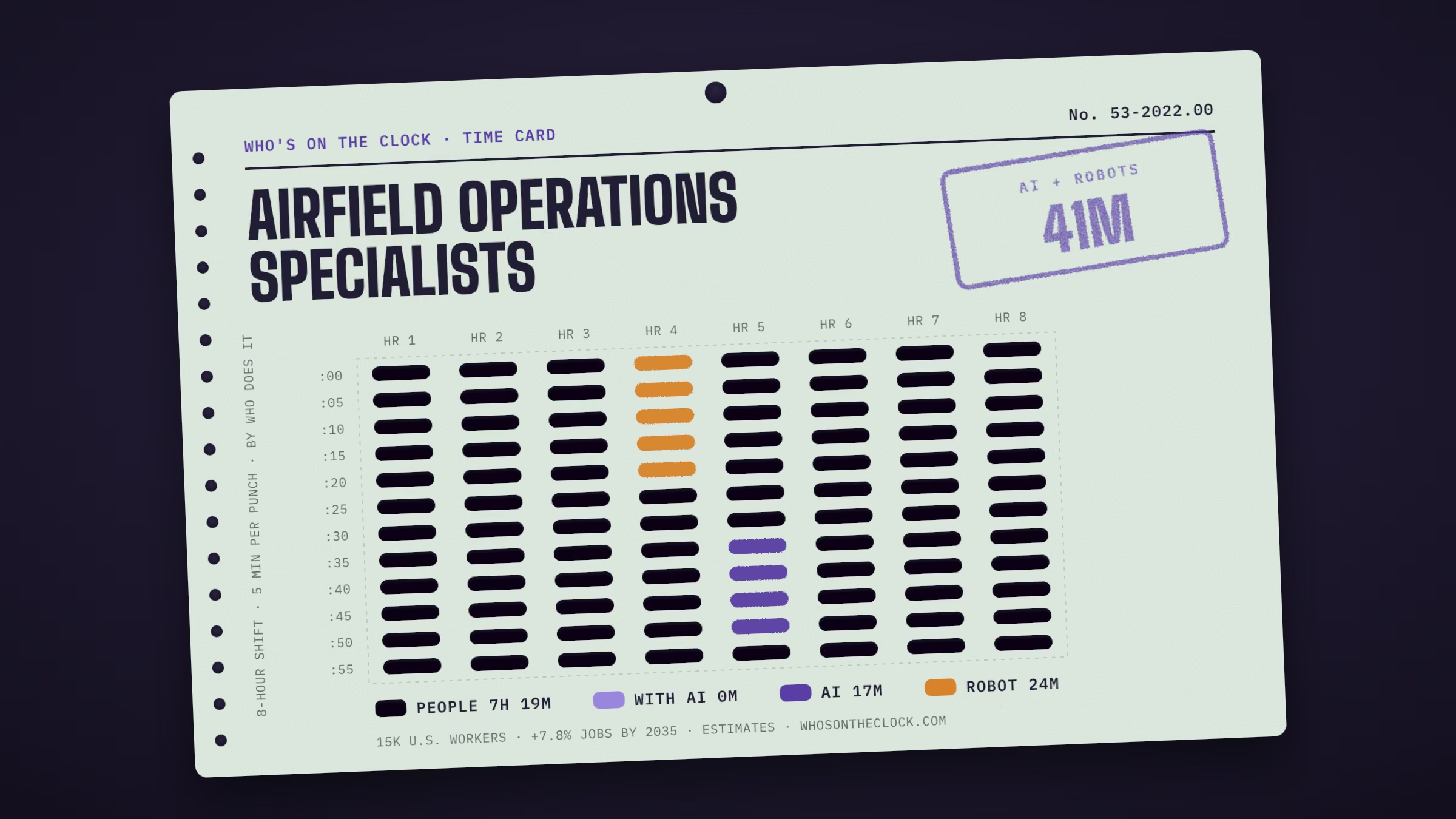
Unlikely, though parts of the work are changing. About 41m of an 8-hour shift goes to tasks touched by robots. The breakdown: 17m that AI mostly does alone, 23m that robots have done in real workplaces. The other 7h 19m (92%) stays with people. Separately, BLS expects about 7.8% more of these jobs by 2035 (all jobs: +3.5%).

Time card for airfield operations specialists showing a typical 8-hour shift: 7h 19m done by people, 17m by AI, 23m by robots.
Each mark is 5 minutes of a typical shift for airfield operations specialists, colored by who does that task today. Estimates from O*NET tasks and Anthropic Economic Index data. How it's made

Home / Transportation & warehouse / Airfield Operations Specialists

Ensure the safe takeoff and landing of commercial and military aircraft. Duties include coordination between air-traffic control and maintenance personnel, dispatching, using airfield landing and navigational aids, implementing airfield safety procedures, monitoring and maintaining flight records, and applying knowledge of weather information.

Time card

Untick tasks you don't do, or set your own times.
MineTask, by time spentHumanWith AIAIRobot
Inspect airfield conditions to ensure compliance with federal regulatory requirements.46m a shift · No AI or robot evidence found
Implement airfield safety procedures to ensure a safe operating environment for personnel and aircraft operation.35m a shift · Robots only in factory cells
Perform and supervise airfield management activities, including mobile airfield management functions.35m a shift · No AI or robot evidence found
Monitor the arrival, parking, refueling, loading, and departure of all aircraft.35m a shift · No AI or robot evidence found
Coordinate communications between air traffic control and maintenance personnel.29m a shift · No AI or robot evidence found
Conduct inspections of the airport property and perimeter to maintain controlled access to airfields.23m a shift · Robots deployed · e.g. Teksbotics/UISEE Autonomous Patrol Car (APC)
Coordinate with agencies, such as air traffic control, civil engineers, or command posts, to ensure support of airfield management activities.23m a shift · No AI or robot evidence found
Maintain flight and event logs, air crew flying records, and flight operations records of incoming and outgoing flights.23m a shift · No AI or robot evidence found
Relay departure, arrival, delay, aircraft and airfield status, and other pertinent information to upline controlling agencies.17m a shift · No AI or robot evidence found
Provide aircrews with information and services needed for airfield management and flight planning.17m a shift · Observed in AI use
Use airfield landing and navigational aids and digital data terminal communications equipment to perform duties.17m a shift · No AI or robot evidence found
Receive, transmit, and control message traffic.17m a shift · No AI or robot evidence found
Maintain air-to-ground and point-to-point radio contact with aircraft commanders.17m a shift · No AI or robot evidence found
Receive and post weather information and flight plan data, such as air routes or arrival and departure times.17m a shift · No AI or robot evidence found
Assist in responding to aircraft and medical emergencies.12m a shift · No AI or robot evidence found
Initiate or conduct airport-wide coordination of snow removal on runways and taxiways.12m a shift · No AI or robot evidence found
Manage wildlife on and around airport grounds.12m a shift · No AI or robot evidence found
Plan and coordinate airfield construction.12m a shift · No AI or robot evidence found
Train operations staff.12m a shift · No AI or robot evidence found
Coordinate with agencies to meet aircrew requirements for billeting, messing, refueling, ground transportation, and transient aircraft maintenance.12m a shift · No AI or robot evidence found
Procure, produce, and provide information on the safe operation of aircraft, such as flight planning publications, operations publications, charts and maps, or weather information.12m a shift · No AI or robot evidence found
Conduct departure and arrival briefings.12m a shift · No AI or robot evidence found
Coordinate changes to flight itineraries with appropriate Air Traffic Control (ATC) agencies.12m a shift · No AI or robot evidence found
Anticipate aircraft equipment needs for air evacuation and cargo flights.6m a shift · No AI or robot evidence found
Post visual display boards and status boards.6m a shift · No AI or robot evidence found
Collaborate with others to plan flight schedules and air crew assignments.6m a shift · No AI or robot evidence found
Check military flight plans with civilian agencies.6m a shift · No AI or robot evidence found

On the floor

No company news tracked for this job yet. New stories are added as they happen.

Ask the clock

Will AI replace airfield operations specialists?

Unlikely, though parts of the work are changing. About 41m of an 8-hour shift goes to tasks touched by robots. The breakdown: 17m that AI mostly does alone, 23m that robots have done in real workplaces. The other 7h 19m (92%) stays with people. Separately, BLS expects about 7.8% more of these jobs by 2035 (all jobs: +3.5%).

What can AI already do for airfield operations specialists?

AI shows up regularly in 1 of 27 tasks, about 17m of a typical shift. The biggest ones:

  • Provide aircrews with information and services needed for airfield management and flight planning. (17m a shift, AI mostly does it alone)
Where do robots fit in?

For some tasks, yes. Robots have done 1 of this job's tasks in workplaces like this one, about 23m of a typical shift. 1 more task has only been done in factory setups built around the machine, so it stays with people here. For 4 physical tasks, no robot has shown it can do the work yet.

  • Conduct inspections of the airport property and perimeter to maintain controlled access to airfields. (23m a shift; e.g. Teksbotics/UISEE Autonomous Patrol Car (APC), in use)
What still needs a person?

7h 19m of a typical shift, or 92%, goes to tasks with no AI or robot evidence yet. No AI usage or robot deployment has shown up for these so far. The biggest:

  • Inspect airfield conditions to ensure compliance with federal regulatory requirements. (46m a shift)
  • Implement airfield safety procedures to ensure a safe operating environment for personnel and aircraft operation. (35m a shift)
  • Perform and supervise airfield management activities, including mobile airfield management functions. (35m a shift)
  • Monitor the arrival, parking, refueling, loading, and departure of all aircraft. (35m a shift)
  • Coordinate communications between air traffic control and maintenance personnel. (29m a shift)
Why is that work hard to automate?

Much of it comes down to where and how the work happens. In-person, hands-on and high-stakes work is where AI and robots have made the least headway so far. In the official O*NET survey of people in this job:

  • 98% say dealing with the public is very or extremely important
  • 98% say a mistake would be very or extremely serious
  • 93% are in constant contact with other people
Are employers still hiring airfield operations specialists?

On Indeed, job postings in the Aviation sector are at 120% of their February 2020 level (all U.S. postings: 104%), up 12.4% from a year earlier, as of Oct 9, 2026. BLS separately expects about 1,500 openings a year in this job through 2035. Across all U.S. postings, 7.3% now mention AI skills. Sector postings cover more than this one job and move for many reasons besides AI.

How much do airfield operations specialists make?

The median pay is about $56,850 a year ($27.33 an hour), 12% above the median for all U.S. jobs ($50,980). Most people in this job earn between $35,870 and $102,120 a year; that range covers the middle 80%. Pay figures are from BLS, May 2025, and vary a lot by state and employer. Pick a state to compare:

Is this job growing or shrinking?

BLS projects growth of 7.8% from 2025 to 2035, compared with 3.5% growth for all jobs. That's about 17,000 jobs in 2035. It expects about 1,500 openings a year, mostly from people retiring or changing careers. These projections don't single out AI as a cause.

How many airfield operations specialists are there in the U.S.?

About 15,000 people in the U.S., roughly 0.01% of all workers (BLS, May 2025). That makes it the 590th largest of the 796 jobs on this site. BLS expects about 17,000 in 2035.

What training do airfield operations specialists need?

The most common requirement is a bachelor's degree: about 51% of people in the job said so in the official O*NET survey. O*NET rates the job at level 3 of 5 for preparation, which usually means: vocational school or associate's degree. Requirements vary by state and employer, especially for licensed work.

What should I learn to stay ahead of AI?

These come from the job's official skill ratings and from the tasks that AI and robots touch least today. Building them keeps you strong in the parts of the work that still need a person:

  • Skills that matter more here than in most jobs: Monitoring, Coordination, Active Listening, Systems Evaluation
  • Get strong at the parts of the job that stay with people (listed above), which take 7h 19m of a typical shift
  • Tools employers list: Microsoft Office software, Microsoft Excel, Adobe Photoshop, Extensible markup language XML, Intuit QuickBooks
  • Learn to use AI well on the tasks where it already shows up in this job (listed above)
What new tasks are airfield operations specialists taking on?

Yes. Occupational experts recently added these to the official task list, a sign of how the work itself is shifting. New tasks aren't rated for AI or robots yet:

  • Issue notices to advise flight crews of airfield status.
  • Monitor and manage the operation of drones within the airport airspace to ensure safe aircraft operations.
What other jobs could airfield operations specialists move into?

These use similar skills. Matches come from 109 official ratings of skills, knowledge and work activities, and each needs the same or less preparation unless the official list relates the jobs directly:

  • Aircraft Cargo Handling Supervisors (0m touched, $58k median pay)
  • Aviation Inspectors (59m touched, $92k median pay)
  • Commercial Pilots (2h 14m touched, $123k median pay)
How solid are these numbers?

Each task carries its own evidence label. For this job: 1 observed in real AI use, 1 with robots in real deployments, 25 with no AI or robot evidence found. The minutes per task are estimates, not measured hours, and "no evidence" doesn't prove a task is safe.

Tools in demand

  • Microsoft Office software
  • Microsoft Excel
  • Adobe Photoshop
  • Extensible markup language XML
  • Intuit QuickBooks
  • Linux
  • Microsoft Access
  • Microsoft Outlook

Also called

Airfield Operations Specialist, Airfield Services Officer, Airline Dispatcher, Airport Agent, Airport Operations Agent, Airport Operations Coordinator, Airport Operations Crew Member, Airport Operations Officer, Airport Operations Specialist, Airport Ramp Agent, Airport Security Officer, Airport Services Supervisor, Airport Supervisor, Aviation Operations Specialist