Home / Tasks / Analyze data to identify trends or relationships among variables
In 5 of the 19 jobs that do this, AI or robots already show up on it, most often as work people hand to AI. In the other 14, there's no evidence yet. Jobs spend a median of 23m of an 8-hour shift on it, and about 2.7 million U.S. workers hold these jobs.
Every job that does this
Each job words the task its own way. Minutes are that job's estimate for a typical shift; the label is the evidence for that job's version.
| Job and its version of the task | Per shift | Evidence |
|---|---|---|
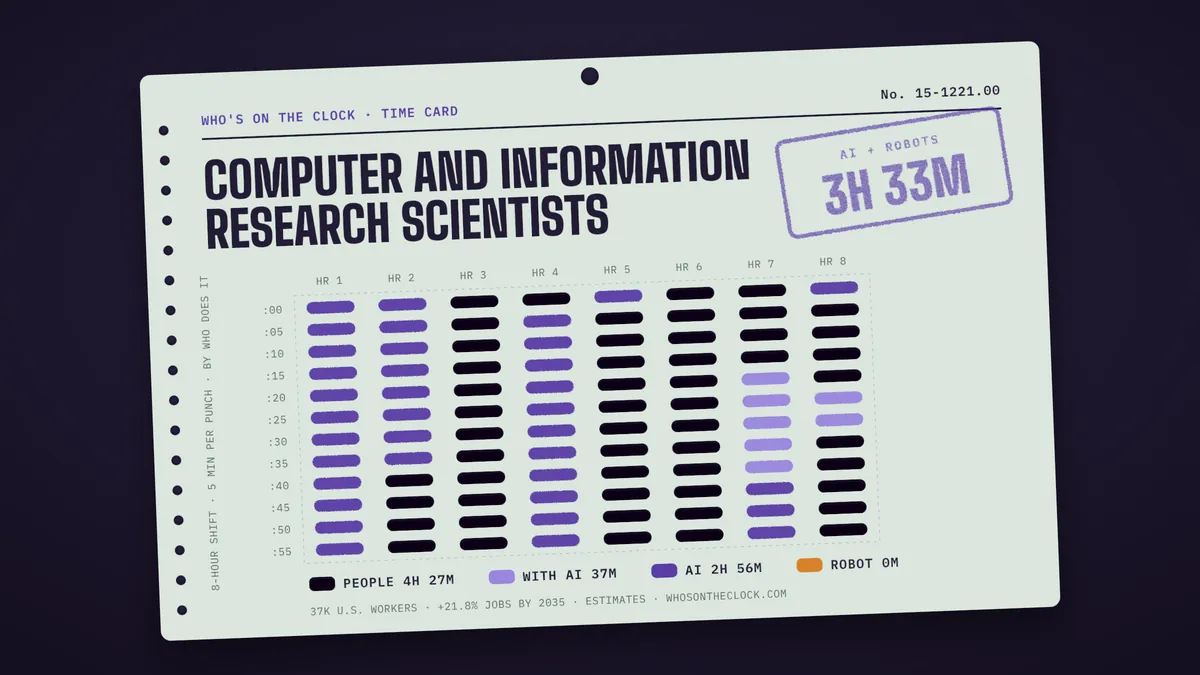
| Computer and Information Research ScientistsConduct logical analyses of business, scientific, engineering, and other technical problems, formulating mathematical models of problems for solution by computers. | 1h 1m | Often handed to AI |
| BiologistsProgram and use computers to store, process, and analyze data. | 53m | No evidence yet |
| MathematiciansPerform computations and apply methods of numerical analysis to data. | 51m | No evidence yet |
| Data ScientistsIdentify relationships and trends or any factors that could affect the results of research. | 35m | With AI |
| Information Technology Project ManagersPrepare project status reports by collecting, analyzing, and summarizing information and trends. | 33m | Often handed to AI |
| Data Warehousing SpecialistsPerform system analysis, data analysis or programming, using a variety of computer languages and procedures. | 32m | Often handed to AI |
| StatisticiansIdentify relationships and trends in data, as well as any factors that could affect the results of research. | 30m | Often handed to AI |
| Preventive Medicine PhysiciansIdentify groups at risk for specific preventable diseases or injuries. | 26m | No evidence yet |
| Occupational Health and Safety SpecialistsAnalyze incident data to identify trends in injuries, illnesses, accidents, or other hazards. | 25m | No evidence yet |
| ActuariesConstruct probability tables for events such as fires, natural disasters, and unemployment, based on analysis of statistical data and other pertinent information. | 23m | No evidence yet |
| Transportation PlannersAnalyze information from traffic counting programs. | 19m | No evidence yet |
| PharmacistsAnalyze prescribing trends to monitor patient compliance and to prevent excessive usage or harmful interactions. | 18m | No evidence yet |
| Operations Research AnalystsBreak systems into their components, assign numerical values to each component, and examine the mathematical relationships between them. | 18m | No evidence yet |
| BiostatisticiansPrepare statistical data for inclusion in reports to data monitoring committees, federal regulatory agencies, managers, or clients. | 17m | No evidence yet |
| Database AdministratorsIdentify and evaluate industry trends in database systems to serve as a source of information and advice for upper management. | 13m | No evidence yet |
| Geographic Information Systems Technologists and TechniciansPerform integrated or computerized Geographic Information Systems (GIS) analyses to address scientific problems. | 12m | No evidence yet |
| Database ArchitectsIdentify and evaluate industry trends in database systems to serve as a source of information and advice for upper management. | 12m | No evidence yet |
| Software Quality Assurance Analysts and TestersConduct historical analyses of test results. | 6m | No evidence yet |
| Forensic Science TechniciansReconstruct crime scenes to determine relationships among pieces of evidence. | 6m | No evidence yet |
How to read this
This task type comes from O*NET's detailed work activities, which link similar tasks across jobs. A label applies to one job's version of the task: AI use comes from real AI conversations (Anthropic Economic Index) and robot evidence from deployments in real workplaces. "No evidence yet" may just mean the task is rare in the data. How we keep time.
See all 250 shared tasks, or find any job on the big clock.