Will AI replace first-line supervisors of construction trades and extraction workers?
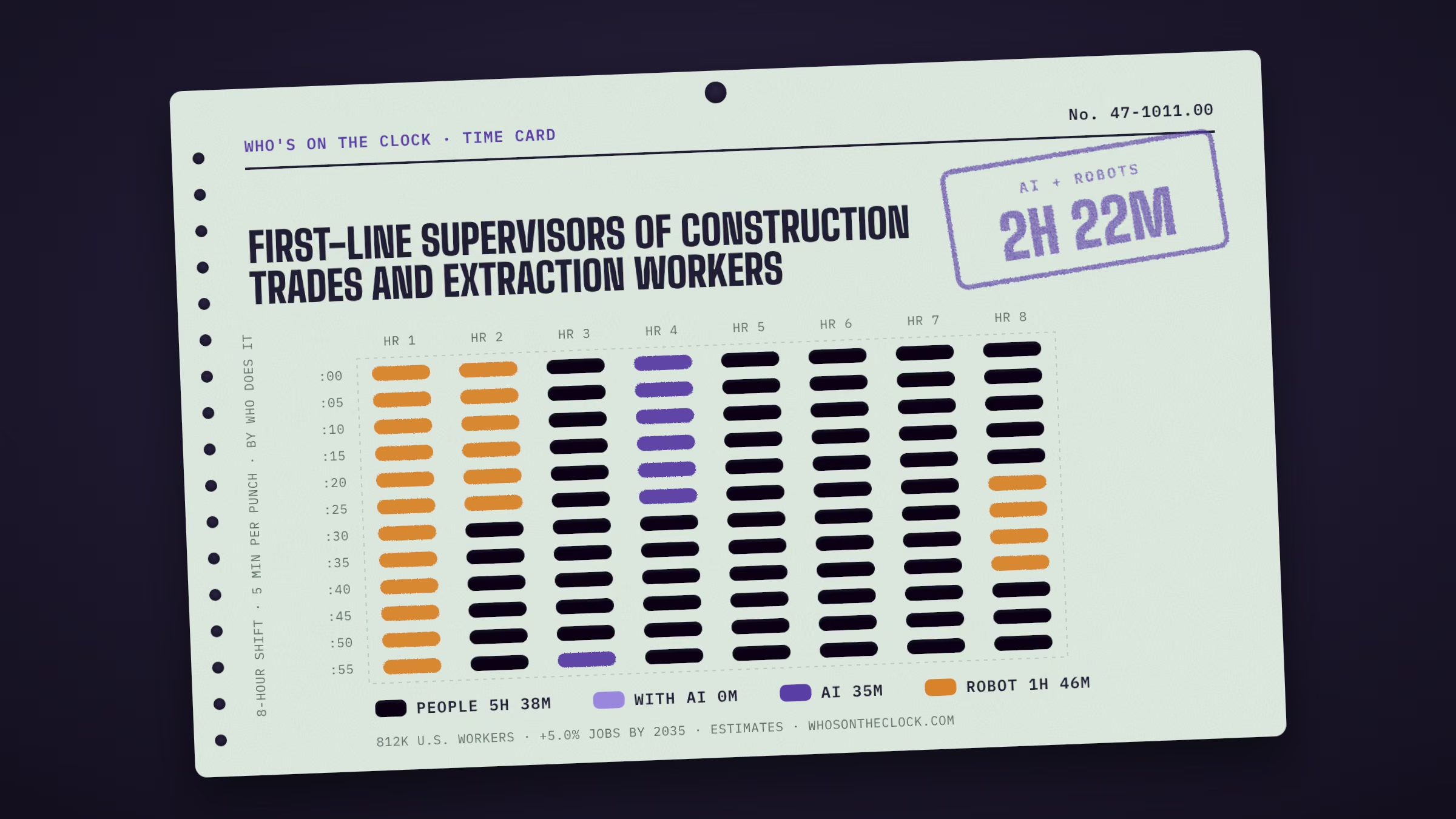
Parts of the job are being automated. About 2h 22m of an 8-hour shift goes to tasks that AI or robots already do largely on their own. The rest still needs a person. The breakdown: 35m that AI mostly does alone, 1h 46m that robots have done in real workplaces. The other 5h 38m (71%) stays with people. Separately, BLS expects about 5% more of these jobs by 2035 (all jobs: +3.5%).
⤢ Full sizeEach mark is 5 minutes of a typical shift for first-line supervisors of construction trades and extraction workers, colored by who does that task today. Estimates from O*NET tasks and Anthropic Economic Index data. How it's made
Home / Construction / First-Line Supervisors of Construction Trades and Extraction Workers
Directly supervise and coordinate activities of construction or extraction workers.
Supervise, coordinate, or schedule the activities of construction or extractive workers.1h 26m a shift · No AI or robot evidence found
Read specifications, such as blueprints, to determine construction requirements or to plan procedures.35m a shift · Observed in AI use
Confer with managerial or technical personnel, other departments, or contractors to resolve problems or to coordinate activities.35m a shift · No AI or robot evidence found
Assign work to employees, based on material or worker requirements of specific jobs.30m a shift · No AI or robot evidence found
Coordinate work activities with other construction project activities.30m a shift · No AI or robot evidence found
Provide assistance to workers engaged in construction or extraction activities, using hand tools or other equipment.30m a shift · Robots only in factory cells
Estimate material or worker requirements to complete jobs.25m a shift · No AI or robot evidence found
Record information, such as personnel, production, or operational data on specified forms or reports.25m a shift · No AI or robot evidence found
Analyze worker or production problems and recommend solutions, such as improving production methods or implementing motivational plans.20m a shift · No AI or robot evidence found
Order or requisition materials or supplies.20m a shift · No AI or robot evidence found
Train workers in construction methods, operation of equipment, safety procedures, or company policies.20m a shift · No AI or robot evidence found
Locate, measure, and mark site locations or placement of structures or equipment, using measuring and marking equipment.20m a shift · Robots deployed · e.g. Dusty Robotics FieldPrinter
Arrange for repairs of equipment or machinery.10m a shift · No AI or robot evidence found
Suggest or initiate personnel actions, such as promotions, transfers, or hires.5m a shift · No AI or robot evidence found
Suffolk embeds AI engineers at its jobsites nationwide
Suffolk will embed AI engineers at its sites to work on design, schedule and process problems. Tools so far include AI design review that flags drawing conflicts and AI procurement tracking.
Will AI replace first-line supervisors of construction trades and extraction workers?
Parts of the job are being automated. About 2h 22m of an 8-hour shift goes to tasks that AI or robots already do largely on their own. The rest still needs a person. The breakdown: 35m that AI mostly does alone, 1h 46m that robots have done in real workplaces. The other 5h 38m (71%) stays with people. Separately, BLS expects about 5% more of these jobs by 2035 (all jobs: +3.5%).
What parts of the job can AI already do?
AI shows up regularly in 1 of 15 tasks, about 35m of a typical shift. The biggest ones:
Read specifications, such as blueprints, to determine construction requirements or to plan procedures. (35m a shift, AI mostly does it alone)
Can a robot do this job?
For some tasks, yes. Robots have done 2 of this job's tasks in workplaces like this one, about 1h 46m of a typical shift. 1 more task has only been done in factory setups built around the machine, so it stays with people here.
Inspect work progress, equipment, or construction sites to verify safety or to ensure that specifications are met. (1h 26m a shift; e.g. Boston Dynamics Spot with FieldAI Field Foundation Models, in use)
Locate, measure, and mark site locations or placement of structures or equipment, using measuring and marking equipment. (20m a shift; e.g. Dusty Robotics FieldPrinter, in use)
What parts of the job are still done by people?
5h 38m of a typical shift, or 71%, goes to tasks with no AI or robot evidence yet. No AI usage or robot deployment has shown up for these so far. The biggest:
Supervise, coordinate, or schedule the activities of construction or extractive workers. (1h 26m a shift)
Confer with managerial or technical personnel, other departments, or contractors to resolve problems or to coordinate activities. (35m a shift)
Assign work to employees, based on material or worker requirements of specific jobs. (30m a shift)
Coordinate work activities with other construction project activities. (30m a shift)
Provide assistance to workers engaged in construction or extraction activities, using hand tools or other equipment. (30m a shift)
Why does a person still do this work?
Part of the answer is the setting, not just the tasks. Work that is in person, hands on or high stakes is where AI and robots have made the least headway so far. In the official O*NET survey of people in this job:
100% carry high or very high responsibility for other workers' safety
97% are in constant contact with other people
86% work at arm's length or closer to other people
What are companies actually doing?
We track 1 sourced company move that affects this job. Most recent:
Jun 17, 2026: Suffolk embeds AI engineers at its jobsites nationwide (Announced)
Are employers still hiring for this job?
On Indeed, job postings in the Construction sector are at 129% of their February 2020 level (all U.S. postings: 104%), up 6.4% from a year earlier, as of Oct 9, 2026. BLS separately expects about 67,000 openings a year in this job through 2035. Across all U.S. postings, 7.3% now mention AI skills. Sector postings cover more than this one job and move for many reasons besides AI.
How much do first-line supervisors of construction trades and extraction workers make?
The median pay is about $79,920 a year ($38.42 an hour), 57% above the median for all U.S. jobs ($50,980). Most people in this job earn between $53,280 and $128,260 a year; that range covers the middle 80%. Pay figures are from BLS, May 2025, and vary a lot by state and employer. Pick a state to compare:
Is this job growing or shrinking?
BLS projects growth of 5% from 2025 to 2035, compared with 3.5% growth for all jobs. That's about 959,000 jobs in 2035. It expects about 67,000 openings a year, mostly from people retiring or changing careers. These projections don't single out AI as a cause.
How many people do this job?
About 812,000 people in the U.S., roughly 0.52% of all workers (BLS, May 2025). That makes it the 50th largest of the 796 jobs on this site. BLS expects about 959,000 in 2035.
What do you need to become one?
The most common requirement is a post-secondary certificate: about 27% of people in the job said so in the official O*NET survey. O*NET rates the job at level 3 of 5 for preparation, which usually means: vocational school or associate's degree. Requirements vary by state and employer, especially for licensed work.
What should I learn to stay ahead?
These come from the job's official skill ratings and from the tasks that AI and robots touch least today. Building them keeps you strong in the parts of the work that still need a person:
Skills that matter more here than in most jobs: Management of Personnel Resources, Coordination, Quality Control Analysis, Time Management
Get strong at the parts of the job that stay with people (listed above), which take 5h 38m of a typical shift
Tools employers list: Microsoft Office software, Adobe Acrobat, Autodesk AutoCAD, Microsoft Excel, Microsoft Outlook
Learn to use AI well on the tasks where it already shows up in this job (listed above)
What similar jobs could I move into?
These use similar skills, with less of a typical shift touched by AI or robots. Matches come from 109 official ratings of skills, knowledge and work activities, and each needs the same or less preparation unless the official list relates the jobs directly:
Solar Energy Installation Managers (0m touched, $80k median pay)
First-Line Supervisors of Mechanics, Installers, and Repairers (1h 23m touched, $80k median pay)
First-Line Supervisors of Production and Operating Workers (11m touched, $74k median pay)
How solid are these numbers?
Each task carries its own evidence label. For this job: 1 observed in real AI use, 2 with robots in real deployments, 12 with no AI or robot evidence found. The minutes per task are estimates, not measured hours, and "no evidence" doesn't prove a task is safe.