Will AI replace psychiatric technicians?

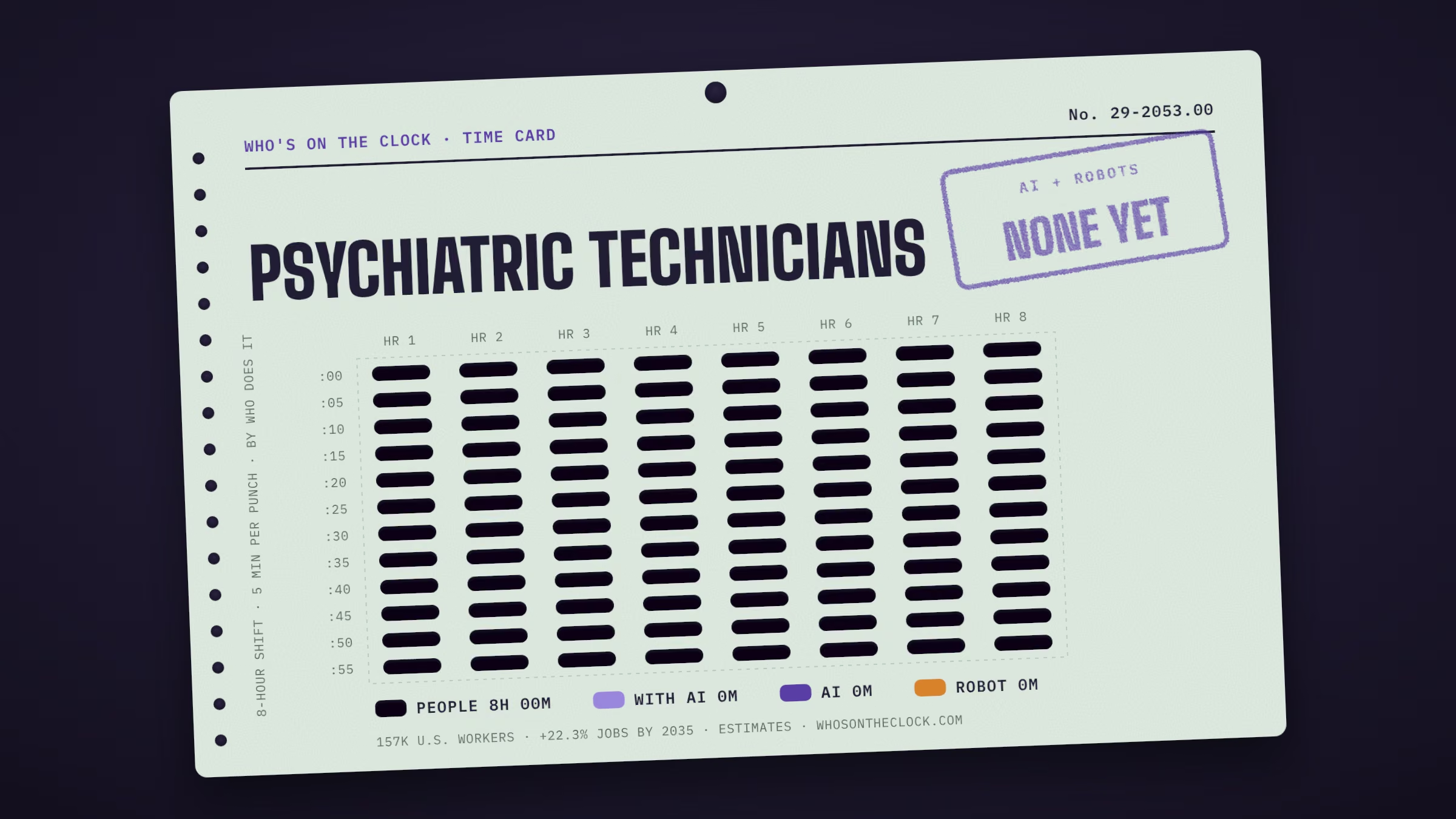
Not on current evidence. Less than 30 minutes of a typical shift goes to tasks that AI or robots are doing today. The other 8h (100%) stays with people. Separately, BLS expects about 22.3% more of these jobs by 2035 (all jobs: +3.5%).

Home / Healthcare practitioners / Psychiatric Technicians

Time card for psychiatric technicians showing a typical 8-hour shift: 8h done by people.
Each mark is 5 minutes of a typical shift for psychiatric technicians, colored by who does that task today. Estimates from O*NET tasks and Anthropic Economic Index data. How it's made

Care for individuals with mental or emotional conditions or disabilities, following the instructions of physicians or other health practitioners. Monitor patients' physical and emotional well-being and report to medical staff. May participate in rehabilitation and treatment programs, help with personal hygiene, and administer oral or injectable medications.

Time card

Untick tasks you don't do, or set your own times.
MineTask, by time spentHumanWith AIAIRobot
Monitor patients' physical and emotional well-being and report unusual behavior or physical ailments to medical staff.1h 18m a shift · No AI or robot evidence found
Provide nursing, psychiatric, or personal care to patients with cognitive, intellectual, or developmental disabilities.1h 11m a shift · No AI or robot evidence found
Observe and influence patients' behavior, communicating and interacting with them and teaching, counseling, or befriending them.1h 5m a shift · No AI or robot evidence found
Aid patients in performing tasks, such as bathing or keeping beds, clothing, or living areas clean.39m a shift · Robots only in factory cells
Encourage patients to develop work skills and to participate in social, recreational, or other therapeutic activities that enhance interpersonal skills or develop social relationships.32m a shift · No AI or robot evidence found
Take and record measures of patients' physical condition, using devices such as thermometers or blood pressure gauges.32m a shift · Robots only in factory cells
Collaborate with or assist doctors, psychologists, or rehabilitation therapists in working with patients with cognitive, intellectual, or developmental disabilities to treat, rehabilitate, and return patients to the community.26m a shift · No AI or robot evidence found
Administer oral medications or hypodermic injections, following physician's prescriptions and hospital procedures.26m a shift · No AI or robot evidence found
Restrain violent, potentially violent, or suicidal patients by verbal or physical means as required.19m a shift · No AI or robot evidence found
Lead prescribed individual or group therapy sessions as part of specific therapeutic procedures.19m a shift · No AI or robot evidence found
Develop or teach strategies to promote client wellness and independence.19m a shift · No AI or robot evidence found
Escort patients to medical appointments.13m a shift · No AI or robot evidence found
Issue medications from dispensary and maintain records in accordance with specified procedures.13m a shift · No AI or robot evidence found
Interview new patients to complete admission forms, to assess their mental health status, or to obtain their mental health and treatment history.13m a shift · No AI or robot evidence found
Train or instruct new employees on procedures to follow with psychiatric patients.6m a shift · No AI or robot evidence found
Contact patients' relatives to arrange family conferences.6m a shift · No AI or robot evidence found

On the floor

No company news tracked for this job yet. New stories are added as they happen.

Straight answers

Will AI replace psychiatric technicians?

Not on current evidence. Less than 30 minutes of a typical shift goes to tasks that AI or robots are doing today. The other 8h (100%) stays with people. Separately, BLS expects about 22.3% more of these jobs by 2035 (all jobs: +3.5%).

What parts of the job can AI already do?

None of this job's tasks show regular AI use yet. That can mean the work is hands-on or in person, or simply that it rarely comes up in AI usage data.

Can a robot do this job?

Not in workplaces like this one, based on a 2026 review of robot deployments. 2 more tasks have only been done in factory setups built around the machine, so they stay with people here. For 7 physical tasks, no robot has shown it can do the work yet.

What parts of the job are still done by people?

8h of a typical shift, or 100%, goes to tasks with no AI or robot evidence yet. The biggest:

  • Monitor patients' physical and emotional well-being and report unusual behavior or physical ailments to medical staff. (1h 18m a shift)
  • Provide nursing, psychiatric, or personal care to patients with cognitive, intellectual, or developmental disabilities. (1h 11m a shift)
  • Observe and influence patients' behavior, communicating and interacting with them and teaching, counseling, or befriending them. (1h 5m a shift)
  • Aid patients in performing tasks, such as bathing or keeping beds, clothing, or living areas clean. (39m a shift)
  • Encourage patients to develop work skills and to participate in social, recreational, or other therapeutic activities that enhance interpersonal skills or develop social relationships. (32m a shift)
How much do psychiatric technicians make?

The median pay is about $45,130 a year ($21.70 an hour), 11% below the median for all U.S. jobs ($50,980). Source: BLS, May 2025.

Is this job growing or shrinking?

BLS projects growth of 22.3% from 2025 to 2035, compared with 3.5% growth for all jobs. That's about 198,000 jobs in 2035. It expects about 17,000 openings a year, mostly from people retiring or changing careers. These projections don't single out AI as a cause.

How many people do this job?

About 157,000 people in the U.S., roughly 0.10% of all workers (BLS, May 2025).

What do you need to become one?

Vocational school or associate's degree. O*NET rates this job at level 3 of 5 for preparation.

What should I learn to stay ahead?

Based on official skill ratings and the tasks that stay with people:

  • Skills that matter more here than in most jobs: Social Perceptiveness, Coordination, Monitoring, Service Orientation
  • Get strong at the parts of the job that stay with people (listed above), which take 8h of a typical shift
  • Tools employers list: Microsoft Excel, Microsoft Office software, Microsoft Outlook, Microsoft Word
What similar jobs could I move into?

These use similar skills:

  • Psychiatric Aides (0m touched, $45k median pay)
  • Recreational Therapists (1h 14m touched, $62k median pay)
  • Occupational Therapy Assistants (0m touched, $72k median pay)
How solid are these numbers?

Each task carries its own evidence label. For this job: 16 with no AI or robot evidence found. The minutes per task are estimates, not measured hours, and "no evidence" doesn't prove a task is safe.

Tools in demand

  • Microsoft Excel
  • Microsoft Office software
  • Microsoft Outlook
  • Microsoft Word

Also called

Autism Behavior Technician (Autism Behavior Tech), BHT (Behavioral Health Technician), Behavior Technician (Behavior Tech), Behavioral Health Associate, Behavioral Technician (Behavioral Tech), Counselor, Health Care Technician (Health Care Tech), LPT (Licensed Psychiatric Technician), MHA (Mental Health Assistant), MHW (Mental Health Worker), Mental Health Associate, Mental Health Specialist, Mental Health Technician (MHT), Milieu Therapist