Home / Tasks / Adjust equipment controls to regulate flow of production materials or products
In 8 of the 16 jobs that do this, AI or robots already show up on it, most often as robots doing it. In the other 8, there's no evidence yet. Jobs spend a median of 22m of an 8-hour shift on it, and about 980,000 U.S. workers hold these jobs.
Every job that does this
Each job words the task its own way. Minutes are that job's estimate for a typical shift; the label is the evidence for that job's version.
| Job and its version of the task | Per shift | Evidence |
|---|---|---|
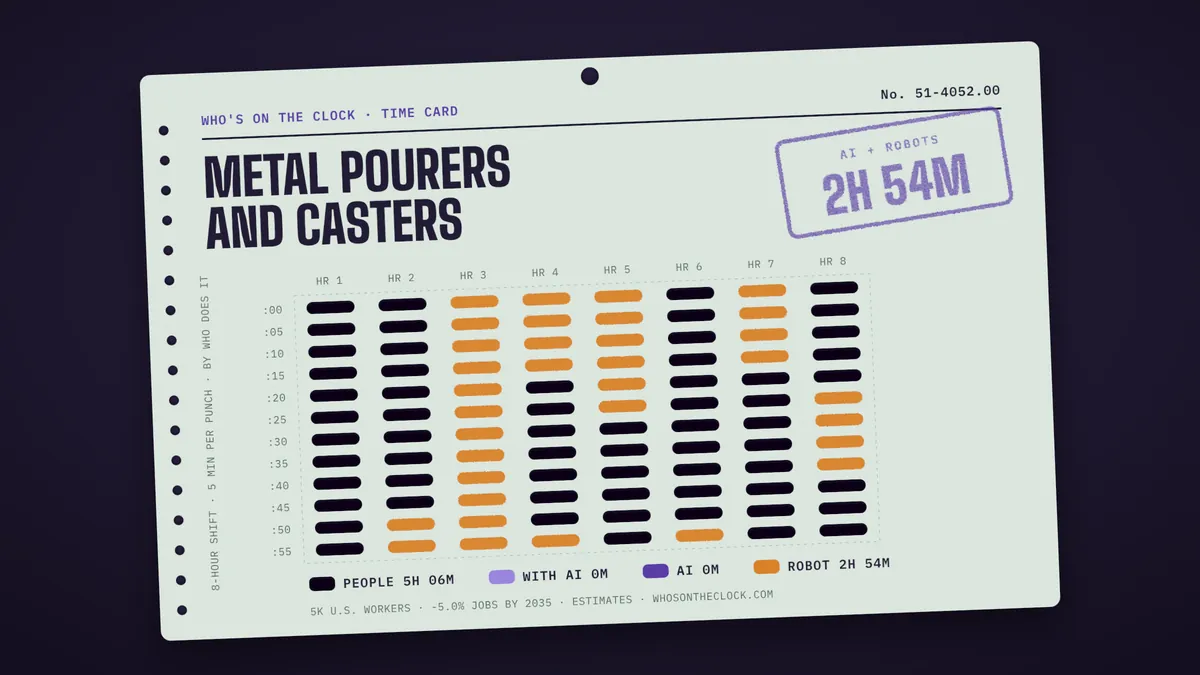
| Metal Pourers and CastersPour and regulate the flow of molten metal into molds and forms to produce ingots or other castings, using ladles or hand-controlled mechanisms. | 1h 48m | No evidence yet |
| Food Cooking Machine Operators and TendersObserve gauges, dials, and product characteristics, and adjust controls to maintain appropriate temperature, pressure, and flow of ingredients. | 1h 6m | Robots |
| Extruding, Forming, Pressing, and Compacting Machine Setters, Operators, and TendersAdjust machine components to regulate speeds, pressures, and temperatures, and amounts, dimensions, and flow of materials or ingredients. | 53m | Robots |
| Extruding and Forming Machine Setters, Operators, and Tenders, Synthetic and Glass FibersLoad materials into extruding and forming machines, using hand tools, and adjust feed mechanisms to set feed rates. | 36m | No evidence yet |
| Adhesive Bonding Machine Operators and TendersAdjust machine components according to specifications such as widths, lengths, and thickness of materials and amounts of glue, cement, or adhesive required. | 31m | Robots |
| Separating, Filtering, Clarifying, Precipitating, and Still Machine Setters, Operators, and TendersSet up or adjust machine controls to regulate conditions such as material flow, temperature, or pressure. | 30m | Robots |
| Cooling and Freezing Equipment Operators and TendersRead dials and gauges on panel control boards to ascertain temperatures, alkalinities, and densities of mixtures, and turn valves to obtain specified mixtures. | 30m | Robots |
| Chemical Plant and System OperatorsTurn valves to regulate flow of products or byproducts through agitator tanks, storage drums, or neutralizer tanks. | 22m | No evidence yet |
| Printing Press OperatorsAdjust ink fountain flow rates. | 18m | Robots |
| Plating Machine Setters, Operators, and Tenders, Metal and PlasticMix and test solutions, and turn valves to fill tanks with solutions. | 17m | No evidence yet |
| Food and Tobacco Roasting, Baking, and Drying Machine Operators and TendersOpen valves, gates, or chutes or use shovels to load or remove products from ovens or other equipment. | 12m | Robots |
| Print Binding and Finishing WorkersSet up or operate glue machines by filling glue reservoirs, turning switches to activate heating elements, or adjusting glue flow or conveyor speed. | 12m | Robots |
| Coating, Painting, and Spraying Machine Setters, Operators, and TendersTurn dials, handwheels, valves, or switches to regulate conveyor speeds, machine temperature, air pressure and circulation, and the flow or spray of coatings or paints. | 12m | No evidence yet |
| Multiple Machine Tool Setters, Operators, and Tenders, Metal and PlasticStart machines and turn handwheels or valves to engage feeding, cooling, and lubricating mechanisms. | 12m | No evidence yet |
| Computer Numerically Controlled Tool OperatorsAdjust machine feed and speed, change cutting tools, or adjust machine controls when automatic programming is faulty or if machines malfunction. | 12m | No evidence yet |
| Mixing and Blending Machine Setters, Operators, and TendersOpen valves to drain slurry from mixers into storage tanks. | 6m | No evidence yet |
How to read this
This task type comes from O*NET's detailed work activities, which link similar tasks across jobs. A label applies to one job's version of the task: AI use comes from real AI conversations (Anthropic Economic Index) and robot evidence from deployments in real workplaces. "No evidence yet" may just mean the task is rare in the data. How we keep time.
See all 250 shared tasks, or find any job on the big clock.