Will AI replace printing press operators?

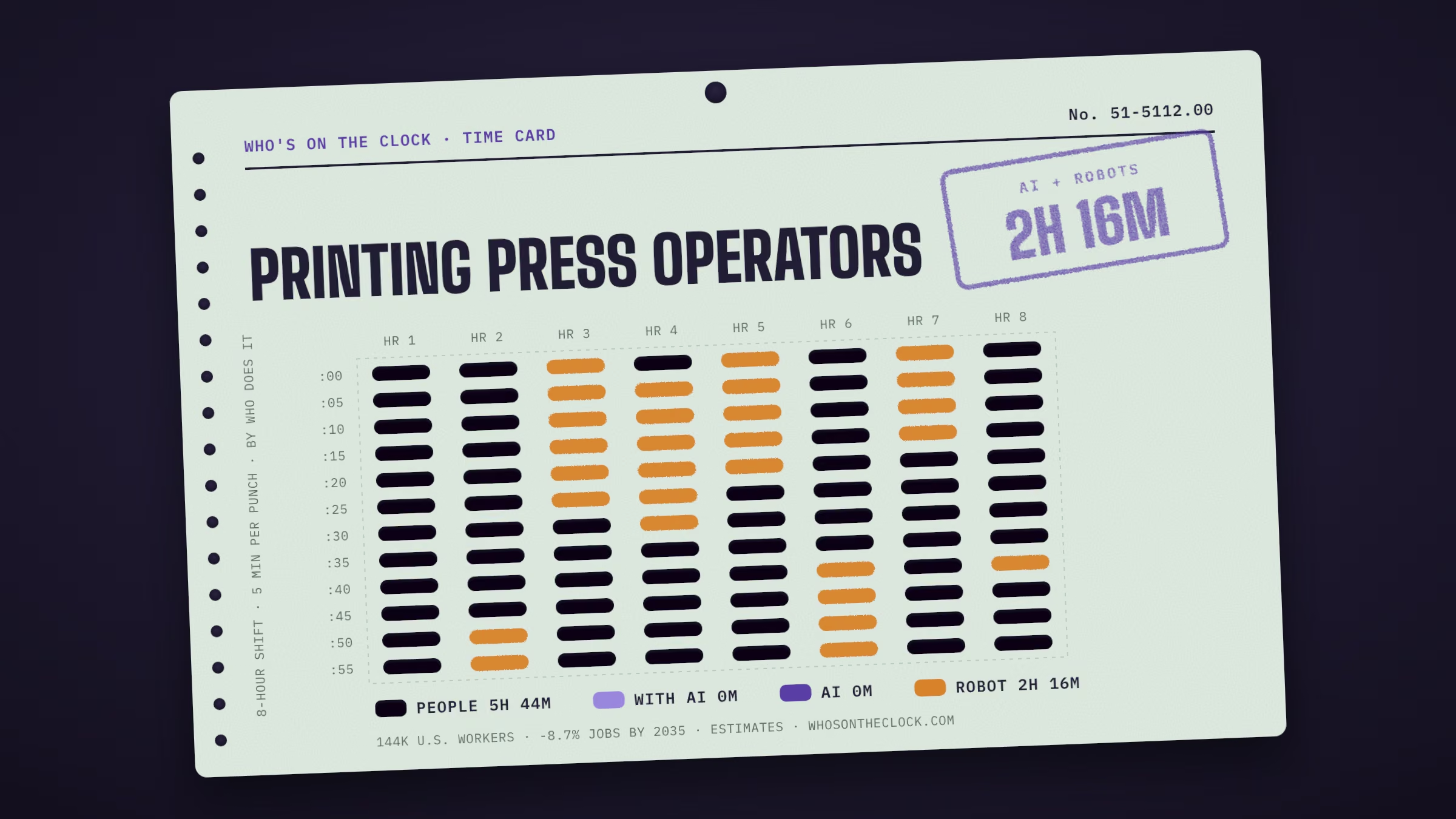
Some tasks are already handled by AI or machines; the rest still needs a person. About 2h 16m of an 8-hour shift goes to tasks that AI or robots largely take over. The other 5h 44m (72%) stays with people. Separately, BLS expects about 8.7% fewer of these jobs by 2035 (all jobs: +3.5%).

Time card for printing press operators showing a typical 8-hour shift: 5h 44m done by people, 2h 16m by robots.
Each mark is 5 minutes of a typical shift for printing press operators, colored by who does that task today. Estimates from O*NET tasks and Anthropic Economic Index data. How it's made

Home / Production & factory / Printing Press Operators

Set up and operate digital, letterpress, lithographic, flexographic, gravure, or other printing machines. Includes short-run offset printing presses.

Time card

Untick tasks you don't do, or set your own times.
MineTask, by time spentHumanWith AIAIRobot
Collect and inspect random samples during print runs to identify any necessary adjustments.53m a shift · Robots only in factory cells
Monitor automated press operation systems and respond to fault, error, or alert messages.53m a shift · No AI or robot evidence found
Start presses and pull proofs to check for ink coverage and density, alignment, and registration.41m a shift · Robots deployed · e.g. Prinect Inpress Control / Inpress Control 2 (Heidelberg Speedmaster)
Clean ink fountains, plates, or printing unit cylinders when press runs are completed.36m a shift · Robots only in factory cells
Load presses with paper and make necessary adjustments, according to paper size.30m a shift · Robots deployed · e.g. Patras materials logistics (reel-clamp and forklift AGVs)
Examine job orders to determine quantities to be printed, stock specifications, colors, or special printing instructions.24m a shift · No AI or robot evidence found
Feed paper through press cylinders and adjust feed and tension controls.24m a shift · Robots deployed · e.g. Speedmaster XL 106 with Prinect Inspection Control 4 / waste extraction
Secure printing plates to printing units and adjust tolerances.24m a shift · Robots only in factory cells
Change press plates, blankets, or cylinders, as required.24m a shift · Robots only in factory cells
Clean or oil presses or make minor repairs, using hand tools.24m a shift · Robots only in factory cells
Adjust ink fountain flow rates.18m a shift · Robots deployed · e.g. Speedmaster XL 106-6+L with Inpress Control 2 and Push to Stop at Moquin Press
Obtain or mix inks and fill ink fountains.18m a shift · Robots deployed · e.g. Sentinel iPro Ink Management System
Input production job settings into workstation terminals that control automated printing systems.18m a shift · No AI or robot evidence found
Set up or operate auxiliary equipment, such as cutting, folding, plate-making, drilling, or laminating machines.18m a shift · Robots only in factory cells
Verify that paper and ink meet the specifications for a given job.12m a shift · Robots only in factory cells
Maintain time or production records.12m a shift · No AI or robot evidence found
Download or scan files to be printed, using printing production software.12m a shift · No AI or robot evidence found
Direct or monitor work of press crews.12m a shift · No AI or robot evidence found
Monitor inventory levels on a regular basis, ordering or requesting additional supplies, as necessary.6m a shift · No AI or robot evidence found
Monitor environmental factors, such as humidity and temperature, that may impact equipment performance and make necessary adjustments.6m a shift · Robots deployed · e.g. Condair MLP RO high-pressure humidification system
Adjust digital files to alter print elements, such as fonts, graphics, or color separations.6m a shift · No AI or robot evidence found
Download completed jobs to archive media so that questions can be answered or jobs replicated.6m a shift · No AI or robot evidence found
Control workflow scheduling or job tracking, using computer database software.6m a shift · No AI or robot evidence found

On the floor

No company news tracked for this job yet. New stories are added as they happen.

Ask the clock

Will AI replace printing press operators?

Some tasks are already handled by AI or machines; the rest still needs a person. About 2h 16m of an 8-hour shift goes to tasks that AI or robots largely take over. The other 5h 44m (72%) stays with people. Separately, BLS expects about 8.7% fewer of these jobs by 2035 (all jobs: +3.5%).

What can AI already do for printing press operators?

None of this job's tasks show regular AI use yet. That can mean the work is hands-on or in person, or simply that it rarely comes up in AI usage data.

Where do robots fit in?

For some tasks, yes. Robots have done 6 of this job's tasks in workplaces like this one, about 2h 16m of a typical shift. 7 more tasks have only been done in factory setups built around the machine, so they stay with people here. For 1 physical task, no robot has shown it can do the work yet.

  • Start presses and pull proofs to check for ink coverage and density, alignment, and registration. (41m a shift; e.g. Prinect Inpress Control / Inpress Control 2 (Heidelberg Speedmaster), in use)
  • Load presses with paper and make necessary adjustments, according to paper size. (30m a shift; e.g. Patras materials logistics (reel-clamp and forklift AGVs), in use)
  • Feed paper through press cylinders and adjust feed and tension controls. (24m a shift; e.g. Speedmaster XL 106 with Prinect Inspection Control 4 / waste extraction, in use)
  • Adjust ink fountain flow rates. (18m a shift; e.g. Speedmaster XL 106-6+L with Inpress Control 2 and Push to Stop at Moquin Press, in use)
What still needs a person?

5h 44m of a typical shift, or 72%, goes to tasks with no AI or robot evidence yet. No AI usage or robot deployment has shown up for these so far. The biggest:

  • Collect and inspect random samples during print runs to identify any necessary adjustments. (53m a shift)
  • Monitor automated press operation systems and respond to fault, error, or alert messages. (53m a shift)
  • Clean ink fountains, plates, or printing unit cylinders when press runs are completed. (36m a shift)
  • Examine job orders to determine quantities to be printed, stock specifications, colors, or special printing instructions. (24m a shift)
  • Secure printing plates to printing units and adjust tolerances. (24m a shift)
Why is that work hard to automate?

Much of it comes down to where and how the work happens. In-person, hands-on and high-stakes work is where AI and robots have made the least headway so far. In the official O*NET survey of people in this job:

  • 93% use their hands on tools, objects or controls more than half the time
  • 90% spend more than half the day on their feet
  • 71% spend more than half the day walking or moving
Are employers still hiring printing press operators?

On Indeed, job postings in the Production & Manufacturing sector are at 124% of their February 2020 level (all U.S. postings: 104%), up 12.6% from a year earlier, as of Oct 9, 2026. BLS separately expects about 12,000 openings a year in this job through 2035. Across all U.S. postings, 7.3% now mention AI skills. Sector postings cover more than this one job and move for many reasons besides AI.

How much do printing press operators make?

The median pay is about $45,780 a year ($22.01 an hour), 10% below the median for all U.S. jobs ($50,980). Most people in this job earn between $33,330 and $63,520 a year; that range covers the middle 80%. Pay figures are from BLS, May 2025, and vary a lot by state and employer. Pick a state to compare:

Is this job growing or shrinking?

BLS projects a decline of 8.7% from 2025 to 2035, compared with 3.5% growth for all jobs. That's about 131,000 jobs in 2035. Even so, it expects about 12,000 openings a year, mostly from people retiring or changing careers. These projections don't single out AI as a cause.

How many printing press operators are there in the U.S.?

About 144,000 people in the U.S., roughly 0.09% of all workers (BLS, May 2025). That makes it the 221st largest of the 796 jobs on this site. BLS expects about 131,000 in 2035.

What training do printing press operators need?

The most common requirement is a high school diploma: about 73% of people in the job said so in the official O*NET survey. O*NET rates the job at level 2 of 5 for preparation, which usually means: high school diploma, some training. Requirements vary by state and employer, especially for licensed work.

What should I learn to stay ahead of AI?

These come from the job's official skill ratings and from the tasks that AI and robots touch least today. Building them keeps you strong in the parts of the work that still need a person:

  • Skills that matter more here than in most jobs: Quality Control Analysis, Repairing, Equipment Maintenance, Operations Monitoring
  • Get strong at the parts of the job that stay with people (listed above), which take 5h 44m of a typical shift
  • Tools employers list: Adobe Acrobat, Adobe Illustrator, Adobe InDesign, Adobe Photoshop, Microsoft Excel
What other jobs could printing press operators move into?

These use similar skills, with less of a typical shift touched by AI or robots. Matches come from 109 official ratings of skills, knowledge and work activities, and each needs the same or less preparation unless the official list relates the jobs directly:

  • Coating, Painting, and Spraying Machine Setters, Operators, and Tenders (1h 18m touched, $48k median pay)
  • Cutting and Slicing Machine Setters, Operators, and Tenders (1h 19m touched, $47k median pay)
  • Grinding and Polishing Workers, Hand (18m touched, $43k median pay)
  • Rolling Machine Setters, Operators, and Tenders, Metal and Plastic (1h 4m touched, $50k median pay)
  • Paper Goods Machine Setters, Operators, and Tenders (1h 38m touched, $50k median pay)
How solid are these numbers?

Each task carries its own evidence label. For this job: 6 with robots in real deployments, 17 with no AI or robot evidence found. The minutes per task are estimates, not measured hours, and "no evidence" doesn't prove a task is safe.

Tools in demand

  • Adobe Acrobat
  • Adobe Illustrator
  • Adobe InDesign
  • Adobe Photoshop
  • Microsoft Excel
  • Microsoft Office software
  • Microsoft Outlook
  • Microsoft Word

Also called

Aniline Press Worker, Back Up Machine Operator, Backer, Bag Press Operator, Bag Printer, Balloon Design Printer, Bander and Liner Operator, Ben-Day Artist, Binding Printer, Block Printer, Box Press Operator, Box Printer, Calico Printer, Carton Stamper