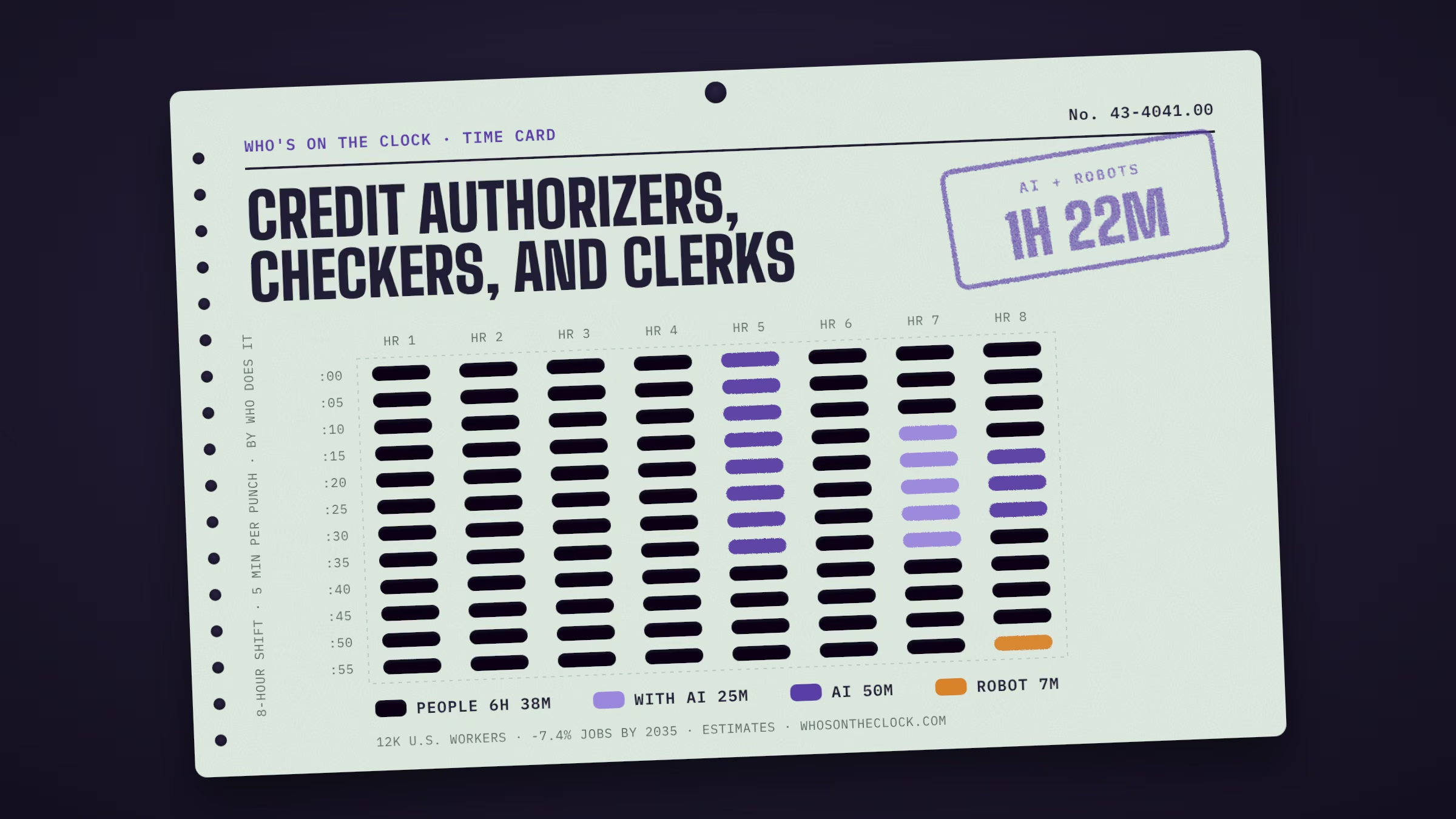
Will AI replace credit authorizers, checkers, and clerks?
Not replace, but it is changing the job. About 1h 22m of an 8-hour shift goes to tasks touched by AI working on its own. The breakdown: 25m done by people with AI help, 50m that AI mostly does alone, 7m that robots have done in real workplaces. The other 6h 38m (83%) stays with people. Separately, BLS expects about 7.4% fewer of these jobs by 2035 (all jobs: +3.5%).
⤢ Full sizeEach mark is 5 minutes of a typical shift for credit authorizers, checkers, and clerks, colored by who does that task today. Estimates from O*NET tasks and Anthropic Economic Index data. How it's made
Authorize credit charges against customers' accounts. Investigate history and credit standing of individuals or business establishments applying for credit. May interview applicants to obtain personal and financial data, determine credit worthiness, process applications, and notify customers of acceptance or rejection of credit.
Time card
Untick tasks you don't do, or set your own times.
Mine
Task, by time spent
Human
With AI
AI
Robot
Evaluate customers' computerized credit records and payment histories to decide whether to approve new credit, based on predetermined standards.1h 28m a shift · No AI or robot evidence found
Compile and analyze credit information gathered by investigation.57m a shift · No AI or robot evidence found
Obtain information about potential creditors from banks, credit bureaus, and other credit services, and provide reciprocal information if requested.51m a shift · No AI or robot evidence found
Interview credit applicants by telephone or in person to obtain personal and financial data needed to complete credit report.44m a shift · No AI or robot evidence found
Receive charge slips or credit applications by mail, or receive information from salespeople or merchants by telephone.38m a shift · Observed in AI use
Consult with customers to resolve complaints or verify financial or credit transactions.38m a shift · No AI or robot evidence found
Keep records of customers' charges and payments.32m a shift · No AI or robot evidence found
Call customers to collect payment on delinquent accounts.25m a shift · No AI or robot evidence found
Prepare reports of findings and recommendations.25m a shift · Observed in AI useTypical AI request: about 11h 1m alone, 1h 3m with AI
Examine city directories and public records to verify residence property ownership, bankruptcies, liens, arrest record, or unpaid taxes of applicants.19m a shift · No AI or robot evidence found
Review individual or commercial customer files to identify and select delinquent accounts for collection.19m a shift · No AI or robot evidence found
Relay credit report information to subscribers by mail or by telephone.13m a shift · Observed in AI use
Contact former employers and other acquaintances to verify applicants' references, employment, health history, or social behavior.13m a shift · No AI or robot evidence found
File sales slips in customers' ledgers for billing purposes.6m a shift · Robots only in factory cells
Mail charge statements to customers.6m a shift · Robots only in factory cells
No company news tracked for this job yet. New stories are added as they happen.
Ask the clock
Will AI replace credit authorizers, checkers, and clerks?
Not replace, but it is changing the job. About 1h 22m of an 8-hour shift goes to tasks touched by AI working on its own. The breakdown: 25m done by people with AI help, 50m that AI mostly does alone, 7m that robots have done in real workplaces. The other 6h 38m (83%) stays with people. Separately, BLS expects about 7.4% fewer of these jobs by 2035 (all jobs: +3.5%).
What parts of the job can AI already do?
AI shows up regularly in 3 of 16 tasks, about 1h 16m of a typical shift. The biggest ones:
Receive charge slips or credit applications by mail, or receive information from salespeople or merchants by telephone. (38m a shift, AI mostly does it alone)
Relay credit report information to subscribers by mail or by telephone. (13m a shift, AI mostly does it alone)
Prepare reports of findings and recommendations. (25m a shift, people use AI to help)
Can a robot do this job?
For some tasks, yes. Robots have done 1 of this job's tasks in workplaces like this one, about 7m of a typical shift. 2 more tasks have only been done in factory setups built around the machine, so they stay with people here.
Prepare credit cards or charge account plates. (6m a shift; e.g. Datacard CE870 instant issuance system + Entrust Financial Instant Issuance software, in use)
What parts of the job are still done by people?
6h 38m of a typical shift, or 83%, goes to tasks with no AI or robot evidence yet. No AI usage or robot deployment has shown up for these so far. The biggest:
Evaluate customers' computerized credit records and payment histories to decide whether to approve new credit, based on predetermined standards. (1h 28m a shift)
Compile and analyze credit information gathered by investigation. (57m a shift)
Obtain information about potential creditors from banks, credit bureaus, and other credit services, and provide reciprocal information if requested. (51m a shift)
Interview credit applicants by telephone or in person to obtain personal and financial data needed to complete credit report. (44m a shift)
Consult with customers to resolve complaints or verify financial or credit transactions. (38m a shift)
How much time does AI save on this job's tasks?
For the 1 task in this job where AI shows up and timing data exists, a typical request takes about 11h 1m for a person alone and about 1h 3m with AI. These are Claude's own estimates from real conversations in April and May 2026 (Anthropic Economic Index). They describe single requests, not whole workdays, and time saved on a task doesn't mean jobs are cut. The biggest gaps:
Prepare reports of findings and recommendations (about 11h 1m alone, 1h 3m with AI)
Are employers still hiring for this job?
On Indeed, job postings in the Customer Service sector are at 87% of their February 2020 level (all U.S. postings: 104%), down 1.5% from a year earlier, as of Oct 9, 2026. BLS separately expects about 900 openings a year in this job through 2035. Across all U.S. postings, 7.3% now mention AI skills. Sector postings cover more than this one job and move for many reasons besides AI.
How much do credit authorizers, checkers, and clerks make?
The median pay is about $50,080 a year ($24.08 an hour), 2% below the median for all U.S. jobs ($50,980). Most people in this job earn between $30,260 and $72,700 a year; that range covers the middle 80%. Pay figures are from BLS, May 2025, and vary a lot by state and employer. Pick a state to compare:
Is this job growing or shrinking?
BLS projects a decline of 7.4% from 2025 to 2035, compared with 3.5% growth for all jobs. That's about 11,000 jobs in 2035. Even so, it expects about 900 openings a year, mostly from people retiring or changing careers. These projections don't single out AI as a cause.
How many people do this job?
About 12,000 people in the U.S., roughly 0.01% of all workers (BLS, May 2025). That makes it the 643rd largest of the 796 jobs on this site. BLS expects about 11,000 in 2035.
What do you need to become one?
O*NET rates the job at level 2 of 5 for preparation, which usually means: high school diploma, some training. Requirements vary by state and employer, especially for licensed work.
What should I learn to stay ahead?
These come from the job's official skill ratings and from the tasks that AI and robots touch least today. Building them keeps you strong in the parts of the work that still need a person:
Skills that matter more here than in most jobs: Reading Comprehension, Speaking, Service Orientation, Time Management
Get strong at the parts of the job that stay with people (listed above), which take 6h 38m of a typical shift
Tools employers list: Microsoft Word, Microsoft PowerPoint, Microsoft Outlook, Microsoft Office software, Microsoft Excel
Learn to use AI well on the tasks where it already shows up in this job (listed above)
What similar jobs could I move into?
These use similar skills. Matches come from 109 official ratings of skills, knowledge and work activities, and each needs the same or less preparation unless the official list relates the jobs directly:
Correspondence Clerks (3h 57m touched, $47k median pay)
Bill and Account Collectors (2h 38m touched, $47k median pay)
Customer Service Representatives (6h touched, $45k median pay)
Credit Analysts (2h 5m touched, $84k median pay)
Loan Officers (1h 43m touched, $77k median pay)
How solid are these numbers?
Each task carries its own evidence label. For this job: 3 observed in real AI use, 1 with robots in real deployments, 12 with no AI or robot evidence found. The minutes per task are estimates, not measured hours, and "no evidence" doesn't prove a task is safe.