Will AI replace petroleum engineers?

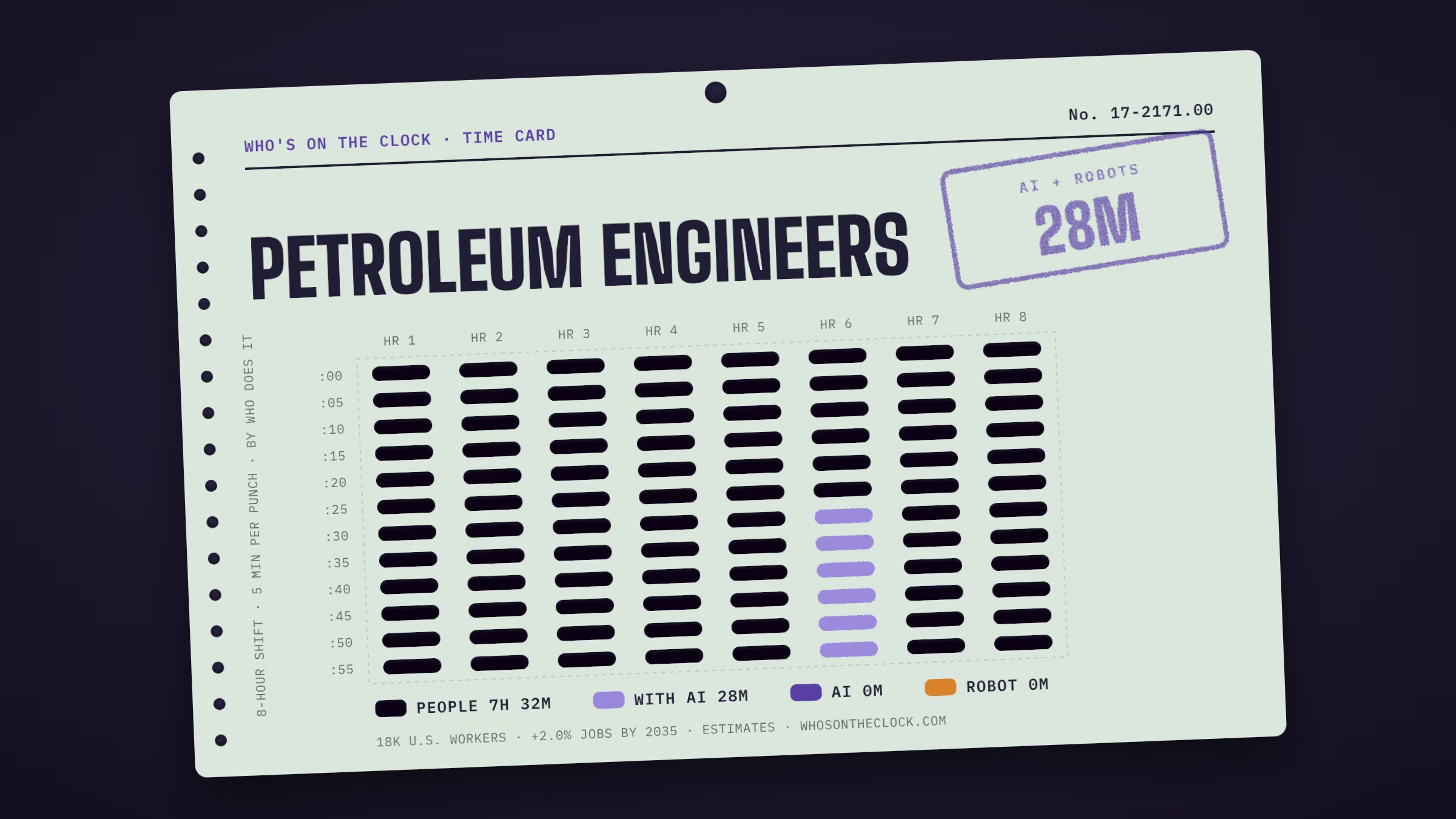
Not on current evidence. Less than 30 minutes of a typical shift goes to tasks that AI or robots are doing today. The other 7h 32m (94%) stays with people. Separately, BLS expects about 2% more of these jobs by 2035 (all jobs: +3.5%).

Time card for petroleum engineers showing a typical 8-hour shift: 7h 32m done by people, 28m done by people with AI.
Each mark is 5 minutes of a typical shift for petroleum engineers, colored by who does that task today. Estimates from O*NET tasks and Anthropic Economic Index data. How it's made

Home / Engineering & architecture / Petroleum Engineers

Devise methods to improve oil and gas extraction and production and determine the need for new or modified tool designs. Oversee drilling and offer technical advice.

Time card

Untick tasks you don't do, or set your own times.
MineTask, by time spentHumanWith AIAIRobot
Monitor production rates, and plan rework processes to improve production.40m a shift · No AI or robot evidence found
Analyze data to recommend placement of wells and supplementary processes to enhance production.40m a shift · No AI or robot evidence found
Assist engineering and other personnel to solve operating problems.40m a shift · No AI or robot evidence found
Direct and monitor the completion and evaluation of wells, well testing, or well surveys.40m a shift · No AI or robot evidence found
Develop plans for oil and gas field drilling, and for product recovery and treatment.40m a shift · No AI or robot evidence found
Assess costs and estimate the production capabilities and economic value of oil and gas wells, to evaluate the economic viability of potential drilling sites.40m a shift · No AI or robot evidence found
Specify and supervise well modification and stimulation programs to maximize oil and gas recovery.28m a shift · No AI or robot evidence found
Maintain records of drilling and production operations.28m a shift · No AI or robot evidence found
Confer with scientific, engineering, and technical personnel to resolve design, research, and testing problems.28m a shift · No AI or robot evidence found
Write technical reports for engineering and management personnel.28m a shift · Observed in AI useTypical AI request: about 10h 18m alone, 38m with AI
Simulate reservoir performance for different recovery techniques, using computer models.23m a shift · No AI or robot evidence found
Interpret drilling and testing information for personnel.17m a shift · No AI or robot evidence found
Coordinate activities of workers engaged in research, planning, and development.11m a shift · No AI or robot evidence found
Evaluate findings to develop, design, or test equipment or processes.11m a shift · No AI or robot evidence found
Assign work to staff to obtain maximum utilization of personnel.11m a shift · No AI or robot evidence found
Design and implement environmental controls on oil and gas operations.11m a shift · No AI or robot evidence found
Coordinate the installation, maintenance, and operation of mining and oil field equipment.11m a shift · No AI or robot evidence found
Test machinery and equipment to ensure that it is safe and conforms to performance specifications.6m a shift · No AI or robot evidence found
Supervise the removal of drilling equipment, the removal of any waste, and the safe return of land to structural stability when wells or pockets are exhausted.6m a shift · No AI or robot evidence found
Inspect oil and gas wells to determine that installations are completed.6m a shift · No AI or robot evidence found
Take samples to assess the amount and quality of oil, the depth at which resources lie, and the equipment needed to properly extract them.6m a shift · No AI or robot evidence found
Design or modify mining and oil field machinery and tools, applying engineering principles.6m a shift · No AI or robot evidence found
Conduct engineering research experiments to improve or modify mining and oil machinery and operations.6m a shift · No AI or robot evidence found

On the floor

No company news tracked for this job yet. New stories are added as they happen.

Ask the clock

Will AI replace petroleum engineers?

Not on current evidence. Less than 30 minutes of a typical shift goes to tasks that AI or robots are doing today. The other 7h 32m (94%) stays with people. Separately, BLS expects about 2% more of these jobs by 2035 (all jobs: +3.5%).

What can AI already do for petroleum engineers?

AI shows up regularly in 1 of 23 tasks, about 28m of a typical shift. The biggest ones:

  • Write technical reports for engineering and management personnel. (28m a shift, people use AI to help)
What still needs a person?

7h 32m of a typical shift, or 94%, goes to tasks with no AI or robot evidence yet. No AI usage or robot deployment has shown up for these so far. The biggest:

  • Monitor production rates, and plan rework processes to improve production. (40m a shift)
  • Analyze data to recommend placement of wells and supplementary processes to enhance production. (40m a shift)
  • Assist engineering and other personnel to solve operating problems. (40m a shift)
  • Direct and monitor the completion and evaluation of wells, well testing, or well surveys. (40m a shift)
  • Develop plans for oil and gas field drilling, and for product recovery and treatment. (40m a shift)
Why is that work hard to automate?

Much of it comes down to where and how the work happens. In-person, hands-on and high-stakes work is where AI and robots have made the least headway so far. In the official O*NET survey of people in this job:

  • 99% talk face to face with others every day
  • 65% are in constant contact with other people
  • 58% say dealing with the public is very or extremely important
How much time does AI save on these tasks?

For the 1 task in this job where AI shows up and timing data exists, a typical request takes about 10h 18m for a person alone and about 38m with AI. These are Claude's own estimates from real conversations in April and May 2026 (Anthropic Economic Index). They describe single requests, not whole workdays, and time saved on a task doesn't mean jobs are cut. The biggest gaps:

  • Write technical reports for engineering and management personnel (about 10h 18m alone, 38m with AI)
Are employers still hiring petroleum engineers?

On Indeed, job postings in the Mechanical Engineering sector are at 168% of their February 2020 level (all U.S. postings: 104%), up 43.4% from a year earlier, as of Oct 9, 2026. BLS separately expects about 1,000 openings a year in this job through 2035. Across all U.S. postings, 7.3% now mention AI skills. Sector postings cover more than this one job and move for many reasons besides AI.

How much do petroleum engineers make?

The median pay is about $144,910 a year ($69.67 an hour), 184% above the median for all U.S. jobs ($50,980). Most people in this job earn between $81,440 and $253,200 or more a year; that range covers the middle 80%. Pay figures are from BLS, May 2025, and vary a lot by state and employer. Pick a state to compare:

Is this job growing or shrinking?

BLS projects growth of 2% from 2025 to 2035, compared with 3.5% growth for all jobs. That's about 19,000 jobs in 2035. It expects about 1,000 openings a year, mostly from people retiring or changing careers. These projections don't single out AI as a cause.

How many petroleum engineers are there in the U.S.?

About 18,000 people in the U.S., roughly 0.01% of all workers (BLS, May 2025). That makes it the 567th largest of the 796 jobs on this site. BLS expects about 19,000 in 2035.

What training do petroleum engineers need?

The most common requirement is a bachelor's degree: about 72% of people in the job said so in the official O*NET survey. O*NET rates the job at level 4 of 5 for preparation, which usually means: bachelor's degree. Requirements vary by state and employer, especially for licensed work.

What should I learn to stay ahead of AI?

These come from the job's official skill ratings and from the tasks that AI and robots touch least today. Building them keeps you strong in the parts of the work that still need a person:

  • Skills that matter more here than in most jobs: Systems Evaluation, Systems Analysis, Science, Time Management
  • Get strong at the parts of the job that stay with people (listed above), which take 7h 32m of a typical shift
  • Tools employers list: Microsoft PowerPoint, Microsoft Office software, Microsoft Excel, Autodesk AutoCAD, C#
  • Learn to use AI well on the tasks where it already shows up in this job (listed above)
What new tasks are petroleum engineers taking on?

Yes. Occupational experts recently added these to the official task list, a sign of how the work itself is shifting. New tasks aren't rated for AI or robots yet:

  • Use drone technology for aerial surveying and monitoring of drilling sites.
What other jobs could petroleum engineers move into?

These use similar skills. Matches come from 109 official ratings of skills, knowledge and work activities, and each needs the same or less preparation unless the official list relates the jobs directly:

  • Mining and Geological Engineers, Including Mining Safety Engineers (56m touched, $106k median pay)
  • Energy Engineers (29m touched, $123k median pay)
  • Water/Wastewater Engineers (0m touched, $101k median pay)
  • Chemical Engineers (0m touched, $125k median pay)
How solid are these numbers?

Each task carries its own evidence label. For this job: 1 observed in real AI use, 22 with no AI or robot evidence found. The minutes per task are estimates, not measured hours, and "no evidence" doesn't prove a task is safe.

Tools in demand

  • Microsoft PowerPoint
  • Microsoft Office software
  • Microsoft Excel
  • Autodesk AutoCAD
  • C#
  • C++
  • Eclipse IDE
  • Google Analytics

Also called

Certification Engineer, Completion Engineer, Completions Engineer, Design Engineer, Drilling Engineer, Engineer, Exploration Engineer, Gas Distribution Engineer, Gas Engineer, Gas Turbine Engineer, Logging Engineer, Mining and Oil Field Equipment Design Engineer, Mining and Oil Field Equipment Test Engineer, Mining and Oil Well Equipment Research Engineer