Will AI replace power plant operators?

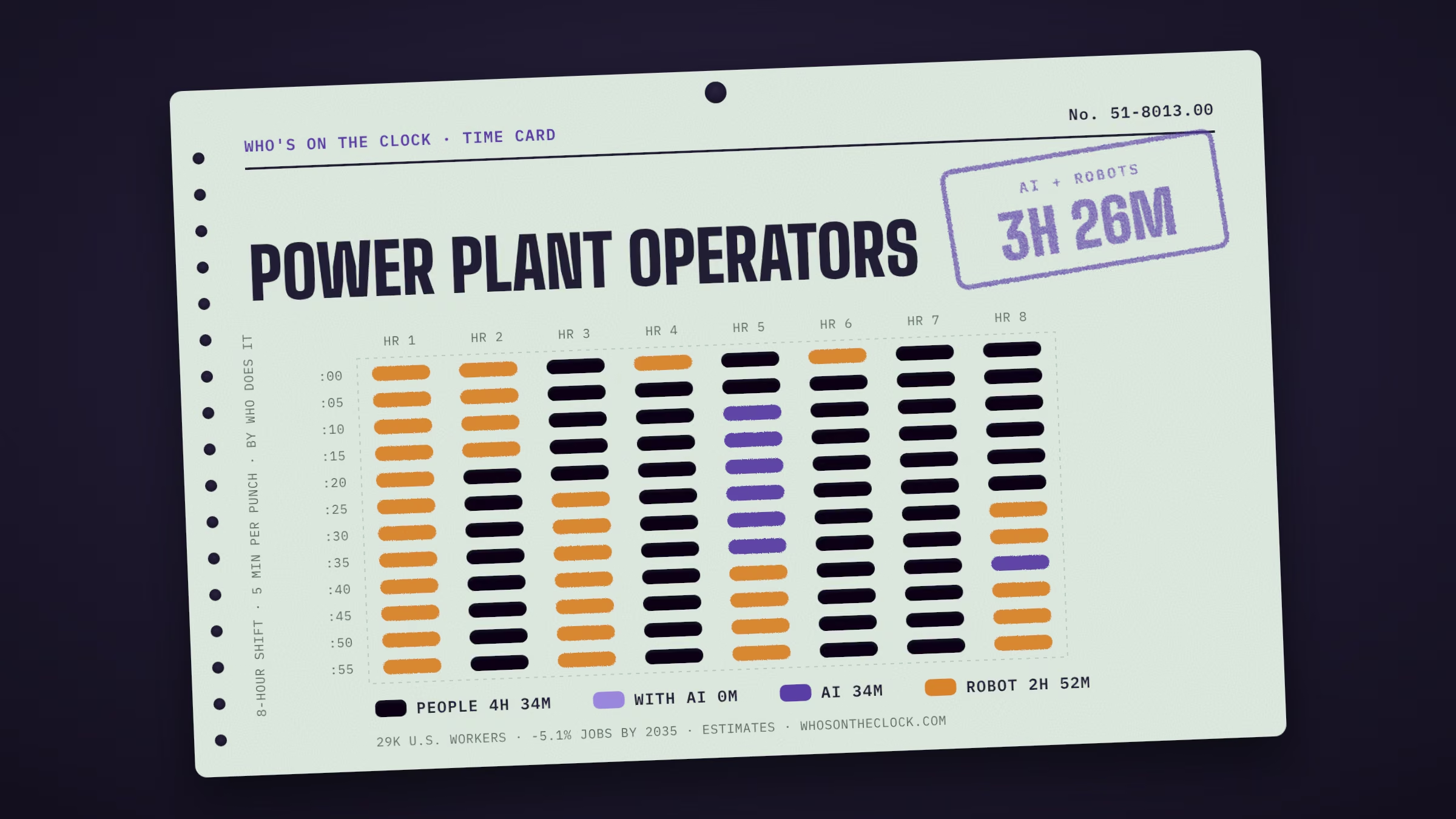
Some tasks are already handled by AI or machines; the rest still needs a person. About 3h 26m of an 8-hour shift goes to tasks that AI or robots largely take over. The breakdown: 34m that AI mostly does alone, 2h 52m that robots have done in real workplaces. The other 4h 34m (57%) stays with people. Separately, BLS expects about 5.1% fewer of these jobs by 2035 (all jobs: +3.5%).

Time card for power plant operators showing a typical 8-hour shift: 4h 34m done by people, 34m by AI, 2h 52m by robots.
Each mark is 5 minutes of a typical shift for power plant operators, colored by who does that task today. Estimates from O*NET tasks and Anthropic Economic Index data. How it's made

Home / Production & factory / Power Plant Operators

Control, operate, or maintain machinery to generate electric power. Includes auxiliary equipment operators.

Time card

Untick tasks you don't do, or set your own times.
MineTask, by time spentHumanWith AIAIRobot
Monitor power plant equipment and indicators to detect evidence of operating problems.1h 20m a shift · Robots deployed · e.g. Spot (Boston Dynamics) with Smart Inspection payloads/software
Control power generating equipment, including boilers, turbines, generators, or reactors, using control boards or semi-automatic equipment.1h 3m a shift · No AI or robot evidence found
Take regulatory action, based on readings from charts, meters and gauges, at established intervals.40m a shift · Robots deployed · e.g. Combustion Optimizer (AI/neural-net combustion optimization applied to plant DCS)
Regulate equipment operations and conditions, such as water levels, based on instrument data or from computers.34m a shift · No AI or robot evidence found
Control or maintain auxiliary equipment, such as pumps, fans, compressors, condensers, feedwater heaters, filters, or chlorinators, to supply water, fuel, lubricants, air, or auxiliary power.29m a shift · Robots only in factory cells
Record and compile operational data by completing and maintaining forms, logs, or reports.29m a shift · Observed in AI useTypical AI request: about 2h 5m alone, 17m with AI
Start or stop generators, auxiliary pumping equipment, turbines, or other power plant equipment as necessary.23m a shift · Robots deployed · e.g. GE SPEEDTRONIC Mark V gas turbine control system (and successor Mark VI/VIe)
Inspect records or log book entries or communicate with plant personnel to assess equipment operating status.23m a shift · No AI or robot evidence found
Clean, lubricate, or maintain equipment, such as generators, turbines, pumps, or compressors, to prevent failure or deterioration.23m a shift · Robots only in factory cells
Make adjustments or minor repairs, such as tightening leaking gland or pipe joints.17m a shift · Robots only in factory cells
Adjust controls to generate specified electrical power or to regulate the flow of power between generating stations and substations.17m a shift · No AI or robot evidence found
Communicate with systems operators to regulate and coordinate line voltages and transmission loads and frequencies.17m a shift · No AI or robot evidence found
Control generator output to match the phase, frequency, or voltage of electricity supplied to panels.11m a shift · No AI or robot evidence found
Open and close valves and switches in sequence to start or shut down auxiliary units.11m a shift · Robots only in factory cells
Prepare and submit compliance, operational, and safety forms or reports.11m a shift · No AI or robot evidence found
Operate or maintain distributed power generation equipment, including fuel cells or microturbines, to produce energy on-site for manufacturing or other commercial purposes.6m a shift · Robots only in factory cells
Receive outage calls and request necessary personnel during power outages or emergencies.6m a shift · No AI or robot evidence found
Collect oil, water, or electrolyte samples for laboratory analysis.6m a shift · Robots only in factory cells
Examine and test electrical power distribution machinery and equipment, using testing devices.6m a shift · Robots deployed · e.g. Spot (Boston Dynamics) with thermal and visual inspection payloads
Place standby emergency electrical generators on line in emergencies and monitor the temperature, output, and lubrication of the system.6m a shift · Robots deployed · e.g. Browns Ferry Unit 3 emergency diesel generators with automatic start/load-sequencing logic
Analyze the layout, instrumentation, or function of electrical generation or transmission facilities.6m a shift · Observed in AI use
Diagnose or troubleshoot problems with gas collection systems.6m a shift · Robots deployed · e.g. LoCI Controller / WellWatcher
Monitor well fields periodically to ensure proper functioning and performance.6m a shift · Robots deployed · e.g. Spot with Orbit (Boston Dynamics), deployed by TECO/J-POWER
Operate landfill gas, methane, or natural gas fueled electrical generation systems.6m a shift · Robots deployed · e.g. Siemens Energy Omnivise T3000 + 2x SGT-800 gas turbines (VW Kraftwerk Wolfsburg, BosB72 mode)
Operate, control, or monitor equipment, such as acid or gas carbon dioxide removal units, carbon dioxide compressors, or pipelines, to capture, store, or transport carbon dioxide exhaust.time not estimated · Robots deployed · e.g. Yokogawa FKDPP autonomous control AI agents on CENTUM VP (Aramco Fadhili Gas Plant AGR unit)
Operate, control, or monitor gasifiers or related equipment, such as coolers, water quenches, water gas shifts reactors, or sulfur recovery units, to produce syngas or electricity from coal.time not estimated · Robots deployed · e.g. ANYmal (ANYbotics)
Operate, control, or monitor integrated gasification combined cycle (IGCC) or related equipment, such as air separation units, to generate electricity from coal.time not estimated · No AI or robot evidence found
Repair or replace gas piping.time not estimated · No AI or robot evidence found
Trace electrical circuitry to ensure compliance of electrical systems with applicable codes or laws.time not estimated · No AI or robot evidence found
Verify that well field monitoring data conforms to applicable regulations.time not estimated · No AI or robot evidence found

On the floor

No company news tracked for this job yet. New stories are added as they happen.

Ask the clock

Will AI replace power plant operators?

Some tasks are already handled by AI or machines; the rest still needs a person. About 3h 26m of an 8-hour shift goes to tasks that AI or robots largely take over. The breakdown: 34m that AI mostly does alone, 2h 52m that robots have done in real workplaces. The other 4h 34m (57%) stays with people. Separately, BLS expects about 5.1% fewer of these jobs by 2035 (all jobs: +3.5%).

What can AI already do for power plant operators?

AI shows up regularly in 2 of 30 tasks, about 34m of a typical shift. The biggest ones:

  • Record and compile operational data by completing and maintaining forms, logs, or reports. (29m a shift, AI mostly does it alone)
  • Analyze the layout, instrumentation, or function of electrical generation or transmission facilities. (6m a shift, AI mostly does it alone)
Where do robots fit in?

For some tasks, yes. Robots have done 8 of this job's tasks in workplaces like this one, about 2h 52m of a typical shift. 6 more tasks have only been done in factory setups built around the machine, so they stay with people here. For 3 physical tasks, no robot has shown it can do the work yet.

  • Monitor power plant equipment and indicators to detect evidence of operating problems. (1h 20m a shift; e.g. Spot (Boston Dynamics) with Smart Inspection payloads/software, in use)
  • Take regulatory action, based on readings from charts, meters and gauges, at established intervals. (40m a shift; e.g. Combustion Optimizer (AI/neural-net combustion optimization applied to plant DCS), in use)
  • Start or stop generators, auxiliary pumping equipment, turbines, or other power plant equipment as necessary. (23m a shift; e.g. GE SPEEDTRONIC Mark V gas turbine control system (and successor Mark VI/VIe), in use)
  • Examine and test electrical power distribution machinery and equipment, using testing devices. (6m a shift; e.g. Spot (Boston Dynamics) with thermal and visual inspection payloads, in use)
What still needs a person?

4h 34m of a typical shift, or 57%, goes to tasks with no AI or robot evidence yet. No AI usage or robot deployment has shown up for these so far. The biggest:

  • Control power generating equipment, including boilers, turbines, generators, or reactors, using control boards or semi-automatic equipment. (1h 3m a shift)
  • Regulate equipment operations and conditions, such as water levels, based on instrument data or from computers. (34m a shift)
  • Control or maintain auxiliary equipment, such as pumps, fans, compressors, condensers, feedwater heaters, filters, or chlorinators, to supply water, fuel, lubricants, air, or auxiliary power. (29m a shift)
  • Inspect records or log book entries or communicate with plant personnel to assess equipment operating status. (23m a shift)
  • Clean, lubricate, or maintain equipment, such as generators, turbines, pumps, or compressors, to prevent failure or deterioration. (23m a shift)
Why is that work hard to automate?

Much of it comes down to where and how the work happens. In-person, hands-on and high-stakes work is where AI and robots have made the least headway so far. In the official O*NET survey of people in this job:

  • 92% say a mistake would be very or extremely serious
  • 85% work in very hot or cold conditions at least weekly
  • 71% carry high or very high responsibility for other workers' safety
How much time does AI save on these tasks?

For the 1 task in this job where AI shows up and timing data exists, a typical request takes about 2h 5m for a person alone and about 17m with AI. These are Claude's own estimates from real conversations in April and May 2026 (Anthropic Economic Index). They describe single requests, not whole workdays, and time saved on a task doesn't mean jobs are cut. The biggest gaps:

  • Record and compile operational data by completing and maintaining forms, logs, or reports (about 2h 5m alone, 17m with AI)
Are employers still hiring power plant operators?

On Indeed, job postings in the Production & Manufacturing sector are at 124% of their February 2020 level (all U.S. postings: 104%), up 12.6% from a year earlier, as of Oct 9, 2026. BLS separately expects about 2,300 openings a year in this job through 2035. Across all U.S. postings, 7.3% now mention AI skills. Sector postings cover more than this one job and move for many reasons besides AI.

How much do power plant operators make?

The median pay is about $102,040 a year ($49.06 an hour), 100% above the median for all U.S. jobs ($50,980). Most people in this job earn between $61,790 and $131,940 a year; that range covers the middle 80%. Pay figures are from BLS, May 2025, and vary a lot by state and employer. Pick a state to compare:

Is this job growing or shrinking?

BLS projects a decline of 5.1% from 2025 to 2035, compared with 3.5% growth for all jobs. That's about 28,000 jobs in 2035. Even so, it expects about 2,300 openings a year, mostly from people retiring or changing careers. These projections don't single out AI as a cause.

How many power plant operators are there in the U.S.?

About 29,000 people in the U.S., roughly 0.02% of all workers (BLS, May 2025). That makes it the 482nd largest of the 796 jobs on this site. BLS expects about 28,000 in 2035.

What training do power plant operators need?

The most common requirement is a high school diploma: about 60% of people in the job said so in the official O*NET survey. O*NET rates the job at level 2 of 5 for preparation, which usually means: high school diploma, some training. Requirements vary by state and employer, especially for licensed work.

What should I learn to stay ahead of AI?

These come from the job's official skill ratings and from the tasks that AI and robots touch least today. Building them keeps you strong in the parts of the work that still need a person:

  • Skills that matter more here than in most jobs: Operations Monitoring, Operation and Control, Repairing, Equipment Maintenance
  • Get strong at the parts of the job that stay with people (listed above), which take 4h 34m of a typical shift
  • Tools employers list: Microsoft PowerPoint, Microsoft Outlook, Microsoft Office software, Microsoft Excel, Microsoft Access
  • Learn to use AI well on the tasks where it already shows up in this job (listed above)
What other jobs could power plant operators move into?

These use similar skills, with less of a typical shift touched by AI or robots. Matches come from 109 official ratings of skills, knowledge and work activities, and each needs the same or less preparation unless the official list relates the jobs directly:

  • Rolling Machine Setters, Operators, and Tenders, Metal and Plastic (1h 4m touched, $50k median pay)
  • Separating, Filtering, Clarifying, Precipitating, and Still Machine Setters, Operators, and Tenders (1h 42m touched, $52k median pay)
  • Milling and Planing Machine Setters, Operators, and Tenders, Metal and Plastic (2h 36m touched, $53k median pay)
  • Computer Numerically Controlled Tool Operators (1h 22m touched, $51k median pay)
  • Mixing and Blending Machine Setters, Operators, and Tenders (1h 51m touched, $49k median pay)
How solid are these numbers?

Each task carries its own evidence label. For this job: 2 observed in real AI use, 10 with robots in real deployments, 18 with no AI or robot evidence found. The minutes per task are estimates, not measured hours, and "no evidence" doesn't prove a task is safe.

Tools in demand

  • Microsoft PowerPoint
  • Microsoft Outlook
  • Microsoft Office software
  • Microsoft Excel
  • Microsoft Access
  • Microsoft Word
  • SAP software

Also called

Asphalt Plant Operator, Auxiliary Equipment Tender, Auxiliary Operator, Auxiliary Power Equipment Operator, Batch Plant Operator, Booster Operator, Booster Plant Operator, Booster Pump Operator, Carbon Capture Power Plant Engineer, Carbon Capture Power Plant Operator, Carbon Sequestration Plant Engineer, Carbon Sequestration Plant Operator, Coal Gasification Technician (Coal Gasification Tech), Cogeneration Technician (Cogeneration Tech)