Home / Tasks / Collect information from people through observation, interviews, or surveys
In 8 of the 17 jobs that do this, AI or robots already show up on it, most often as work people hand to AI. In the other 9, there's no evidence yet. Jobs spend a median of 18m of an 8-hour shift on it, and about 363,000 U.S. workers hold these jobs.
Every job that does this
Each job words the task its own way. Minutes are that job's estimate for a typical shift; the label is the evidence for that job's version.
| Job and its version of the task | Per shift | Evidence |
|---|---|---|
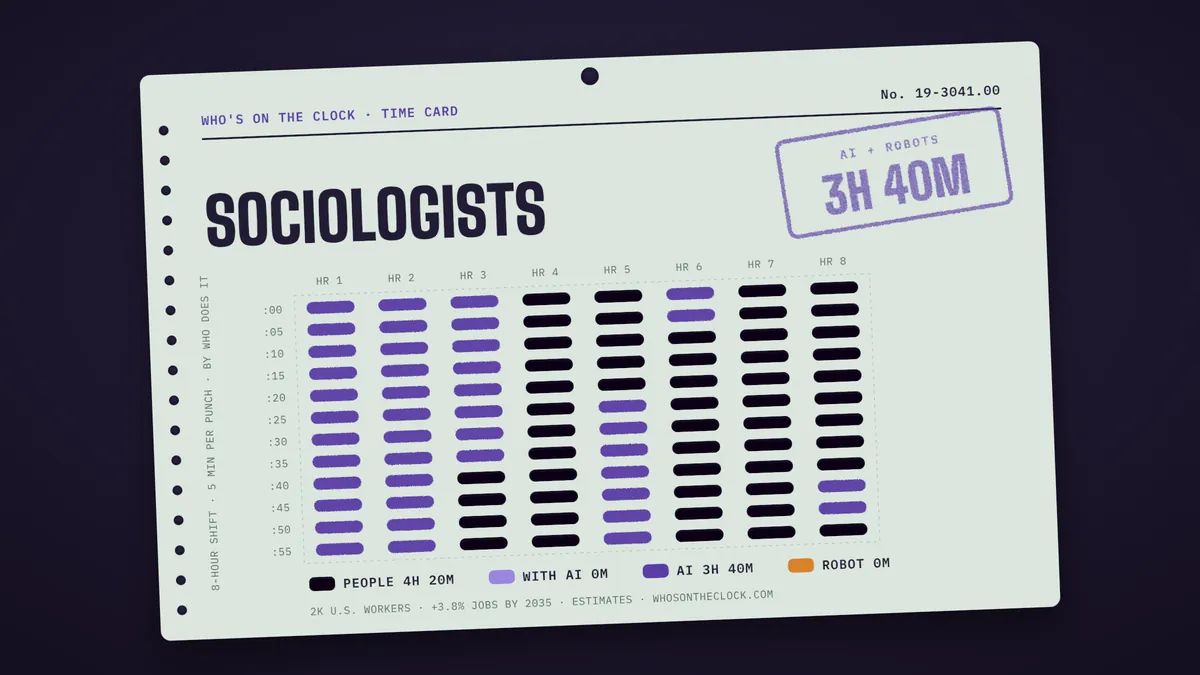
| SociologistsCollect data about the attitudes, values, and behaviors of people in groups, using observation, interviews, and review of documents. | 46m | Often handed to AI |
| Clinical NeuropsychologistsInterview patients to obtain comprehensive medical histories. | 45m | With AI |
| School PsychologistsAssess an individual child's needs, limitations, and potential, using observation, review of school records, and consultation with parents and school personnel. | 41m | No evidence yet |
| NeuropsychologistsInterview patients to obtain comprehensive medical histories. | 41m | With AI |
| Survey ResearchersConduct research to gather information about survey topics. | 29m | Often handed to AI |
| Anthropologists and ArcheologistsCollect information and make judgments through observation, interviews, and review of documents. | 26m | No evidence yet |
| EmbalmersConduct interviews to arrange for the preparation of obituary notices, to assist with the selection of caskets or urns, and to determine the location and time of burials or cremations. | 23m | No evidence yet |
| Clinical and Counseling PsychologistsCollect information about individuals or clients, using interviews, case histories, observational techniques, and other assessment methods. | 19m | Often handed to AI |
| Industrial-Organizational PsychologistsObserve and interview workers to obtain information about the physical, mental, and educational requirements of jobs, as well as information about aspects such as job satisfaction. | 18m | No evidence yet |
| HistoriansInterview people to gather information about historical events and to record oral histories. | 18m | No evidence yet |
| Museum Technicians and ConservatorsPerform on-site field work which may involve interviewing people, inspecting and identifying artifacts, note-taking, viewing sites and collections, and repainting exhibition spaces. | 13m | No evidence yet |
| Social Science Research AssistantsObtain informed consent of research subjects or their guardians. | 13m | No evidence yet |
| Urban and Regional PlannersConduct interviews, surveys and site inspections concerning factors that affect land usage, such as zoning, traffic flow and housing. | 12m | Robots |
| Materials ScientistsVisit suppliers of materials or users of products to gather specific information. | 12m | No evidence yet |
| Park NaturalistsInterview specialists in desired fields to obtain and develop data for park information programs. | 6m | No evidence yet |
| BiostatisticiansCollect data through surveys or experimentation. | 6m | Often handed to AI |
| Geological TechniciansInterview individuals, and research public databases in order to obtain information. | 6m | Often handed to AI |
How to read this
This task type comes from O*NET's detailed work activities, which link similar tasks across jobs. A label applies to one job's version of the task: AI use comes from real AI conversations (Anthropic Economic Index) and robot evidence from deployments in real workplaces. "No evidence yet" may just mean the task is rare in the data. How we keep time.
See all 250 shared tasks, or find any job on the big clock.