Will AI replace athletic trainers?

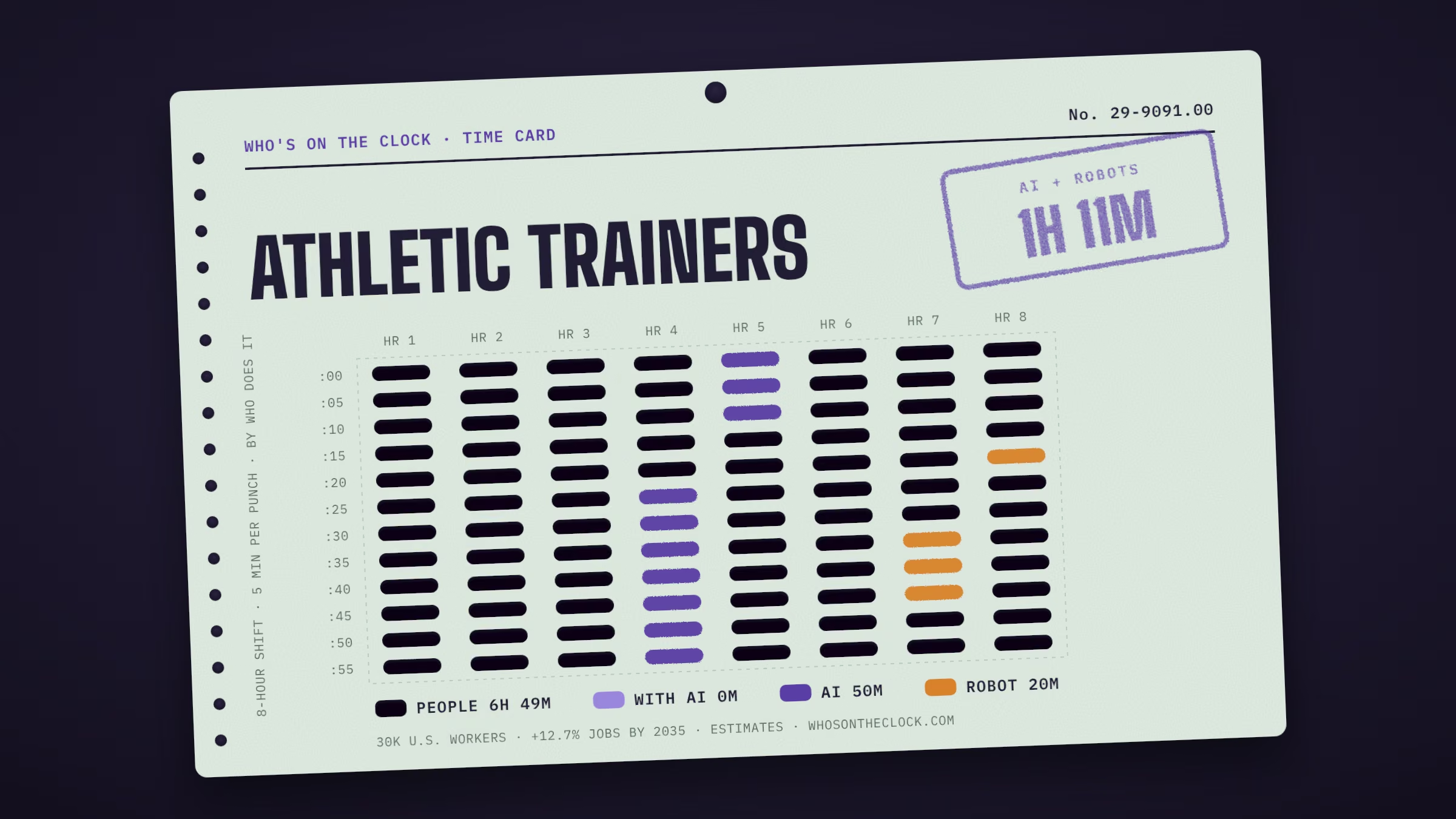
Unlikely, though parts of the work are changing. About 1h 11m of an 8-hour shift goes to tasks touched by AI working on its own. The breakdown: 50m that AI mostly does alone, 20m that robots have done in real workplaces. The other 6h 49m (85%) stays with people. Separately, BLS expects about 12.7% more of these jobs by 2035 (all jobs: +3.5%).

Time card for athletic trainers showing a typical 8-hour shift: 6h 49m done by people, 50m by AI, 20m by robots.
Each mark is 5 minutes of a typical shift for athletic trainers, colored by who does that task today. Estimates from O*NET tasks and Anthropic Economic Index data. How it's made

Home / Healthcare practitioners / Athletic Trainers

Evaluate and treat musculoskeletal injuries or illnesses. Provide preventive, therapeutic, emergency, and rehabilitative care.

Time card

Untick tasks you don't do, or set your own times.
MineTask, by time spentHumanWith AIAIRobot
Care for athletic injuries, using physical therapy equipment, techniques, or medication.1h 21m a shift · No AI or robot evidence found
Apply protective or injury preventive devices, such as tape, bandages, or braces, to body parts, such as ankles, fingers, or wrists.1h 1m a shift · No AI or robot evidence found
Travel with athletic teams to be available at sporting events.1h 1m a shift · No AI or robot evidence found
Perform general administrative tasks, such as keeping records or writing reports.51m a shift · Observed in AI useTypical AI request: about 1h 39m alone, 24m with AI
Conduct an initial assessment of an athlete's injury or illness to provide emergency or continued care and to determine whether they should be referred to physicians for definitive diagnosis and treatment.40m a shift · No AI or robot evidence found
Assess and report the progress of recovering athletes to coaches or physicians.20m a shift · No AI or robot evidence found
Perform team support duties, such as running errands, maintaining equipment, or stocking supplies.20m a shift · Robots only in factory cells
Evaluate athletes' readiness to play and provide participation clearances when necessary and warranted.15m a shift · No AI or robot evidence found
Clean and sanitize athletic training rooms.15m a shift · Robots only in factory cells
Instruct coaches, athletes, parents, medical personnel, or community members in the care and prevention of athletic injuries.15m a shift · No AI or robot evidence found
Collaborate with physicians to develop and implement comprehensive rehabilitation programs for athletic injuries.15m a shift · No AI or robot evidence found
Massage body parts to relieve soreness, strains, or bruises.15m a shift · Robots deployed · e.g. Aescape (Aertable / Aerpoints)
Plan or implement comprehensive athletic injury or illness prevention programs.10m a shift · No AI or robot evidence found
Develop training programs or routines designed to improve athletic performance.10m a shift · No AI or robot evidence found
Lead stretching exercises for team members prior to games or practices.10m a shift · No AI or robot evidence found
Inspect playing fields to locate any items that could injure players.5m a shift · Robots deployed · e.g. Turf Tank One / Turf Tank Two
Advise athletes on the proper use of equipment.5m a shift · No AI or robot evidence found
Confer with coaches to select protective equipment.5m a shift · No AI or robot evidence found
Accompany injured athletes to hospitals.5m a shift · No AI or robot evidence found
Conduct research or provide instruction on subject matter related to athletic training or sports medicine.5m a shift · No AI or robot evidence found
Recommend special diets to improve athletes' health, increase their stamina, or alter their weight.5m a shift · No AI or robot evidence found
File athlete insurance claims and communicate with insurance providers.5m a shift · No AI or robot evidence found
Teach sports medicine courses to athletic training students.5m a shift · No AI or robot evidence found

On the floor

No company news tracked for this job yet. New stories are added as they happen.

Ask the clock

Will AI replace athletic trainers?

Unlikely, though parts of the work are changing. About 1h 11m of an 8-hour shift goes to tasks touched by AI working on its own. The breakdown: 50m that AI mostly does alone, 20m that robots have done in real workplaces. The other 6h 49m (85%) stays with people. Separately, BLS expects about 12.7% more of these jobs by 2035 (all jobs: +3.5%).

What can AI already do for athletic trainers?

AI shows up regularly in 1 of 23 tasks, about 50m of a typical shift. The biggest ones:

  • Perform general administrative tasks, such as keeping records or writing reports. (51m a shift, AI mostly does it alone)
Where do robots fit in?

For some tasks, yes. Robots have done 2 of this job's tasks in workplaces like this one, about 20m of a typical shift. 2 more tasks have only been done in factory setups built around the machine, so they stay with people here. For 9 physical tasks, no robot has shown it can do the work yet.

  • Massage body parts to relieve soreness, strains, or bruises. (15m a shift; e.g. Aescape (Aertable / Aerpoints), in use)
  • Inspect playing fields to locate any items that could injure players. (5m a shift; e.g. Turf Tank One / Turf Tank Two, in use)
What still needs a person?

6h 49m of a typical shift, or 85%, goes to tasks with no AI or robot evidence yet. No AI usage or robot deployment has shown up for these so far. The biggest:

  • Care for athletic injuries, using physical therapy equipment, techniques, or medication. (1h 21m a shift)
  • Apply protective or injury preventive devices, such as tape, bandages, or braces, to body parts, such as ankles, fingers, or wrists. (1h 1m a shift)
  • Travel with athletic teams to be available at sporting events. (1h 1m a shift)
  • Conduct an initial assessment of an athlete's injury or illness to provide emergency or continued care and to determine whether they should be referred to physicians for definitive diagnosis and treatment. (40m a shift)
  • Assess and report the progress of recovering athletes to coaches or physicians. (20m a shift)
Why is that work hard to automate?

Much of it comes down to where and how the work happens. In-person, hands-on and high-stakes work is where AI and robots have made the least headway so far. In the official O*NET survey of people in this job:

  • 88% talk face to face with others every day
  • 87% are in constant contact with other people
  • 68% say a mistake would be very or extremely serious
How much time does AI save on these tasks?

For the 1 task in this job where AI shows up and timing data exists, a typical request takes about 1h 39m for a person alone and about 24m with AI. These are Claude's own estimates from real conversations in April and May 2026 (Anthropic Economic Index). They describe single requests, not whole workdays, and time saved on a task doesn't mean jobs are cut. The biggest gaps:

  • Perform general administrative tasks, such as keeping records or writing reports (about 1h 39m alone, 24m with AI)
How much do athletic trainers make?

The median pay is about $62,520 a year, 23% above the median for all U.S. jobs ($50,980). Most people in this job earn between $48,180 and $88,760 a year; that range covers the middle 80%. Pay figures are from BLS, May 2025, and vary a lot by state and employer. Pick a state to compare:

Is this job growing or shrinking?

BLS projects growth of 12.7% from 2025 to 2035, compared with 3.5% growth for all jobs. That's about 40,000 jobs in 2035. It expects about 2,400 openings a year, mostly from people retiring or changing careers. These projections don't single out AI as a cause.

How many athletic trainers are there in the U.S.?

About 31,000 people in the U.S., roughly 0.02% of all workers (BLS, May 2025). That makes it the 478th largest of the 796 jobs on this site. BLS expects about 40,000 in 2035.

What training do athletic trainers need?

The most common requirement is a master's degree: about 54% of people in the job said so in the official O*NET survey. O*NET rates the job at level 5 of 5 for preparation, which usually means: graduate degree. Requirements vary by state and employer, especially for licensed work.

What should I learn to stay ahead of AI?

These come from the job's official skill ratings and from the tasks that AI and robots touch least today. Building them keeps you strong in the parts of the work that still need a person:

  • Skills that matter more here than in most jobs: Monitoring, Judgment and Decision Making, Instructing, Service Orientation
  • Get strong at the parts of the job that stay with people (listed above), which take 6h 49m of a typical shift
  • Tools employers list: Microsoft Office software, Microsoft Excel, Microsoft Outlook, Microsoft PowerPoint, Microsoft Word
  • Learn to use AI well on the tasks where it already shows up in this job (listed above)
What new tasks are athletic trainers taking on?

Yes. Occupational experts recently added these to the official task list, a sign of how the work itself is shifting. New tasks aren't rated for AI or robots yet:

  • Develop emergency action plans for sports facilities.
What other jobs could athletic trainers move into?

These use similar skills, with less of a typical shift touched by AI or robots. Matches come from 109 official ratings of skills, knowledge and work activities, and each needs the same or less preparation unless the official list relates the jobs directly:

  • Occupational Therapists (19m touched, $100k median pay)
  • Physical Therapists (7m touched, $103k median pay)
  • Exercise Physiologists (7m touched, $59k median pay)
  • Physical Therapist Assistants (0m touched, $68k median pay)
How solid are these numbers?

Each task carries its own evidence label. For this job: 1 observed in real AI use, 2 with robots in real deployments, 20 with no AI or robot evidence found. The minutes per task are estimates, not measured hours, and "no evidence" doesn't prove a task is safe.

Tools in demand

  • Microsoft Office software
  • Microsoft Excel
  • Microsoft Outlook
  • Microsoft PowerPoint
  • Microsoft Word

Also called

Athletic Instructor, Athletic Lecturer, Athletic Trainer, Certified Athletic Trainer, Clinical Athletic Instructor, Clinical Athletic Trainer, Fitness Specialist, Licensed Athletic Trainer, On-Site Industrial Athletic Trainer, Outreach Athletic Trainer, Personal Trainer, Physical Trainer, Resident Athletic Trainer, Sports Athletic Trainer