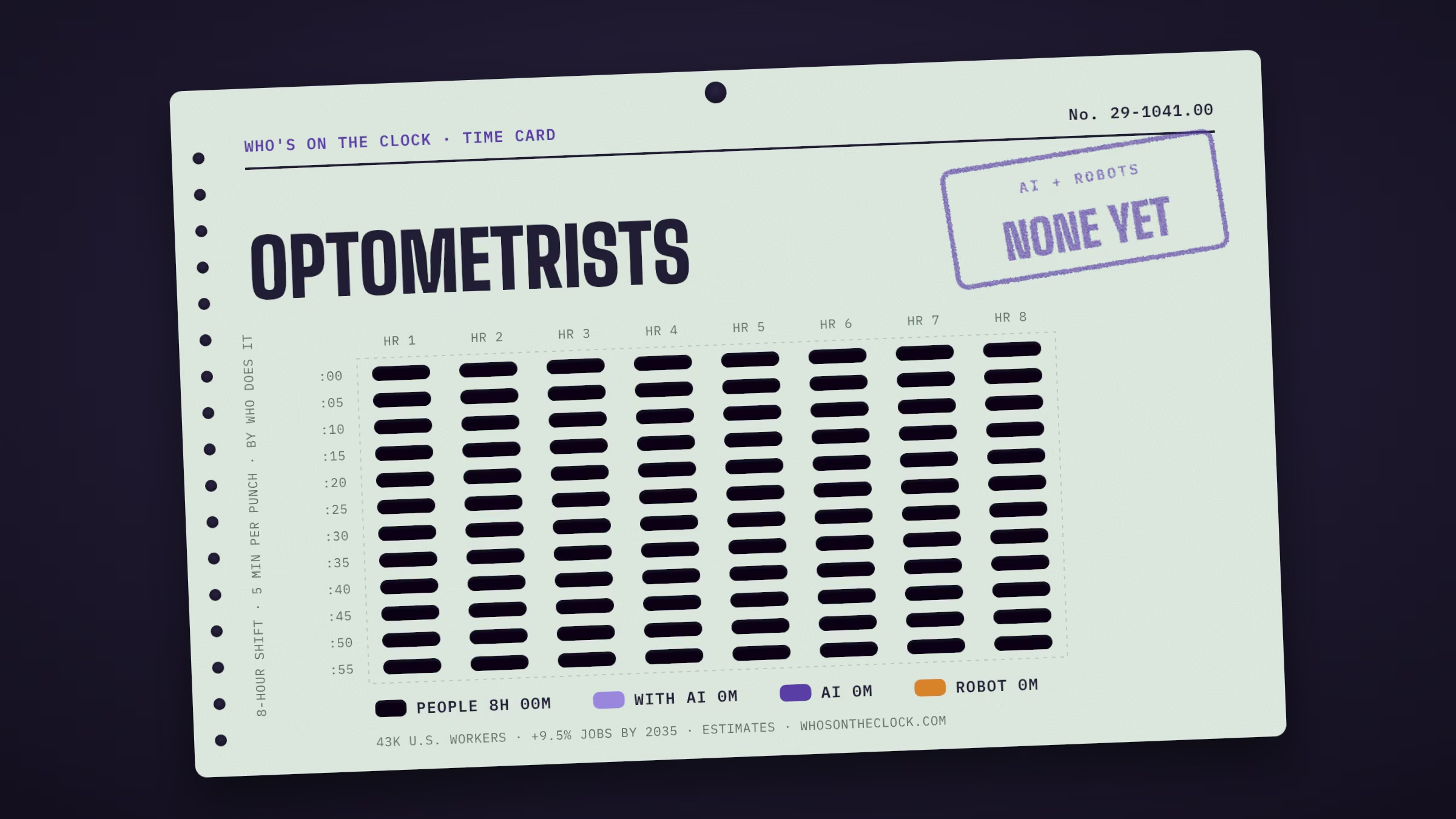
Not on current evidence. Less than 30 minutes of a typical shift goes to tasks that AI or robots are doing today. The other 8h (100%) stays with people. Separately, BLS expects about 9.5% more of these jobs by 2035 (all jobs: +3.5%).
⤢ Full sizeEach mark is 5 minutes of a typical shift for optometrists, colored by who does that task today. Estimates from O*NET tasks and Anthropic Economic Index data. How it's made
Diagnose, manage, and treat conditions and diseases of the human eye and visual system. Examine eyes and visual system, diagnose problems or impairments, prescribe corrective lenses, and provide treatment. May prescribe therapeutic drugs to treat specific eye conditions.
Time card
Untick tasks you don't do, or set your own times.
Mine
Task, by time spent
Human
With AI
AI
Robot
Examine eyes, using observation, instruments, and pharmaceutical agents, to determine visual acuity and perception, focus, and coordination and to diagnose diseases and other abnormalities, such as glaucoma or color blindness.3h 28m a shift · No AI or robot evidence found
Prescribe, supply, fit and adjust eyeglasses, contact lenses, and other vision aids.1h 18m a shift · No AI or robot evidence found
Analyze test results and develop a treatment plan.1h 5m a shift · No AI or robot evidence found
Educate and counsel patients on contact lens care, visual hygiene, lighting arrangements, and safety factors.39m a shift · No AI or robot evidence found
Provide patients undergoing eye surgeries, such as cataract and laser vision correction, with pre- and post-operative care.26m a shift · No AI or robot evidence found
Prescribe medications to treat eye diseases if state laws permit.19m a shift · No AI or robot evidence found
Consult with and refer patients to ophthalmologist or other health care practitioner if additional medical treatment is determined necessary.13m a shift · No AI or robot evidence found
Prescribe therapeutic procedures to correct or conserve vision.13m a shift · No AI or robot evidence found
Provide vision therapy and low-vision rehabilitation.13m a shift · No AI or robot evidence found
Remove foreign bodies from the eye.6m a shift · No AI or robot evidence found
On the floor
No company news tracked for this job yet. New stories are added as they happen.
Ask the clock
Will AI replace optometrists?
Not on current evidence. Less than 30 minutes of a typical shift goes to tasks that AI or robots are doing today. The other 8h (100%) stays with people. Separately, BLS expects about 9.5% more of these jobs by 2035 (all jobs: +3.5%).
What can AI already do for optometrists?
None of this job's tasks show regular AI use yet. That can mean the work is hands-on or in person, or simply that it rarely comes up in AI usage data.
Where do robots fit in?
Not in workplaces like this one, based on a 2026 review of robot deployments. For 4 physical tasks, no robot has shown it can do the work yet.
What still needs a person?
8h of a typical shift, or 100%, goes to tasks with no AI or robot evidence yet. No AI usage or robot deployment has shown up for these so far. The biggest:
Examine eyes, using observation, instruments, and pharmaceutical agents, to determine visual acuity and perception, focus, and coordination and to diagnose diseases and other abnormalities, such as glaucoma or color blindness. (3h 28m a shift)
Prescribe, supply, fit and adjust eyeglasses, contact lenses, and other vision aids. (1h 18m a shift)
Analyze test results and develop a treatment plan. (1h 5m a shift)
Educate and counsel patients on contact lens care, visual hygiene, lighting arrangements, and safety factors. (39m a shift)
Provide patients undergoing eye surgeries, such as cataract and laser vision correction, with pre- and post-operative care. (26m a shift)
Why is that work hard to automate?
Much of it comes down to where and how the work happens. In-person, hands-on and high-stakes work is where AI and robots have made the least headway so far. In the official O*NET survey of people in this job:
100% talk face to face with others every day
95% work at arm's length or closer to other people
81% say dealing with the public is very or extremely important
Are employers still hiring optometrists?
On Indeed, job postings in the Medical Technician sector are at 125% of their February 2020 level (all U.S. postings: 104%), down 2.6% from a year earlier, as of Oct 9, 2026. BLS separately expects about 2,000 openings a year in this job through 2035. Across all U.S. postings, 7.3% now mention AI skills. Sector postings cover more than this one job and move for many reasons besides AI.
How much do optometrists make?
The median pay is about $136,570 a year ($65.66 an hour), 168% above the median for all U.S. jobs ($50,980). Most people in this job earn between $74,870 and $202,180 a year; that range covers the middle 80%. Pay figures are from BLS, May 2025, and vary a lot by state and employer. Pick a state to compare:
Is this job growing or shrinking?
BLS projects growth of 9.5% from 2025 to 2035, compared with 3.5% growth for all jobs. That's about 49,000 jobs in 2035. It expects about 2,000 openings a year, mostly from people retiring or changing careers. These projections don't single out AI as a cause.
How many optometrists are there in the U.S.?
About 43,000 people in the U.S., roughly 0.03% of all workers (BLS, May 2025). That makes it the 412th largest of the 796 jobs on this site. BLS expects about 49,000 in 2035.
What training do optometrists need?
The most common requirement is a doctoral degree: about 95% of people in the job said so in the official O*NET survey. O*NET rates the job at level 5 of 5 for preparation, which usually means: graduate degree. Requirements vary by state and employer, especially for licensed work.
What should I learn to stay ahead of AI?
These come from the job's official skill ratings and from the tasks that AI and robots touch least today. Building them keeps you strong in the parts of the work that still need a person:
Skills that matter more here than in most jobs: Science, Social Perceptiveness, Critical Thinking, Writing
Get strong at the parts of the job that stay with people (listed above), which take 8h of a typical shift
Tools employers list: Mozilla Firefox, Microsoft Edge, Apple Safari, Intuit QuickBooks, Microsoft Access
What other jobs could optometrists move into?
These use similar skills. Matches come from 109 official ratings of skills, knowledge and work activities, and each needs the same or less preparation unless the official list relates the jobs directly:
Physical Medicine and Rehabilitation Physicians (0m touched, $266k median pay)
Urologists (1h 17m touched, $266k median pay)
Neurologists (55m touched, $249k median pay)
Audiologists (0m touched, $96k median pay)
Chiropractors (22m touched, $79k median pay)
How solid are these numbers?
Each task carries its own evidence label. For this job: 10 with no AI or robot evidence found. The minutes per task are estimates, not measured hours, and "no evidence" doesn't prove a task is safe.
Tools in demand
Mozilla Firefox
Microsoft Edge
Apple Safari
Intuit QuickBooks
Microsoft Access
Microsoft Excel
Microsoft SQL Server
Microsoft Word
Also called
Optometrist, Optometry Doctor (OD), Therapeutic Optometrist