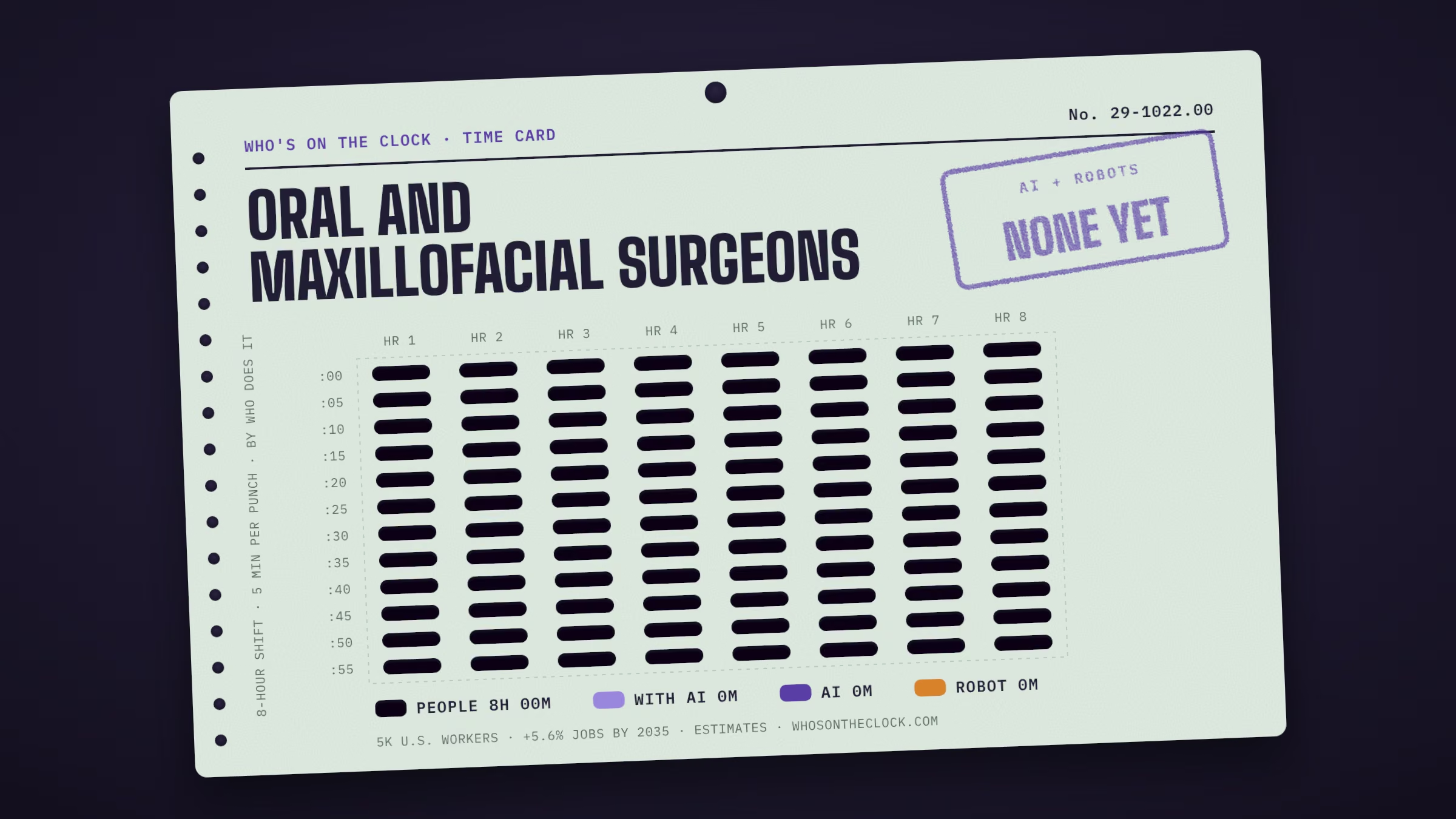
Not on current evidence. Less than 30 minutes of a typical shift goes to tasks that AI or robots are doing today. The other 8h (100%) stays with people. Separately, BLS expects about 5.6% more of these jobs by 2035 (all jobs: +3.5%).
⤢ Full sizeEach mark is 5 minutes of a typical shift for oral and maxillofacial surgeons, colored by who does that task today. Estimates from O*NET tasks and Anthropic Economic Index data. How it's made
Perform surgery and related procedures on the hard and soft tissues of the oral and maxillofacial regions to treat diseases, injuries, or defects. May diagnose problems of the oral and maxillofacial regions. May perform surgery to improve function or appearance.
Time card
Untick tasks you don't do, or set your own times.
Mine
Task, by time spent
Human
With AI
AI
Robot
Remove impacted, damaged, and non-restorable teeth.2h 5m a shift · No AI or robot evidence found
Perform surgery to prepare the mouth for dental implants and to aid in the regeneration of deficient bone and gum tissues.1h 27m a shift · No AI or robot evidence found
Administer general and local anesthetics.1h 2m a shift · No AI or robot evidence found
Evaluate the position of the wisdom teeth to determine whether problems exist currently or might occur in the future.44m a shift · No AI or robot evidence found
Collaborate with other professionals, such as restorative dentists and orthodontists, to plan treatment.31m a shift · No AI or robot evidence found
Provide emergency treatment of facial injuries including facial lacerations, intra-oral lacerations, and fractured facial bones.31m a shift · No AI or robot evidence found
Treat infections of the oral cavity, salivary glands, jaws, and neck.25m a shift · No AI or robot evidence found
Perform surgery on the mouth and jaws to treat conditions such as cleft lip, cleft palate, and jaw growth problems.25m a shift · No AI or robot evidence found
Remove tumors and other abnormal growths of the oral and facial regions, using surgical instruments.19m a shift · No AI or robot evidence found
Treat problems affecting the oral mucosa, such as mouth ulcers and infections.12m a shift · No AI or robot evidence found
Restore form and function by moving skin, bone, nerves, and other tissues from other parts of the body to reconstruct the jaws and face.6m a shift · No AI or robot evidence found
Perform minor cosmetic procedures, such as chin and cheekbone enhancements.6m a shift · No AI or robot evidence found
Perform minor facial rejuvenation procedures, including the use of Botox and laser technology.6m a shift · Robots only in factory cells
Treat snoring problems, using laser surgery.time not estimated · No AI or robot evidence found
On the floor
No company news tracked for this job yet. New stories are added as they happen.
Ask the clock
Will AI replace oral and maxillofacial surgeons?
Not on current evidence. Less than 30 minutes of a typical shift goes to tasks that AI or robots are doing today. The other 8h (100%) stays with people. Separately, BLS expects about 5.6% more of these jobs by 2035 (all jobs: +3.5%).
What can AI already do for oral and maxillofacial surgeons?
None of this job's tasks show regular AI use yet. That can mean the work is hands-on or in person, or simply that it rarely comes up in AI usage data.
Where do robots fit in?
Not in workplaces like this one, based on a 2026 review of robot deployments. 1 more task has only been done in factory setups built around the machine, so it stays with people here. For 11 physical tasks, no robot has shown it can do the work yet.
What still needs a person?
8h of a typical shift, or 100%, goes to tasks with no AI or robot evidence yet. No AI usage or robot deployment has shown up for these so far. The biggest:
Remove impacted, damaged, and non-restorable teeth. (2h 5m a shift)
Perform surgery to prepare the mouth for dental implants and to aid in the regeneration of deficient bone and gum tissues. (1h 27m a shift)
Administer general and local anesthetics. (1h 2m a shift)
Evaluate the position of the wisdom teeth to determine whether problems exist currently or might occur in the future. (44m a shift)
Collaborate with other professionals, such as restorative dentists and orthodontists, to plan treatment. (31m a shift)
Why is that work hard to automate?
Much of it comes down to where and how the work happens. In-person, hands-on and high-stakes work is where AI and robots have made the least headway so far. In the official O*NET survey of people in this job:
100% carry high or very high responsibility for other workers' safety
100% work at arm's length or closer to other people
97% are exposed to disease or infection every day
Are employers still hiring oral and maxillofacial surgeons?
On Indeed, job postings in the Dental sector are at 117% of their February 2020 level (all U.S. postings: 104%), down 14.9% from a year earlier, as of Oct 9, 2026. BLS separately expects about 200 openings a year in this job through 2035. Across all U.S. postings, 7.3% now mention AI skills. Sector postings cover more than this one job and move for many reasons besides AI.
How much do oral and maxillofacial surgeons make?
The median pay is about $352,220 a year ($169.34 an hour), 591% above the median for all U.S. jobs ($50,980). Most people in this job earn between $86,250 and $622,640 or more a year; that range covers the middle 80%. Pay figures are from BLS, May 2025, and vary a lot by state and employer. Pick a state to compare:
Is this job growing or shrinking?
BLS projects growth of 5.6% from 2025 to 2035, compared with 3.5% growth for all jobs. That's about 5,900 jobs in 2035. It expects about 200 openings a year, mostly from people retiring or changing careers. These projections don't single out AI as a cause.
How many oral and maxillofacial surgeons are there in the U.S.?
About 4,910 people in the U.S., roughly 0.00% of all workers (BLS, May 2025). That makes it the 729th largest of the 796 jobs on this site. BLS expects about 5,900 in 2035.
What training do oral and maxillofacial surgeons need?
The most common requirement is post-doctoral training: about 72% of people in the job said so in the official O*NET survey. O*NET rates the job at level 5 of 5 for preparation, which usually means: graduate degree. Requirements vary by state and employer, especially for licensed work.
What should I learn to stay ahead of AI?
These come from the job's official skill ratings and from the tasks that AI and robots touch least today. Building them keeps you strong in the parts of the work that still need a person:
Skills that matter more here than in most jobs: Judgment and Decision Making, Complex Problem Solving, Operations Analysis, Science
Get strong at the parts of the job that stay with people (listed above), which take 8h of a typical shift
What new tasks are oral and maxillofacial surgeons taking on?
Yes. Occupational experts recently added these to the official task list, a sign of how the work itself is shifting. New tasks aren't rated for AI or robots yet:
Evaluate and treat problems related to the temperomandibular joint (TMJ).
What other jobs could oral and maxillofacial surgeons move into?
These use similar skills. Matches come from 109 official ratings of skills, knowledge and work activities, and each needs the same or less preparation unless the official list relates the jobs directly:
Physical Medicine and Rehabilitation Physicians (0m touched, $266k median pay)
Nurse Anesthetists (0m touched, $237k median pay)
Obstetricians and Gynecologists (2h 18m touched, $293k median pay)
Urologists (1h 17m touched, $266k median pay)
Ophthalmologists (44m touched, $300k median pay)
How solid are these numbers?
Each task carries its own evidence label. For this job: 14 with no AI or robot evidence found. The minutes per task are estimates, not measured hours, and "no evidence" doesn't prove a task is safe.
Tools in demand
None listed.
Also called
Dental Surgeon, Doctor of Dental Surgery (DDS), Maxillofacial Surgeon, Oral Surgeon, Oral and Maxillofacial Surgeon (OMS), Surgeon