Will AI replace veterinarians?

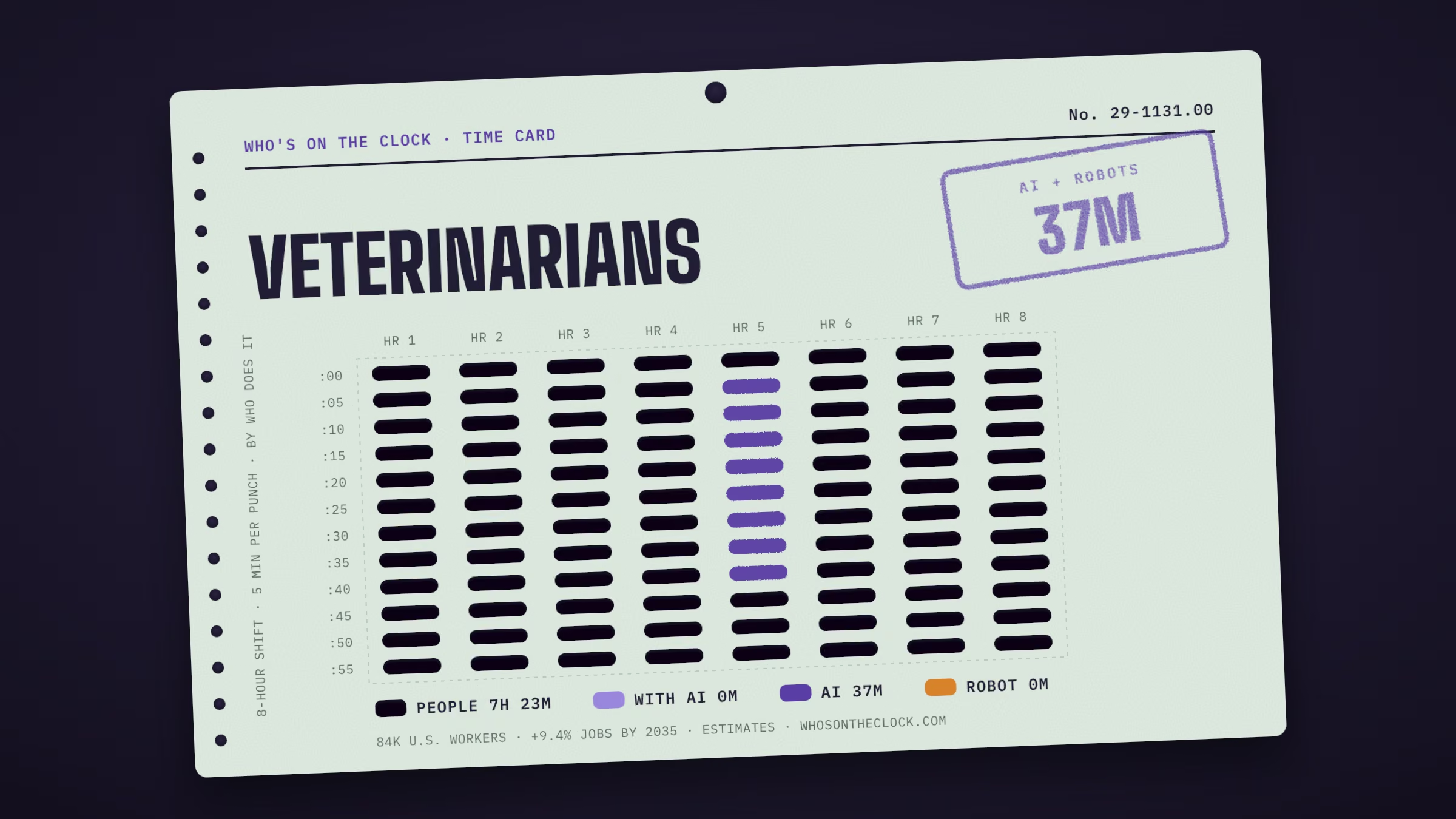
Unlikely, though parts of the work are changing. About 37m of an 8-hour shift goes to tasks touched by AI working on its own. The other 7h 23m (92%) stays with people. Separately, BLS expects about 9.4% more of these jobs by 2035 (all jobs: +3.5%).

Time card for veterinarians showing a typical 8-hour shift: 7h 23m done by people, 37m by AI.
Each mark is 5 minutes of a typical shift for veterinarians, colored by who does that task today. Estimates from O*NET tasks and Anthropic Economic Index data. How it's made

Home / Healthcare practitioners / Veterinarians

Diagnose, treat, or research diseases and injuries of animals. Includes veterinarians who conduct research and development, inspect livestock, or care for pets and companion animals.

Time card

Untick tasks you don't do, or set your own times.
MineTask, by time spentHumanWith AIAIRobot
Treat sick or injured animals by prescribing medication, setting bones, dressing wounds, or performing surgery.1h 57m a shift · No AI or robot evidence found
Examine animals to detect and determine the nature of diseases or injuries.1h 20m a shift · No AI or robot evidence found
Perform administrative or business management tasks, such as scheduling appointments, accepting payments from clients, budgeting, or maintaining business records.43m a shift · No AI or robot evidence found
Advise animal owners regarding sanitary measures, feeding, general care, medical conditions, or treatment options.37m a shift · Observed in AI useTypical AI request: about 1h 23m alone, 46m with AI
Inoculate animals against various diseases, such as rabies or distemper.27m a shift · No AI or robot evidence found
Operate diagnostic equipment, such as radiographic or ultrasound equipment, and interpret the resulting images.27m a shift · No AI or robot evidence found
Collect body tissue, feces, blood, urine, or other body fluids for examination and analysis.21m a shift · No AI or robot evidence found
Train or supervise workers who handle or care for animals.21m a shift · No AI or robot evidence found
Direct the overall operations of animal hospitals, clinics, or mobile services to farms.16m a shift · No AI or robot evidence found
Counsel clients about the deaths of their pets or about euthanasia decisions for their pets.11m a shift · No AI or robot evidence found
Euthanize animals.11m a shift · No AI or robot evidence found
Attend lectures, conferences, or continuing education courses.11m a shift · No AI or robot evidence found
Specialize in a particular type of treatment, such as dentistry, pathology, nutrition, surgery, microbiology, or internal medicine.11m a shift · No AI or robot evidence found
Inspect and test horses, sheep, poultry, or other animals to detect the presence of communicable diseases.11m a shift · No AI or robot evidence found
Educate the public about diseases that can be spread from animals to humans.5m a shift · No AI or robot evidence found
Plan or execute animal nutrition or reproduction programs.5m a shift · No AI or robot evidence found
Conduct postmortem studies and analyses to determine the causes of animals' deaths.5m a shift · No AI or robot evidence found
Establish or conduct quarantine or testing procedures that prevent the spread of diseases to other animals or to humans and that comply with applicable government regulations.5m a shift · No AI or robot evidence found
Research diseases to which animals could be susceptible.5m a shift · No AI or robot evidence found
Provide care to a wide range of animals or specialize in a particular species, such as horses or exotic birds.5m a shift · No AI or robot evidence found
Determine the effects of drug therapies, antibiotics, or new surgical techniques by testing them on animals.5m a shift · No AI or robot evidence found

On the floor

No company news tracked for this job yet. New stories are added as they happen.

Ask the clock

Will AI replace veterinarians?

Unlikely, though parts of the work are changing. About 37m of an 8-hour shift goes to tasks touched by AI working on its own. The other 7h 23m (92%) stays with people. Separately, BLS expects about 9.4% more of these jobs by 2035 (all jobs: +3.5%).

What can AI already do for veterinarians?

AI shows up regularly in 1 of 21 tasks, about 37m of a typical shift. The biggest ones:

  • Advise animal owners regarding sanitary measures, feeding, general care, medical conditions, or treatment options. (37m a shift, AI mostly does it alone)
Where do robots fit in?

Not in workplaces like this one, based on a 2026 review of robot deployments. For 13 physical tasks, no robot has shown it can do the work yet.

What still needs a person?

7h 23m of a typical shift, or 92%, goes to tasks with no AI or robot evidence yet. No AI usage or robot deployment has shown up for these so far. The biggest:

  • Treat sick or injured animals by prescribing medication, setting bones, dressing wounds, or performing surgery. (1h 57m a shift)
  • Examine animals to detect and determine the nature of diseases or injuries. (1h 20m a shift)
  • Perform administrative or business management tasks, such as scheduling appointments, accepting payments from clients, budgeting, or maintaining business records. (43m a shift)
  • Inoculate animals against various diseases, such as rabies or distemper. (27m a shift)
  • Operate diagnostic equipment, such as radiographic or ultrasound equipment, and interpret the resulting images. (27m a shift)
Why is that work hard to automate?

Much of it comes down to where and how the work happens. In-person, hands-on and high-stakes work is where AI and robots have made the least headway so far. In the official O*NET survey of people in this job:

  • 100% talk face to face with others every day
  • 93% say dealing with the public is very or extremely important
  • 84% work at arm's length or closer to other people
How much time does AI save on these tasks?

For the 1 task in this job where AI shows up and timing data exists, a typical request takes about 1h 23m for a person alone and about 46m with AI. These are Claude's own estimates from real conversations in April and May 2026 (Anthropic Economic Index). They describe single requests, not whole workdays, and time saved on a task doesn't mean jobs are cut. The biggest gaps:

  • Advise animal owners regarding sanitary measures, feeding, general care, medical conditions, or treatment options (about 1h 23m alone, 46m with AI)
Are employers still hiring veterinarians?

On Indeed, job postings in the Medical Technician sector are at 125% of their February 2020 level (all U.S. postings: 104%), down 2.6% from a year earlier, as of Oct 9, 2026. BLS separately expects about 3,100 openings a year in this job through 2035. Across all U.S. postings, 7.3% now mention AI skills. Sector postings cover more than this one job and move for many reasons besides AI.

How much do veterinarians make?

The median pay is about $130,100 a year ($62.55 an hour), 155% above the median for all U.S. jobs ($50,980). Most people in this job earn between $73,920 and $215,700 a year; that range covers the middle 80%. Pay figures are from BLS, May 2025, and vary a lot by state and employer. Pick a state to compare:

Is this job growing or shrinking?

BLS projects growth of 9.4% from 2025 to 2035, compared with 3.5% growth for all jobs. That's about 100,000 jobs in 2035. It expects about 3,100 openings a year, mostly from people retiring or changing careers. These projections don't single out AI as a cause.

How many veterinarians are there in the U.S.?

About 84,000 people in the U.S., roughly 0.05% of all workers (BLS, May 2025). That makes it the 300th largest of the 796 jobs on this site. BLS expects about 100,000 in 2035.

What training do veterinarians need?

The most common requirement is a doctoral degree: about 79% of people in the job said so in the official O*NET survey. O*NET rates the job at level 5 of 5 for preparation, which usually means: graduate degree. Requirements vary by state and employer, especially for licensed work.

What should I learn to stay ahead of AI?

These come from the job's official skill ratings and from the tasks that AI and robots touch least today. Building them keeps you strong in the parts of the work that still need a person:

  • Skills that matter more here than in most jobs: Science, Active Learning, Judgment and Decision Making, Complex Problem Solving
  • Get strong at the parts of the job that stay with people (listed above), which take 7h 23m of a typical shift
  • Tools employers list: Adobe Acrobat, Microsoft Access, Microsoft Excel, Microsoft Office software, Microsoft Outlook
  • Learn to use AI well on the tasks where it already shows up in this job (listed above)
What other jobs could veterinarians move into?

These use similar skills. Matches come from 109 official ratings of skills, knowledge and work activities, and each needs the same or less preparation unless the official list relates the jobs directly:

  • General Pediatricians (1h 47m touched, $210k median pay)
  • General Internal Medicine Physicians (2h 7m touched, $257k median pay)
  • Naturopathic Physicians (41m touched, $115k median pay)
  • Allergists and Immunologists (3h 15m touched, $266k median pay)
  • Dermatologists (1h 10m touched, $329k median pay)
How solid are these numbers?

Each task carries its own evidence label. For this job: 1 observed in real AI use, 20 with no AI or robot evidence found. The minutes per task are estimates, not measured hours, and "no evidence" doesn't prove a task is safe.

Tools in demand

  • Adobe Acrobat
  • Microsoft Access
  • Microsoft Excel
  • Microsoft Office software
  • Microsoft Outlook
  • Microsoft PowerPoint
  • Microsoft Word

Also called

Animal Anatomist, Animal Chiropractor, Animal Doctor, Animal Pathologist, Animal Physiologist, Animal Surgeon, Companion Animal Practitioner, Doctor of Veterinary Medicine (DVM), Emergency Veterinarian (Emergency Vet), Equine Dentist, Equine Vet (Equine Veterinarian), Horse Doctor, Laboratory Animal Care Veterinarian (Lab Animal Care Vet), Laboratory Veterinarian (Lab Vet)