Will AI replace anesthesiologist assistants?

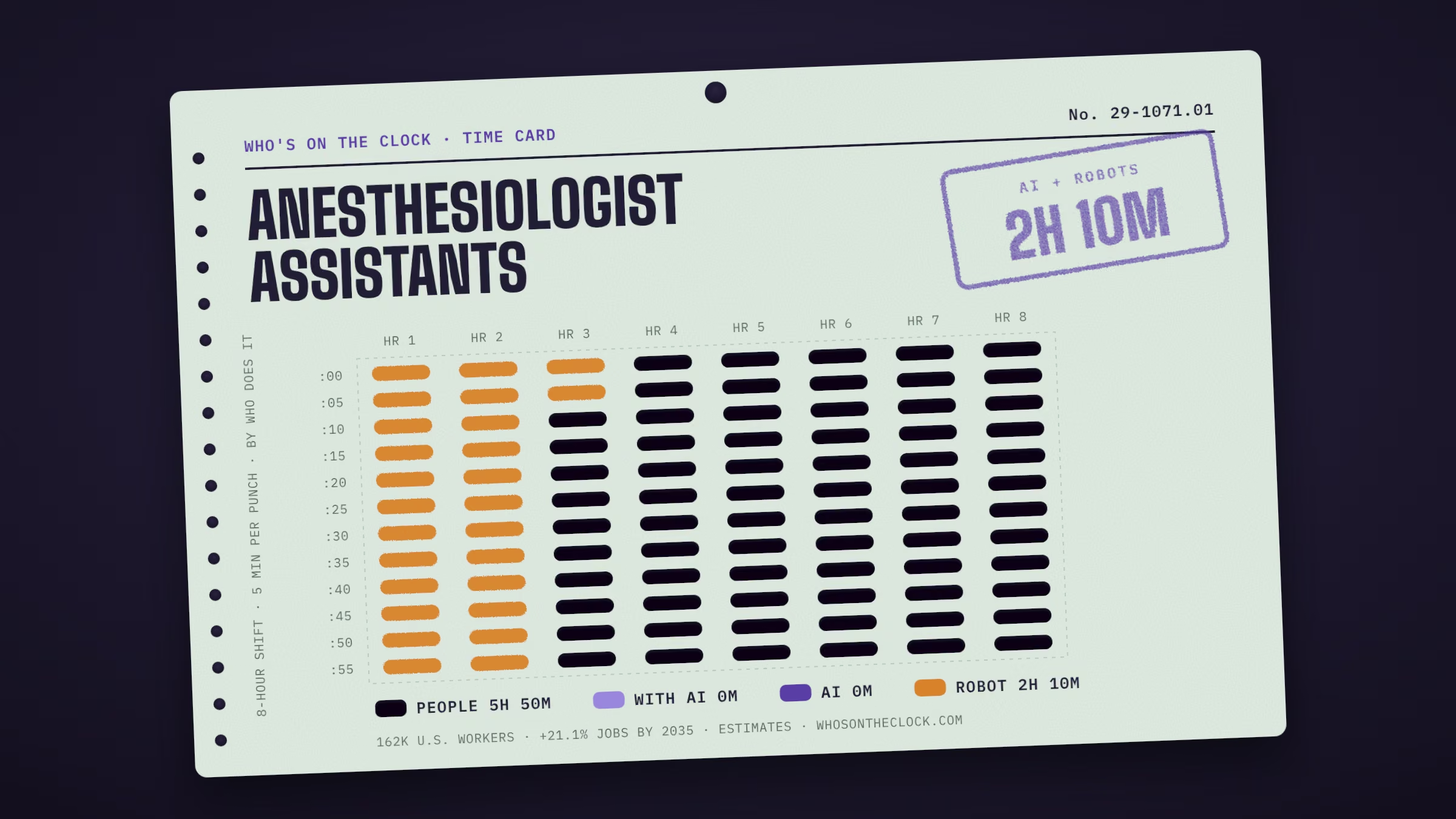
Some tasks are already handled by AI or machines; the rest still needs a person. About 2h 10m of an 8-hour shift goes to tasks that AI or robots largely take over. The other 5h 50m (73%) stays with people. Separately, BLS expects about 21.1% more of these jobs by 2035 (all jobs: +3.5%).

Time card for anesthesiologist assistants showing a typical 8-hour shift: 5h 50m done by people, 2h 10m by robots.
Each mark is 5 minutes of a typical shift for anesthesiologist assistants, colored by who does that task today. Estimates from O*NET tasks and Anthropic Economic Index data. How it's made

Home / Healthcare practitioners / Anesthesiologist Assistants

Assist anesthesiologists in the administration of anesthesia for surgical and non-surgical procedures. Monitor patient status and provide patient care during surgical treatment.

Time card

Untick tasks you don't do, or set your own times.
MineTask, by time spentHumanWith AIAIRobot
Control anesthesia levels during procedures.2h 9m a shift · Robots deployed · e.g. ROP-1680 AsisTIVA
Assist anesthesiologists in monitoring of patients, including electrocardiogram (EKG), direct arterial pressure, central venous pressure, arterial blood gas, hematocrit, or routine measurement of temperature, respiration, blood pressure or heart rate.1h 26m a shift · No AI or robot evidence found
Provide airway management interventions including tracheal intubation, fiber optics, or ventilary support.43m a shift · No AI or robot evidence found
Administer anesthetic, adjuvant, or accessory drugs under the direction of an anesthesiologist.43m a shift · Robots only in factory cells
Collect and document patients' pre-anesthetic health histories.32m a shift · No AI or robot evidence found
Monitor and document patients' progress during post-anesthesia period.32m a shift · No AI or robot evidence found
Administer blood, blood products, or supportive fluids.22m a shift · No AI or robot evidence found
Verify availability of operating room supplies, medications, and gases.16m a shift · Robots only in factory cells
Pretest and calibrate anesthesia delivery systems and monitors.16m a shift · No AI or robot evidence found
Assist anesthesiologists in performing anesthetic procedures, such as epidural or spinal injections.16m a shift · No AI or robot evidence found
Participate in seminars, workshops, or other professional activities to keep abreast of developments in anesthesiology.11m a shift · No AI or robot evidence found
Provide clinical instruction, supervision or training to staff in areas such as anesthesia practices.11m a shift · No AI or robot evidence found
Respond to emergency situations by providing cardiopulmonary resuscitation (CPR), basic cardiac life support (BLS), advanced cardiac life support (ACLS), or pediatric advanced life support (PALS).5m a shift · No AI or robot evidence found
Assist in the provision of advanced life support techniques including those procedures using high frequency ventilation or intra-arterial cardiovascular assistance devices.5m a shift · No AI or robot evidence found
Assist in the application of monitoring techniques, such as pulmonary artery catheterization, electroencephalographic spectral analysis, echocardiography, or evoked potentials.5m a shift · No AI or robot evidence found
Collect samples or specimens for diagnostic testing.5m a shift · Robots only in factory cells

On the floor

No company news tracked for this job yet. New stories are added as they happen.

Ask the clock

Will AI replace anesthesiologist assistants?

Some tasks are already handled by AI or machines; the rest still needs a person. About 2h 10m of an 8-hour shift goes to tasks that AI or robots largely take over. The other 5h 50m (73%) stays with people. Separately, BLS expects about 21.1% more of these jobs by 2035 (all jobs: +3.5%).

What can AI already do for anesthesiologist assistants?

None of this job's tasks show regular AI use yet. That can mean the work is hands-on or in person, or simply that it rarely comes up in AI usage data.

Where do robots fit in?

For some tasks, yes. Robots have done 1 of this job's tasks in workplaces like this one, about 2h 10m of a typical shift. 3 more tasks have only been done in factory setups built around the machine, so they stay with people here. For 8 physical tasks, no robot has shown it can do the work yet.

  • Control anesthesia levels during procedures. (2h 9m a shift; e.g. ROP-1680 AsisTIVA, in use)
What still needs a person?

5h 50m of a typical shift, or 73%, goes to tasks with no AI or robot evidence yet. No AI usage or robot deployment has shown up for these so far. The biggest:

  • Assist anesthesiologists in monitoring of patients, including electrocardiogram (EKG), direct arterial pressure, central venous pressure, arterial blood gas, hematocrit, or routine measurement of temperature, respiration, blood pressure or heart rate. (1h 26m a shift)
  • Provide airway management interventions including tracheal intubation, fiber optics, or ventilary support. (43m a shift)
  • Administer anesthetic, adjuvant, or accessory drugs under the direction of an anesthesiologist. (43m a shift)
  • Collect and document patients' pre-anesthetic health histories. (32m a shift)
  • Monitor and document patients' progress during post-anesthesia period. (32m a shift)
Why is that work hard to automate?

Much of it comes down to where and how the work happens. In-person, hands-on and high-stakes work is where AI and robots have made the least headway so far. In the official O*NET survey of people in this job:

  • 88% work at arm's length or closer to other people
  • 88% are exposed to disease or infection every day
  • 86% carry high or very high responsibility for other workers' safety
Are employers still hiring anesthesiologist assistants?

On Indeed, job postings in the Physicians & Surgeons sector are at 202% of their February 2020 level (all U.S. postings: 104%), up 8.8% from a year earlier, as of Oct 9, 2026. BLS separately expects about 12,000 openings a year in this job through 2035. Across all U.S. postings, 7.3% now mention AI skills. Sector postings cover more than this one job and move for many reasons besides AI.

How much do anesthesiologist assistants make?

The median pay is about $135,880 a year ($65.33 an hour), 167% above the median for all U.S. jobs ($50,980). Most people in this job earn between $99,380 and $190,280 a year; that range covers the middle 80%. Pay figures are from BLS, May 2025, and vary a lot by state and employer. Pick a state to compare:

Is this job growing or shrinking?

BLS projects growth of 21.1% from 2025 to 2035, compared with 3.5% growth for all jobs. That's about 205,000 jobs in 2035. It expects about 12,000 openings a year, mostly from people retiring or changing careers. These projections don't single out AI as a cause.

How many anesthesiologist assistants are there in the U.S.?

About 162,000 people in the U.S., roughly 0.10% of all workers (BLS, May 2025). That makes it the 200th largest of the 796 jobs on this site. BLS expects about 205,000 in 2035.

What training do anesthesiologist assistants need?

The most common requirement is a master's degree: about 42% of people in the job said so in the official O*NET survey. O*NET rates the job at level 5 of 5 for preparation, which usually means: graduate degree. Requirements vary by state and employer, especially for licensed work.

What should I learn to stay ahead of AI?

These come from the job's official skill ratings and from the tasks that AI and robots touch least today. Building them keeps you strong in the parts of the work that still need a person:

  • Skills that matter more here than in most jobs: Science, Monitoring, Operations Monitoring, Operation and Control
  • Get strong at the parts of the job that stay with people (listed above), which take 5h 50m of a typical shift
  • Tools employers list: eClinicalWorks EHR software, Microsoft Access, Microsoft Excel, Microsoft Office software, Microsoft Outlook
What other jobs could anesthesiologist assistants move into?

These use similar skills, with less of a typical shift touched by AI or robots. Matches come from 109 official ratings of skills, knowledge and work activities, and each needs the same or less preparation unless the official list relates the jobs directly:

  • Respiratory Therapists (0m touched, $82k median pay)
  • Anesthesiologists (57m touched, $391k median pay)
  • Nurse Anesthetists (0m touched, $237k median pay)
  • Emergency Medicine Physicians (46m touched, $336k median pay)
How solid are these numbers?

Each task carries its own evidence label. For this job: 1 with robots in real deployments, 15 with no AI or robot evidence found. The minutes per task are estimates, not measured hours, and "no evidence" doesn't prove a task is safe.

Tools in demand

  • eClinicalWorks EHR software
  • Microsoft Access
  • Microsoft Excel
  • Microsoft Office software
  • Microsoft Outlook
  • Microsoft PowerPoint
  • Microsoft Word

Also called

Anesthesia Assistant, Anesthesia Technician, Anesthesia Technologist, Anesthesiologist Assistant, Anesthesiologists' Assistant, Cardiothoracic Anesthesia Technician, Certified Anesthesia Technician, Certified Anesthesiologist Assistant, Operating Room Technician